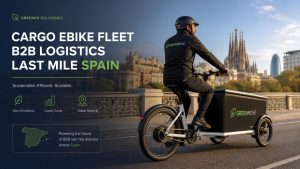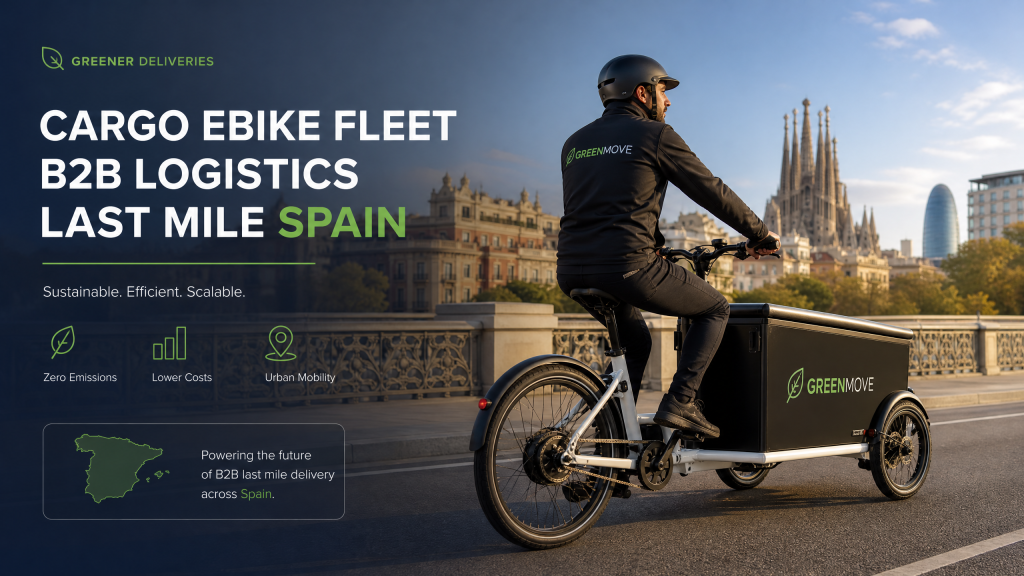
The Last-Mile Crisis: Why Cargo E-Bikes Are Reshaping B2B Logistics in Spain
Urban delivery companies across Spain are spending 53% more per package on last-mile logistics than they did five years ago. Traditional van-based delivery in congested Spanish cities—Madrid, Barcelona, Valencia, Seville—now faces mounting pressure from congestion charges, environmental regulations, and the simple economics of moving single parcels through gridlock. Meanwhile, cargo e-bike adoption among European logistics operators has grown 47% annually since 2021, according to the European Cyclists’ Federation. Yet most European manufacturers of cargo e-bikes lack a structured B2B distribution network to reach the fleet operators and logistics companies that need them most. According to McKinsey operations research, these strategies are increasingly important.
This gap represents a significant opportunity for B2B logistics partners and distributors. Cargo e-bike manufacturers—particularly innovative European startups—need reliable, specialized supply chains to move high-value hardware inventory to the last-mile delivery companies, urban logistics operators, and fleet managers who are actively seeking alternatives to combustion vehicles. Spain, with its dense urban centers, aggressive sustainability targets, and growing urban logistics sector, is a prime market for this transition.
This article explores how B2B distributors can build and operate a cargo e-bike fleet logistics network in Spain, what infrastructure and partnerships are required, and how specialized 3PL providers like Spainbox can accelerate market penetration for cargo e-bike manufacturers across southern Europe.
Understanding the Cargo E-Bike Market in Spain: Who Buys, and Why
The Core B2B Buyer Profile
Cargo e-bikes are not sold to consumers through traditional retail channels in Spain. The primary B2B buyers are:
- Last-mile delivery networks: Companies like Seur, Nacex, and smaller regional operators managing 50–500 vehicle fleets, seeking to reduce operational costs and meet EU sustainability directives.
- Urban logistics operators: Specialized firms handling same-day and next-day delivery in city centers, where congestion charges and parking restrictions make traditional vans economically unviable.
- Micro-mobility fleet managers: Operators like Glovo, Deliveroo, and independent courier collectives that manage shared cargo e-bike fleets.
- Corporate sustainability programs: Large enterprises (retail chains, pharmaceutical distributors, FMCG companies) building internal zero-emission delivery fleets for urban distribution.
- Municipal and regional authorities: City councils and regional governments in Andalusia, Catalonia, and Valencia purchasing cargo e-bikes for public services and waste management.
These buyers operate on procurement cycles of 3–12 months, require bulk orders (typically 10–100 units per purchase), and demand service-level agreements, warranty support, and spare parts availability. They are not price-sensitive in the way consumer buyers are; they prioritize total cost of ownership, reliability, and logistics support.
Market Size and Growth Trajectory
Spain’s cargo e-bike market is projected to reach 12,000–15,000 units annually by 2026, concentrated in the top 15 metropolitan areas. Madrid and Barcelona alone account for roughly 40% of current demand. However, secondary markets in Seville, Málaga, Valencia, and Córdoba’s surrounding logistics hubs are emerging as high-growth segments, particularly for regional distribution networks and small-to-medium last-mile operators.
Building a B2B Cargo E-Bike Distribution Network: The Logistics Framework
Warehouse Location and Strategic Positioning
A successful cargo e-bike B2B logistics operation requires at least one strategically positioned warehouse hub. Córdoba, in southern Spain, offers distinct advantages for this purpose: it sits at the intersection of the Madrid–Seville corridor, provides direct access to Andalusia’s major urban centers (Seville, Málaga, Granada), and offers efficient routing to Portugal and North Africa via southern ports. Spainbox’s warehouse hub in Córdoba is ideally positioned for exactly this purpose—allowing manufacturers to stock inventory centrally and distribute to fragmented B2B customers across a 500-kilometer radius without the congestion and cost penalties of Madrid or Barcelona warehousing.
A warehouse facility for cargo e-bike distribution should include:
- Climate-controlled storage (18–24°C) to protect battery packs and electronics
- Dedicated assembly and quality-control space (cargo e-bikes often arrive partially assembled)
- Secure charging infrastructure for pre-delivery testing and demonstration units
- Staging areas for bulk orders requiring custom branding or configuration
- Parts inventory management (replacement batteries, tires, controllers, cargo boxes)
Fleet Vehicle Requirements
Cargo e-bikes themselves are bulky and require specialized transport. A single cargo e-bike occupies roughly 0.8–1.2 cubic meters of space, and a typical order of 20 units requires a full standard pallet. This means your distribution fleet needs:
- Box trucks (3.5–7.5 tons): For regional deliveries to 1–10 customer locations per route
- Flatbed or open-sided vehicles: For larger bulk orders and direct-to-warehouse deliveries
- Secure, climate-controlled interiors: To protect batteries and electronics during transit
- Tracking and telematics: Real-time visibility for B2B customers expecting high-value hardware delivery
Spainbox operates its own fleet of vehicles optimized for exactly this profile—bulky, high-value hardware distribution with dedicated temperature and shock management. This eliminates the logistics friction that generic parcel carriers introduce when handling cargo e-bikes.
Key Infrastructure and Technology Enablers
Inventory Management and Order Fulfillment Systems
B2B cargo e-bike distribution requires sophisticated inventory visibility and order management. The leading platforms in this space include:
- TraceLink: A supply chain visibility platform widely used by European hardware distributors to manage SKU-level inventory, batch tracking, and compliance documentation for high-value goods. TraceLink integrates with most major ERP systems and provides real-time alerts for stock levels, expiry dates, and quality issues.
- Blue Yonder (formerly JDA): An AI-driven demand planning and fulfillment optimization platform used by logistics operators to forecast B2B orders, optimize warehouse allocation, and automate replenishment. Particularly useful for managing seasonal demand spikes in cargo e-bike sales (typically March–September in Spain).
- Infor CloudSuite: An integrated ERP and supply chain platform designed for mid-market distributors, offering order-to-cash automation, warehouse management, and vendor collaboration portals—critical for managing relationships with multiple cargo e-bike manufacturers.
For smaller distributors or startups, open-source alternatives like Odoo or TradeGecko provide similar functionality at lower cost, though they require more manual configuration and ongoing maintenance.
Last-Mile Delivery Tracking and Customer Communication
B2B buyers of cargo e-bikes expect delivery visibility comparable to consumer e-commerce. Implementing a customer portal—via Shippo, Flexport, or custom API integration—allows delivery companies and fleet operators to:
- Track inbound shipments in real-time
- Receive automated delivery notifications and proof-of-delivery documentation
- Manage returns, warranty claims, and spare parts orders through a centralized dashboard
- Access historical order data and invoicing for accounting integration
Comparative Analysis: Distribution Models for Cargo E-Bike B2B Logistics
Different distribution strategies carry distinct cost, speed, and control tradeoffs. The table below compares the primary approaches a cargo e-bike manufacturer or distributor might pursue in Spain:
| Distribution Model | Setup Cost (€) | Delivery Speed | Inventory Control | Scalability | Best For |
|---|---|---|---|---|---|
| Direct manufacturer fulfillment | €150,000–300,000 | 7–14 days | 100% (full control) | Limited (requires staff/infrastructure growth) | Early-stage startups with <100 units/month |
| Specialized 3PL (Spainbox model) | €20,000–50,000 | 3–7 days | High (real-time visibility) | Excellent (3PL scales with volume) | Growth-stage manufacturers targeting 200–1,000 units/month |
| Regional distributor network | €100,000–250,000 | 2–5 days | Medium (distributor-held inventory) | High (distributed across regions) | Established manufacturers with >500 units/month, seeking regional presence |
| Generic parcel carrier (DHL, Nacex, Seur) | €5,000–15,000 | 5–10 days | Low (opaque handling) | Very high (carrier network) | Low-value or non-fragile orders; not recommended for high-end cargo e-bikes |
For most European cargo e-bike manufacturers entering the Spanish market, the specialized 3PL model (partnering with providers like Spainbox) offers the optimal balance of speed, control, and cost. It allows manufacturers to scale without building internal logistics infrastructure, while maintaining the service quality that B2B buyers demand.
Operational Challenges and How to Solve Them
Battery Compliance and Dangerous Goods Regulations
Cargo e-bikes contain lithium-ion battery packs classified as dangerous goods under IATA, IMDG, and ADR (European road transport) regulations. Distributing them requires:
- Certified dangerous goods handlers on staff
- Proper packaging (UN-certified boxes, thermal protection)
- Documentation compliance (safety data sheets, declarations of conformity)
- Insurance coverage for hazardous materials transport
A specialized 3PL like Spainbox already maintains these certifications and insurance, eliminating this regulatory burden for manufacturers. Generic logistics providers often lack this expertise, leading to delays, rejected shipments, or regulatory fines.
Bulk Order Assembly and Customization
Many B2B buyers request customization: custom branding, color schemes, cargo box modifications, or pre-installed accessories. Managing this requires:
- Flexible warehouse operations (not rigid, high-volume consumer fulfillment)
- Skilled technicians for assembly and testing
- Quality control protocols to ensure consistency across custom orders
- Clear communication channels between manufacturer, distributor, and customer
This is where specialized B2B logistics partners add significant value. Spainbox’s warehouse team can manage small-batch customization, assembly, and quality checks before shipment, reducing the friction between manufacturer and customer.
Spare Parts and Warranty Management
B2B fleet operators expect rapid access to replacement parts (batteries, motors, controllers, tires) and straightforward warranty claims. This requires:
- A dedicated spare parts inventory (typically 5–10% of units sold, held at the warehouse hub)
- A parts ordering system integrated with the main fulfillment platform
- Clear warranty policies and claim procedures documented in B2B contracts
- Reverse logistics capabilities for warranty returns and repairs
Pricing, Margins, and B2B Economics
Typical B2B Pricing Structure
Cargo e-bikes sold through B2B channels typically carry 25–35% gross margin after distribution costs. Here’s a simplified breakdown for a €3,500 cargo e-bike:
- Manufacturer cost: €1,800–2,100
- Manufacturer margin: €800–1,000 (before distribution)
- Distributor/3PL costs: €250–400 (warehouse, transport, handling, documentation)
- Net manufacturer margin: €400–750 (11–21% of retail price)
- B2B customer price: €3,200–3,500 (typically 5–15% discount vs. retail)
The key insight: B2B distribution economics are tight. Efficiency matters enormously. A specialized 3PL that can deliver cargo e-bikes reliably in 3–5 days, manage compliance, and handle customization can justify its margin by enabling faster cash conversion and reduced inventory holding costs for the manufacturer.
Building Customer Relationships and Long-Term Contracts
Sales and Account Management
B2B cargo e-bike sales are relationship-driven, not transactional. Successful distributors invest in:
- Dedicated account managers: Assigned to each major customer (delivery operators, municipal authorities, corporate fleet managers) with deep knowledge of their business needs and procurement cycles.
- Technical support: On-site training for fleet operators on maintenance, battery care, and safety protocols.
- Demand planning collaboration: Quarterly forecasting sessions with customers to align inventory with their growth plans.
- Performance metrics: Regular reporting on delivery performance, defect rates, and customer satisfaction.
Contract Structures and Volume Commitments
B2B customers typically operate under one of two contract models:
- Annual volume agreements: Customer commits to purchasing 50–200 units annually at a fixed price, with quarterly or monthly delivery schedules. This provides manufacturers with demand visibility and allows for inventory optimization.
- Call-off orders: Customer maintains a standing purchase agreement but places orders on a rolling basis (typically 2–4 weeks’ lead time). More flexible but requires higher safety stock.
Both models benefit from transparent communication and reliable fulfillment. This is where the specialized 3PL model adds leverage: a distributor with proven on-time delivery and quality metrics can negotiate better terms with manufacturers and offer more attractive service levels to customers.
Strategic Positioning: Why Córdoba and Southern Spain Matter
The geography of cargo e-bike B2B logistics in Spain is shifting. While Madrid and Barcelona remain large markets,
Related Technical Insights
- Explore our guide on Electric Trailers for Last-Mile Delivery: B2B Logistics and Distribution for European Startups and how it integrates with advanced logistics & automation solutions.
- Explore our guide on Fleet EV Charging Stations for Hotels and Businesses in Spain: B2B Fulfillment and Installation Logistics and how it integrates with innovative logistics & automation technologies.