Rural Spain’s Healthcare Crisis: Why Autonomous Telemedicine Kiosks Are Becoming Essential Infrastructure
Spain’s rural healthcare deficit is acute. According to a 2023 report by the Spanish Ministry of Health, over 8 million Spanish citizens live in municipalities with fewer than 5,000 inhabitants—many of them in Andalusia, Castilla-La Mancha, and Extremadura. These regions face a critical shortage: an average of 0.8 physicians per 1,000 inhabitants, compared to 4.3 in urban centers. The result is that rural patients must travel an average of 45 kilometers to access specialist care, creating a healthcare equity crisis that autonomous telemedicine kiosks are now positioned to solve.
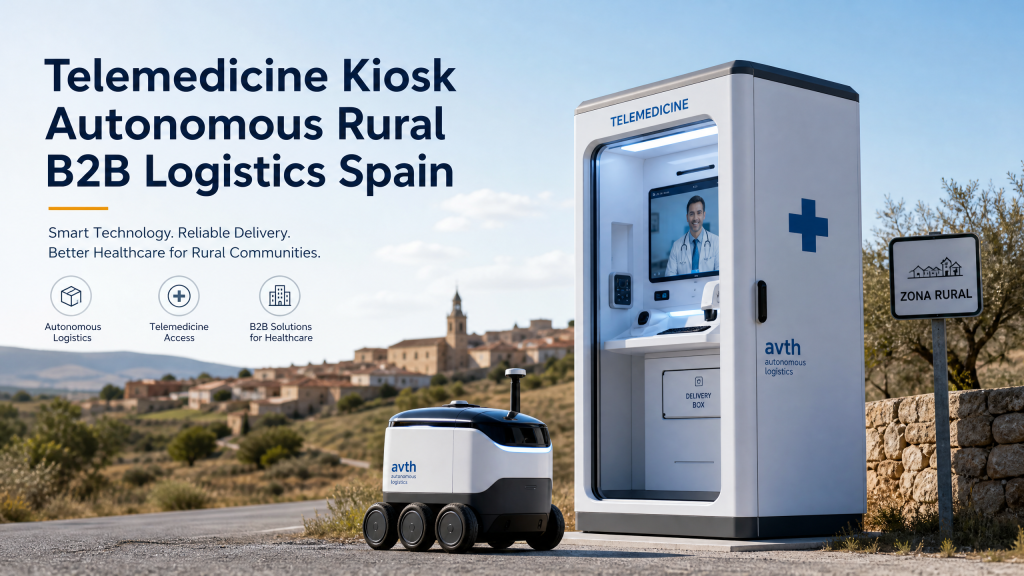
Autonomous telemedicine kiosks—self-contained health cabins equipped with vital-sign monitoring, diagnostic sensors, video conferencing systems, and AI-driven triage software—represent a paradigm shift in rural healthcare delivery. Unlike traditional telehealth platforms that require smartphones or computers, these kiosks are plug-and-play infrastructure deployed directly in municipal health centers, pharmacies, and community spaces. For European healthtech startups manufacturing these devices, the challenge isn’t innovation; it’s distribution. Getting a 200-kilogram, high-value telemedicine cabinet from a manufacturing facility in Barcelona or Valencia to a remote clinic in Huelva or Córdoba province requires specialized B2B logistics expertise that generic parcel carriers simply cannot provide.
This article explores the complete logistics ecosystem for autonomous telemedicine kiosk distribution across Spain and southern Europe, with specific focus on how startups can partner with regional specialists to scale rural healthcare infrastructure.
The Market Opportunity: Why Telemedicine Kiosks Are Attracting Startup Investment
The autonomous telemedicine kiosk market in Europe is projected to grow at a compound annual growth rate (CAGR) of 18.3% through 2030, according to research from Frost & Sullivan. Spain alone represents a €47 million addressable market, driven by three converging forces:
1. Regulatory Tailwinds: Spain’s National Health System (SNS) has committed to deploying 500 telemedicine access points in underserved areas by 2025, creating direct procurement opportunities for startups. The EU’s Digital Europe Programme is co-funding rural health infrastructure projects, making government contracts viable for early-stage companies.
2. Demographic Pressure: Rural depopulation has accelerated physician shortages. The Spanish Society of Rural Medicine reports that 1 in 3 rural health centers operate with a single doctor. Telemedicine kiosks reduce the burden by enabling nurses and community health workers to conduct preliminary diagnostics and consultations without on-site physicians.
3. Post-Pandemic Normalization of Remote Care: COVID-19 fundamentally shifted patient and provider attitudes toward telehealth. Rural patients who were skeptical of video consultations in 2019 now actively seek remote care options. Autonomous kiosks bridge the digital divide by providing standardized, accessible interfaces for populations with limited digital literacy.
Several European startups are already capturing this opportunity. Companies like Telemedicine Robotics (TR) based in Lisbon have deployed over 150 autonomous health cabins across Portugal and are now expanding into Spain. MedTech Kiosk Solutions, headquartered in Barcelona, has secured contracts with regional health authorities in Catalonia and Aragon. These companies face an identical challenge: how to physically move bulky, fragile, high-value hardware from manufacturing hubs to dispersed rural endpoints across a geographically complex country.
The Logistics Challenge: Why Generic Carriers Fail for Telemedicine Hardware
Autonomous telemedicine kiosks are not typical parcels. A standard unit weighs 180–240 kilograms, measures 2.1 meters tall and 0.9 meters wide, and contains integrated electronics (touchscreen displays, thermal imaging cameras, ECG sensors, microphones, and networking hardware) worth €8,000–€15,000. The device requires:
- White-glove handling: Standard pallet networks and parcel couriers cannot guarantee the careful unloading and positioning required for sensitive medical electronics.
- Climate control: Electronic components require temperature stability (16–25°C) and humidity control (30–50%) during transit. A standard refrigerated truck won’t suffice; the kiosk needs a temperature-monitored environment.
- Installation support: Unlike consumer electronics, telemedicine kiosks require on-site electrical integration, network configuration, and staff training. Logistics partners must coordinate with local IT teams and healthcare administrators.
- Regulatory compliance: Medical devices in Spain must comply with CE marking requirements and the Medical Devices Regulation (MDR) 2017/745. Logistics documentation must trace chain-of-custody for regulatory audits.
- Route flexibility: Rural municipalities often have limited vehicle access. Some clinics are reachable only via narrow mountain roads or require multi-leg delivery sequences. Generic carriers optimize for volume and speed, not for complex rural geography.
A startup attempting to use standard courier networks like DHL or UPS for autonomous telemedicine kiosk distribution faces several concrete risks: device damage during handling (estimated cost: €2,000–€4,000 per unit), missed delivery windows due to rural address confusion, and lack of installation coordination. These failures compound—a damaged kiosk means delayed rural healthcare access and damaged startup reputation.
Specialized B2B Logistics: The Spainbox Model for Healthtech Distribution
This is where specialized B2B logistics partners become critical. Companies like Spainbox, based in Córdoba, have built their operations around precisely this challenge: distributing innovative, bulky, high-value hardware from European tech startups to B2B clients across Spain and southern Europe. Córdoba’s strategic location—at the intersection of Andalusia, with direct access to Portugal, North Africa via Algeciras, and the Madrid corridor—makes it an ideal hub for regional healthtech distribution.
Spainbox operates its own fleet of refrigerated and climate-controlled trucks, eliminating dependence on third-party carriers and enabling direct control over device handling. For telemedicine kiosk startups, this means:
- End-to-end responsibility: From warehouse receipt to installation coordination, a single partner manages the entire supply chain, reducing handoff failures.
- Rural route optimization: Specialized logistics providers maintain detailed maps of rural access roads, seasonal closures, and local contact networks that generic carriers lack.
- Installation coordination: Spainbox can arrange on-site technical support, coordinate with local health center staff, and manage power/network integration as part of the delivery service.
- Regulatory documentation: Specialized healthtech logistics partners maintain compliance frameworks for CE marking, medical device tracking, and regulatory audits.
For startups scaling telemedicine kiosk distribution, partnering with a regional specialist like Spainbox eliminates the operational complexity of managing carrier relationships, route planning, and installation logistics. This allows founders to focus on product development and sales, rather than becoming de facto supply chain managers.
Key Players in European Telemedicine Kiosk Manufacturing and Distribution
Understanding the competitive landscape helps startups position their logistics strategy. The primary manufacturers and distributors in the European telemedicine kiosk space include:
| Company | Location | Device Weight/Size | Target Markets | Logistics Partner Strategy |
|---|---|---|---|---|
| Telemedicine Robotics (TR) | Lisbon, Portugal | 220 kg, 2.2m H × 0.95m W | Portugal, Spain, Greece | In-house fleet + regional 3PL partnerships |
| MedTech Kiosk Solutions | Barcelona, Spain | 190 kg, 2.1m H × 0.85m W | Spain, France, Italy | Combination of own vehicles and specialized carriers |
| HealthConnect Cabin (HCC) | Madrid, Spain | 210 kg, 2.15m H × 0.9m W | Spain, Portugal, North Africa | Regional hub model with local delivery partners |
| Telemedicine Kiosk Europe (TKE) | Amsterdam, Netherlands | 200 kg, 2.0m H × 0.88m W | Northern/Central Europe, expanding south | Dedicated logistics subsidiary |
Notice that every established player has moved beyond relying on generic carriers. The pattern is clear: successful telemedicine kiosk companies either build in-house logistics capabilities or partner with specialized regional providers. Startups attempting to compete using standard parcel networks consistently underperform in rural deployment speed and quality.
Distribution Models: Which Logistics Strategy Works Best for Telemedicine Startups?
Telemedicine kiosk startups typically pursue one of three distribution models. Each has distinct logistics implications:
Model 1: Direct Government Procurement (B2G)
Startups secure contracts directly with regional health authorities (Consejerías de Salud) or the Spanish Health Ministry to supply kiosks to public health centers. This model offers high volume and predictable revenue but demands rigorous logistics compliance. According to Amazon Seller Central guidelines, these strategies are increasingly important.
Logistics Requirements:
- Coordinated multi-site deployment across provinces (e.g., 50 kiosks to 50 different municipalities simultaneously).
- Strict delivery windows tied to health center staffing availability.
- Regulatory documentation for each unit (CE certificates, technical specifications, maintenance schedules).
- Training coordination for health center staff at each location.
Why Specialized Partners Matter: Government contracts include penalty clauses for missed delivery dates. A startup using generic carriers risks €500–€1,000 penalties per missed delivery. Specialized logistics partners like Spainbox maintain performance guarantees and have the operational flexibility to meet complex, multi-location deployment schedules.
Model 2: Private Healthcare Network Distribution
Startups partner with private healthcare networks (like Quirónsalud or Teknon) to deploy kiosks across their clinic and hospital locations. This model offers faster decision-making but requires coordination across multiple independent sites.
Logistics Requirements:
- Flexible scheduling to accommodate clinic operating hours.
- On-site installation coordination with each clinic’s IT and facilities teams.
- Maintenance logistics (spare parts, software updates, technical support).
Why Specialized Partners Matter: Private networks often demand white-glove service and rapid response times. A clinic cannot afford downtime while waiting for replacement parts. Specialized logistics partners maintain inventory buffers and can dispatch replacement units or technicians within 24–48 hours.
Model 3: Municipal and Community Health Center Direct Sales
Startups sell directly to individual municipalities and small health centers. This model offers high margin but requires managing numerous small shipments to dispersed locations.
Logistics Requirements:
- Ability to handle single-unit or 2–3 unit shipments to remote locations.
- Coordination with local IT and facilities staff who may have limited technical experience.
- Flexible scheduling around municipal budgets and procurement cycles.
Why Specialized Partners Matter: Generic carriers impose minimum shipment volumes or charge prohibitive fees for single-unit deliveries to rural areas. Specialized regional partners like Spainbox can absorb small shipments into consolidated routes, making per-unit logistics costs economically viable for startups pursuing this high-volume, low-value-per-unit model.
Practical Logistics Workflow: From Startup to Rural Clinic
Here’s a concrete, step-by-step workflow for how a telemedicine kiosk startup should structure its logistics partnership to ensure successful rural deployment:
Phase 1: Pre-Shipment (2–3 Weeks Before Delivery)
- Coordinate with Logistics Partner: Provide the logistics partner (e.g., Spainbox) with a detailed deployment schedule: target clinic addresses, delivery windows, contact persons, and any access constraints (narrow roads, limited parking, etc.).
- Verify Clinic Readiness: Confirm that each clinic has adequate electrical capacity (typically 220V/16A minimum), network connectivity (broadband or cellular backup), and designated installation space.
- Prepare Documentation: Ensure all CE certificates, technical specifications, warranty documents, and training materials are compiled and ready for transport.
- Configure Devices: Pre-configure telemedicine kiosks with clinic-specific settings (local language, regional health authority integrations, staff login credentials) before shipment to minimize on-site setup time.
Phase 2: Shipment and Transit (1–2 Weeks)
- Climate-Controlled Transport: Devices are loaded into Spainbox’s temperature-monitored vehicles (16–25°C maintained throughout transit).
- Real-Time Tracking: The startup receives GPS and temperature logs for each shipment, ensuring transparency and regulatory compliance.
- Route Optimization: Spainbox’s rural route expertise ensures efficient sequencing of deliveries, minimizing travel time and coordinating with clinic availability windows.
Phase 3: Installation and Activation (1–3 Days Per Clinic)
- On-Site Delivery: Spainbox technicians (or coordinated local contractors) unload the kiosk, verify electrical and network connectivity, and position the device in the designated location.
- Staff Training: The startup’s technical team (or a trained representative) conducts brief staff training on device operation, patient intake workflows, and emergency troubleshooting.
- Activation and Testing: The kiosk is connected to the telemedicine platform, tested for video conferencing, vital-sign sensor calibration, and network reliability.
- Documentation: Installation photos, signed delivery receipts, and activation confirmations are compiled for regulatory and warranty purposes.
Phase 4: Post-Deployment Support (Ongoing)
- Remote Monitoring: The startup monitors device performance remotely, tracking uptime, patient usage, and any technical anomalies.
- Maintenance Logistics: Spainbox coordinates scheduled maintenance visits and emergency repairs, ensuring minimal downtime.
- Spare Parts Management: High-wear components (touchscreens, sensors) are stocked at Spainbox’s Córdoba hub, enabling rapid replacement dispatch to any clinic in the network.
Cost Breakdown: What Telemedicine Startups Should Budget for Specialized Logistics
Understanding the true cost of specialized B2B logistics for telemedicine kiosks is essential for startup financial planning
Related Technical Insights
- Explore our guide on HEPA+UV Air Purification Systems for Hospitals and Schools: B2B Distribution in Spain and how it integrates with advanced health & smart cities solutions.