Unit Economics on Amazon FBA: How to Calculate Your Real Margin After PPC, Returns, and All Hidden Costs
In the dynamic world of Amazon FBA, the allure of high sales figures can often mask a less glamorous reality: many sellers operate with a skewed perception of their actual profitability. The difference between gross revenue and a truly healthy net profit margin is vast, often hidden beneath layers of fees, advertising spend, and operational costs. This guide is meticulously crafted for the professional ecommerce entrepreneur in 2026, aiming to demystify the complex process of **unit economics Amazon FBA real margin calculation**. We will equip you with the knowledge to accurately assess your financial health, transforming you into a truly informed **true margin Amazon seller**.
Understanding your unit economics is not merely an accounting exercise; it’s the bedrock of sustainable growth and strategic decision-making. Without a precise grasp of every dollar earned and spent per unit, you risk making critical errors in pricing, inventory management, and marketing. This comprehensive breakdown will walk you through every component, from the obvious to the often-overlooked, ensuring you can build a robust **Amazon FBA profit calculator** that reflects your business’s genuine performance.
What Are Unit Economics in Amazon FBA?
At its core, unit economics refers to the direct revenues and costs associated with a business model on a per-unit basis. For an Amazon FBA seller, this means analyzing the profitability of selling a single product. It’s a far more granular and insightful approach than simply looking at overall monthly or quarterly profit and loss statements. While a P&L gives you the big picture, unit economics reveals the efficiency and viability of each individual product line, allowing for precise optimization. For more details, see our guide on Amazon Buy Box AI dynamic repricing strategy.
In 2026, with increasing competition and evolving Amazon policies, a superficial understanding of costs is no longer sufficient. The market demands a sophisticated approach to financial analysis, where every fee, every click, and every return is factored into the equation. This detailed perspective is what separates thriving businesses from those struggling to stay afloat, making **Amazon FBA unit economics 2026** a critical skill for any serious seller.
Deconstructing Your Revenue: The Starting Point
Before diving into costs, let’s establish the revenue generated per unit. This might seem straightforward, but it’s essential to be precise.
- Product Selling Price: This is the price at which your product is sold on Amazon. Always use the average selling price if you frequently run promotions or price changes.
- Shipping Credits (if applicable): For certain product categories or fulfillment methods (less common with FBA), Amazon might provide a shipping credit. Ensure this is accurately accounted for if it applies to your model.
For the purpose of our **unit economics Amazon FBA real margin calculation**, we’ll focus primarily on the product selling price as the main revenue driver per unit. According to Amazon Seller Central guidelines, these strategies are increasingly important.
The Obvious Costs: Cost of Goods Sold (COGS)
Your Cost of Goods Sold is the most fundamental expense. It’s what it costs you to acquire or manufacture the product and get it ready for sale.
- Direct Product Cost: The price you pay your supplier for each unit. This should include the cost of the product itself, any custom packaging, and labeling.
- Inbound Shipping to Amazon: The cost to transport your inventory from your supplier or warehouse to Amazon’s fulfillment centers. This needs to be allocated per unit. For example, if a shipment of 1000 units costs $500 to ship, then the inbound shipping cost per unit is $0.50.
- Inspection/Prep Fees: If you use a third-party inspection service or a prep center to prepare your products for FBA (e.g., polybagging, bundling, labeling), these costs must be included per unit.
Accurately calculating COGS is the first critical step in building an effective **Amazon FBA profit calculator**. Any miscalculation here will ripple through your entire financial analysis.
Amazon’s Cut: FBA Fees and Referral Fees
Amazon charges a variety of fees for using its platform and fulfillment services. These are non-negotiable and must be precisely accounted for in your **unit economics Amazon FBA real margin calculation**.
Referral Fees
This is Amazon’s commission for selling on their platform. It’s a percentage of the total sales price (including shipping and gift wrap charges) and varies significantly by product category, typically ranging from 8% to 15%. For example, if your product sells for $20 and the referral fee is 15%, Amazon takes $3. For more details, see our guide on how US tariffs impact European Amazon sellers.
FBA Fulfillment Fees
These are the costs associated with Amazon picking, packing, and shipping your product to the customer, as well as providing customer service for these orders. These fees are based on the product’s size and weight. Amazon categorizes products into standard-size and oversize tiers, with further sub-tiers based on dimensions and weight. It’s crucial to know your product’s exact tier to calculate this accurately.
Monthly Storage Fees
Amazon charges for the space your inventory occupies in their fulfillment centers. These fees are calculated per cubic foot and vary by month (higher during Q4) and product size tier. Long-term storage fees (now called aged inventory surcharge) apply to inventory that has been stored for an extended period, significantly impacting profitability if not managed effectively.
Inventory Placement Service Fees
If you opt to send all your inventory to a single fulfillment center and have Amazon distribute it, you’ll incur an inventory placement service fee per unit. While convenient, this adds to your per-unit cost. For more details, see our guide on how to cut Amazon FBA costs and hidden fees.
Return Processing Fees
For certain product categories (e.g., apparel, watches, jewelry, shoes, luggage), Amazon charges a return processing fee for items that are returned by customers. This fee is equal to the FBA fulfillment fee for the product.
The Silent Killers: Hidden Costs That Devour Your Margin
This is where many sellers falter, overlooking expenses that significantly erode their **true margin Amazon seller** status. These are often variable and require diligent tracking. According to Gartner supply chain insights, these strategies are increasingly important.
PPC (Pay-Per-Click) Advertising Costs
Amazon PPC is almost a necessity for visibility, but it comes at a cost. The impact of PPC on your **unit economics Amazon FBA real margin calculation** is profound. You need to calculate your advertising cost per unit sold. This isn’t as simple as dividing total ad spend by total sales, as not all sales come from PPC.
A common approach is to determine your Advertising Cost of Sales (ACoS) or Total ACoS (TACoS) and apply it to your revenue. For example, if your ACoS is 20% and your product sells for $20, then $4 of that revenue is effectively spent on PPC to generate that sale. This is a critical component of any realistic **Amazon FBA profit calculator**. For more details, see our guide on product bundling Amazon increase margins differentiate. For more details, see our guide on VAT and cross-border tax risk for Amazon sellers.
Returns and Refunds
Returns are an inevitable part of ecommerce. Each return carries multiple costs:
- Lost Revenue: The sale is reversed.
- Product Cost: The COGS for the returned item is a sunk cost, especially if the item is unsellable.
- FBA Fulfillment Fee: You still pay the fulfillment fee for the original shipment.
- Refund Administration Fee: Amazon retains a portion of the referral fee (up to $5) for refunded orders.
- Return Processing Fee: As mentioned, for certain categories.
- Shipping Costs: Sometimes, you bear the cost of return shipping.
Calculating the average cost of a return and factoring it into your per-unit economics (e.g., if 5% of your units are returned, multiply your average return cost by 0.05 and add it to your per-unit expenses) is vital for a **true margin Amazon seller**.
Promotions and Discounts
Any coupons, lightning deals, or other promotions directly reduce your selling price and, consequently, your per-unit revenue. Ensure these are factored into your average selling price calculation.
Customer Service (if not fully FBA)
If you handle any aspect of customer service yourself, the time and resources spent should be quantified and allocated per unit.
Damaged or Lost Inventory
Inventory can get lost or damaged in Amazon’s warehouses or during transit. While Amazon often reimburses for this, the process can be slow, and not all losses are covered. Factor in a small percentage for these inevitable losses.
Software and Subscription Fees
Tools for keyword research, listing optimization, inventory management, accounting, etc., are essential. While not directly per-unit, their total cost needs to be spread across your total sales volume to get a per-unit allocation.
The Comprehensive Unit Economics Formula for 2026
Bringing it all together, here’s a robust framework for your **unit economics Amazon FBA real margin calculation**:
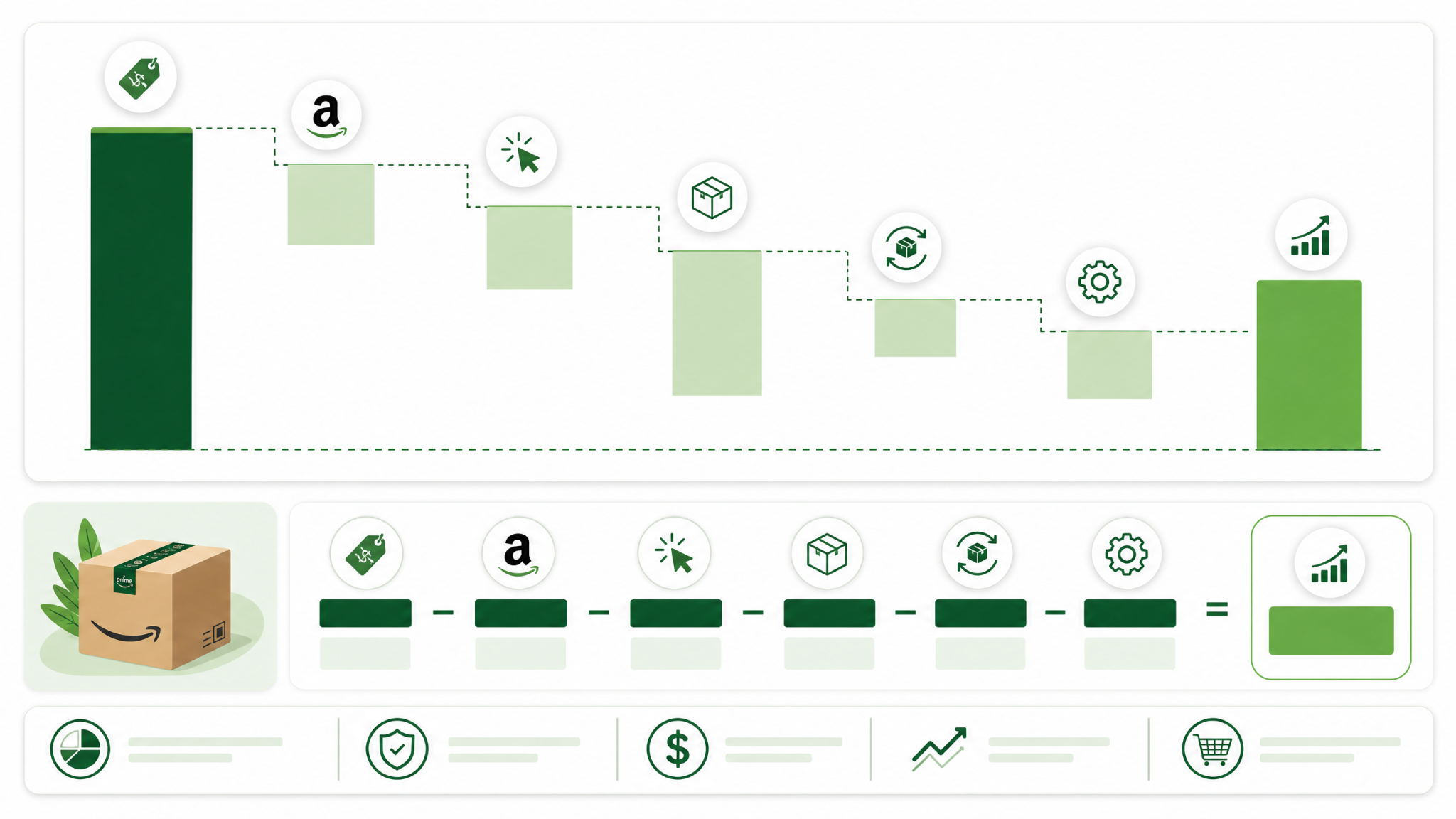
Net Revenue Per Unit = Product Selling Price – Referral Fee – FBA Fulfillment Fee – Return Processing Fee (if applicable) – Promotion/Discount Per Unit
Total Cost Per Unit = COGS Per Unit + Inbound Shipping Per Unit + Inspection/Prep Fees Per Unit + Monthly Storage Fee Per Unit + Inventory Placement Fee Per Unit + PPC Cost Per Unit + Average Return Cost Per Unit + Allocated Software/Subscription Fees Per Unit + Allocated Damaged/Lost Inventory Cost Per Unit For more details, see our guide on importing Europe 2026 tariff increases protect margin.
Real Margin Per Unit = Net Revenue Per Unit – Total Cost Per Unit
Real Margin Percentage = (Real Margin Per Unit / Product Selling Price) * 100
This formula provides a holistic view, moving beyond superficial calculations to reveal your genuine profitability. It’s the ultimate **Amazon FBA profit calculator** for the modern seller.
Example Calculation: Putting Theory into Practice
Let’s assume a product with the following parameters: For more details, see our guide on sell products under 10 euros Amazon FBA profitably.
- Product Selling Price: $25.00
- COGS Per Unit: $5.00
- Inbound Shipping Per Unit: $0.50
- Inspection/Prep Fees Per Unit: $0.20
- Referral Fee (15%): $3.75 (0.15 * $25)
- FBA Fulfillment Fee: $4.00
- Monthly Storage Fee Per Unit: $0.10
- Inventory Placement Fee Per Unit: $0.05
- PPC Cost Per Unit (based on ACoS): $2.50 (10% of $25)
- Average Return Cost Per Unit (e.g., 5% return rate, $10 average return cost): $0.50 (0.05 * $10)
- Allocated Software/Subscription Fees Per Unit: $0.15
- Allocated Damaged/Lost Inventory Cost Per Unit: $0.05
- Promotion/Discount Per Unit: $1.00 (e.g., average coupon redemption)
Net Revenue Per Unit: $25.00 – $3.75 – $4.00 – $1.00 = $16.25 For more details, see our guide on Amazon pricing strategies margin optimization 2026.
Total Cost Per Unit: $5.00 + $0.50 + $0.20 + $0.10 + $0.05 + $2.50 + $0.50 + $0.15 + $0.05 = $9.05
Real Margin Per Unit: $16.25 – $9.05 = $7.20
Real Margin Percentage: ($7.20 / $25.00) * 100 = 28.8%
This detailed calculation provides the **true margin Amazon seller** needs to make informed decisions. A 28.8% margin is significantly different from a gross margin that only considers COGS and revenue.
Strategies for Optimizing Your Unit Economics in 2026
Once you have a clear picture of your **Amazon FBA unit economics 2026**, you can implement targeted strategies to improve your profitability.
1. Price Optimization
- Dynamic Pricing: Utilize tools that adjust prices based on demand, competition, and inventory levels to maximize revenue per unit.
- Bundle Products: Offer product bundles to increase average order value and potentially reduce per-unit FBA fees for combined shipments.
2. Cost Reduction
- Negotiate COGS: Regularly review and negotiate with suppliers for better pricing, minimum order quantities, and payment terms.
- Optimize Inbound Logistics: Explore different freight forwarders and shipping methods to reduce costs to Amazon FBA centers.
- Efficient Prep Services: Streamline your prep process or negotiate better rates with prep centers.
3. FBA Fee Management
- Product Dimensions & Weight: Ensure your product packaging is as compact and lightweight as possible to minimize FBA fulfillment and storage fees. Even a fraction of an inch or an ounce can make a difference.
- Inventory Management: Implement robust inventory forecasting to avoid long-term storage fees and stockouts. Utilize just-in-time inventory strategies where feasible.
4. PPC Efficiency
- Keyword Optimization: Continuously refine your PPC campaigns with highly relevant keywords to improve conversion rates and reduce ACoS.
- Negative Keywords: Use negative keywords to filter out irrelevant searches, saving ad spend.
- Bid Management: Implement sophisticated bid strategies to get the most out of your ad budget.
5. Reducing Returns
- Accurate Product Listings: Provide clear, detailed product descriptions, high-quality images, and accurate dimensions to minimize customer confusion and reduce returns.
- Quality Control: Ensure product quality is consistently high to prevent returns due to defects.
Conclusion: The Path to True Profitability on Amazon FBA
Mastering **unit economics Amazon FBA real margin calculation** is not an option but a necessity for any serious seller aiming for long-term success in 2026 and beyond. By meticulously dissecting every revenue stream and cost component, you gain unparalleled clarity into your business’s financial health. This detailed approach empowers you to move beyond mere sales volume and focus on what truly matters: sustainable, profitable growth.
Embrace the role of a data-driven **true margin Amazon seller**. Utilize a comprehensive **Amazon FBA profit calculator** that accounts for all hidden costs, from PPC to returns. The insights gained will enable you to make strategic decisions, optimize your operations, and ultimately build a more resilient and profitable Amazon FBA business. The future of Amazon selling belongs to those who understand their numbers inside and out.