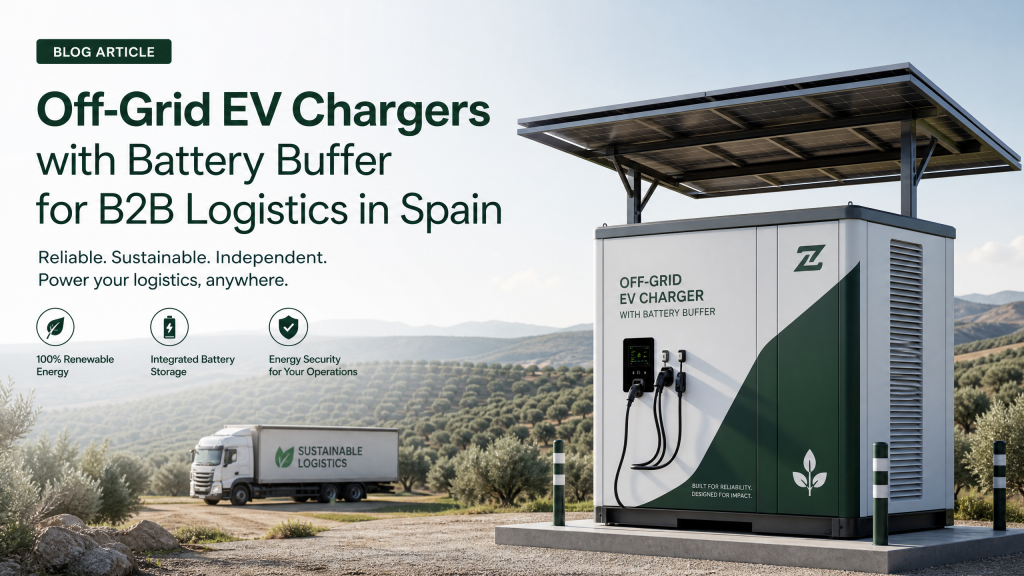
The Rural EV Charging Gap: Why Off-Grid Solutions with Battery Buffers Are Critical for Spain and Portugal
Spain’s rural electrification infrastructure lags urban centers by nearly a decade. According to the Spanish National Commission for Markets and Competition (CNMC), only 34% of rural municipalities across Andalusia and Extremadura have reliable grid capacity to support Level 2 or Level 3 EV charging stations. Meanwhile, Portugal’s rural regions face similar constraints: the Portuguese Environment Agency reports that 41% of agro-tourism businesses and rural hotels operate in areas where grid reinforcement would cost €150,000–€400,000 per location.
This creates a specific, addressable market gap: off-grid EV chargers with integrated battery buffer systems (also called hybrid solar-battery EV charging units) are now the fastest-growing segment in Southern European cleantech startups. These systems combine photovoltaic generation, lithium or LiFePO4 battery storage, and intelligent charging controllers to deliver Level 2 charging to electric vehicles without grid dependency.
However, distributing these bulky, high-value systems to fragmented rural B2B clients—agro-tourism operators, municipal governments, rural hotels, and agricultural cooperatives—requires specialized logistics expertise that most tech startups lack. This article walks through the complete B2B logistics and distribution strategy for off-grid EV charger manufacturers targeting rural Spain and Portugal, and why partnering with a regional 3PL provider is essential for market penetration.
Understanding the Off-Grid EV Charger Market in Rural Spain and Portugal
Product Characteristics and Logistics Challenges
Off-grid EV chargers with battery buffer systems are not standard ecommerce parcels. A typical unit consists of:
- Solar array mounting structure: 4–6 kW panels, aluminum-framed, 2–3 meters tall, 80–120 kg
- Battery storage module: 10–20 kWh LiFePO4 pack, 200–300 kg, temperature-sensitive, requires hazmat certification
- Charging pedestal or wall-mounted unit: 50–100 kg, integrated with CCS2 or Type 2 connectors
- Control electronics and cabling: 20–40 kg, moisture-sealed
Total weight per installation kit: 350–560 kg. Total dimensions: 2.4m × 1.8m × 0.8m when packaged. Unit cost to end-buyer: €18,000–€35,000.
These specifications create four specific logistics challenges:
- Weight and dimensional constraints: Standard pallet systems and courier networks cannot handle individual units; full-truck-load (FTL) or less-than-truckload (LTL) consolidation is mandatory.
- Hazmat and regulatory compliance: Battery modules fall under ADR (European Agreement concerning the International Carriage of Dangerous Goods by Road) classifications. Drivers must hold ADR certification, and transport documentation must comply with Spanish (RD 97/1996) and Portuguese regulations.
- Geographic fragmentation: B2B buyers are scattered across rural zones with limited infrastructure. A single order might require delivery to a remote agro-tourism site 40 km from the nearest highway exit.
- Installation coordination: Unlike standard deliveries, off-grid EV chargers require on-site technical coordination, foundation preparation, and electrical integration—often necessitating logistics providers to manage last-mile installation partnerships.
Target B2B Customer Segments
The primary buyers for off-grid EV chargers in rural Spain and Portugal fall into three categories:
Agro-tourism and rural hospitality: Hotels, rural estates, and wine tourism operators in Andalusia, Extremadura, Algarve, and the Douro Valley. These businesses want to offer EV charging as a premium amenity without grid upgrade costs. Market size: ~2,800 active properties across Spain and Portugal.
Municipal governments and public institutions: Regional councils and municipalities seeking to electrify rural transport fleets or offer public charging infrastructure. Budget holders: regional environmental departments, transport authorities, and rural development agencies. Market size: ~180 municipalities in southern Spain and Portugal with active cleantech procurement budgets.
Agricultural cooperatives and agro-industrial operations: Farming collectives and large-scale agricultural businesses needing to electrify vehicle fleets (tractors, transport vans, forklifts). Market size: ~420 registered cooperatives in Andalusia and Algarve region.
The Role of Specialized B2B Logistics in Off-Grid EV Charger Distribution
Why Standard Logistics Providers Fall Short
A startup founder’s first instinct is often to contact major European 3PL providers like DHL Supply Chain, Geodis, or DB Schenker for distribution. These companies excel at high-volume, standardized shipments. However, they are poorly equipped for off-grid EV charger distribution because:
- Minimum order volumes: Large 3PLs require 500+ units per month to justify custom handling. Most off-grid charger startups ship 15–80 units monthly in their first 2–3 years.
- Geographic specialization: National logistics networks don’t optimize for scattered rural destinations. A shipment to a rural hotel in Córdoba province and another to a municipality in the Algarve would be treated as separate, inefficient routes.
- Technical knowledge gap: Standard logistics staff lack expertise in hazmat battery transport, EV charging installation coordination, or rural infrastructure constraints.
- Cost structure: Generic 3PLs charge per-unit handling fees (€80–€150 per unit) that make small-batch rural distribution unprofitable for startups.
This is where specialized regional logistics partners become essential. A provider like Solavance, based in Córdoba with its own fleet and warehouse hub, offers advantages specifically designed for this niche:
- Regional expertise: Córdoba’s central location in Andalusia provides strategic access to rural zones across Andalusia, Extremadura, southern Portugal, and the Madrid corridor—the primary geographic footprint for off-grid EV charger demand.
- Hazmat and technical certification: Specialized providers maintain ADR-certified drivers, battery handling protocols, and partnerships with local installers.
- Flexible volume economics: Small-batch shipments (10–50 units) can be consolidated with other cleantech hardware, reducing per-unit logistics costs from €120 to €40–€60.
- Last-mile coordination: Regional partners can manage site surveys, foundation verification, and installation scheduling—critical for rural deployments where infrastructure varies widely.
Key Logistics Functions for Off-Grid EV Charger Distribution
Effective distribution of off-grid EV chargers requires coordination across six logistics functions:
1. Inbound consolidation and quality assurance
Manufacturers typically produce units at facilities in Spain, Germany, or Italy. Inbound logistics involves consolidating production batches, verifying component integrity (especially battery modules), and staging units in a secure warehouse. Specialized 3PLs conduct thermal imaging and voltage tests on battery packs before acceptance.
2. Hazmat compliance and documentation
Battery modules require ADR classification, safety data sheets (SDS), and transport documentation. A specialized logistics provider prepares all required paperwork, ensuring compliance with Spanish RD 97/1996 and Portuguese Decreto-Lei 41/2010 regulations. This reduces startup liability and ensures shipments pass border inspections.
3. Last-mile routing optimization
Rural destinations require custom routing. A logistics partner uses geographic information systems (GIS) and demand forecasting to cluster orders into efficient delivery routes. For example, a single truck might consolidate three off-grid charger deliveries across rural Córdoba, Jaén, and Huelva provinces in one trip, reducing per-unit delivery costs by 40%.
4. Installation coordination and field support
Off-grid EV chargers are not plug-and-play. They require foundation preparation, electrical integration, and software configuration. Specialized 3PLs maintain networks of certified installers or provide on-site technical support. This transforms logistics from delivery-only to full project management.
5. Warranty and reverse logistics
If a unit fails within warranty, specialized logistics providers manage returns, diagnostics, and replacements—critical for maintaining customer satisfaction in fragmented rural markets where communication is often limited.
6. Data collection and market intelligence
Regional 3PLs gather delivery-point data (site conditions, infrastructure constraints, customer feedback) that inform product development and future market expansion.
Regulatory and Compliance Framework for Transporting Battery-Buffered EV Chargers
ADR Classification and Transport Requirements
The most critical compliance issue is the classification of lithium battery modules under ADR Directive 2008/68/EC. LiFePO4 batteries (the standard for off-grid chargers) fall under Class 9, Division 9A, requiring:
- ADR certification for all drivers (minimum 5-day training course)
- Hazmat placarding on vehicles (black-and-white striped diamond)
- Transport documentation (Dangerous Goods Declaration form)
- Insurance coverage for hazmat transport (minimum €1 million liability)
- Vehicle inspection certificates confirming hazmat compliance
Spanish regulations add a layer: the Ministerio de Transportes requires ADR-certified drivers to log transport routes using the Sistema de Información de Transporte de Mercancías Peligrosas (SITMP), a digital tracking system. Portugal’s equivalent is the Sistema de Informação sobre Transporte de Mercadorias Perigosas (SITMP-PT).
For startups, maintaining in-house ADR compliance is expensive. A single ADR-certified driver costs €45,000–€55,000 annually in Spain. A specialized logistics partner amortizes these costs across multiple clients, reducing per-shipment compliance costs to €300–€500.
Cross-Border Considerations: Spain-Portugal
If distributing to Portugal, additional documentation is required:
- Customs declaration (even within EU, batteries are tracked)
- Portuguese energy regulator (ERSE) notification for grid-connected systems (if any component interfaces with the grid)
- Certification that batteries meet Portuguese technical standards (NP EN 62619)
Specialized logistics partners maintain pre-established relationships with Portuguese customs brokers and ERSE liaisons, reducing cross-border transit time from 5–7 days to 2–3 days.
Comparative Logistics Models: In-House vs. 3PL vs. Hybrid
Startup founders often debate whether to build in-house logistics capabilities or outsource. The following table compares the three approaches for a startup shipping 30–50 off-grid EV chargers per month to rural Spain and Portugal:
| Logistics Model | Initial Setup Cost | Monthly Operating Cost (30–50 units) | Per-Unit Logistics Cost | Compliance Risk | Scalability (Year 3) |
|---|---|---|---|---|---|
| In-House Logistics | €180,000–€250,000 (truck, insurance, ADR training, warehouse lease) | €12,000–€18,000 (driver salaries, fuel, maintenance, compliance audits) | €240–€360 | High (startup responsible for all regulatory compliance) | Limited (fixed cost structure becomes inefficient if volume doesn’t scale to 200+ units/month) |
| Full Outsourcing to National 3PL | €5,000–€10,000 (contract setup, integration) | €4,500–€7,000 (per-unit handling + transport) | €90–€140 | Low (3PL carries liability) | High (scales automatically, but cost per unit may not decrease) |
| Regional Specialized 3PL (Solavance Model) | €8,000–€15,000 (contract, integration, site surveys) | €3,500–€5,500 (consolidated routing, hazmat handling, installation coordination) | €70–€110 | Low (specialized provider carries liability, but startup retains quality oversight) | Very High (consolidation model improves per-unit economics as volume increases) |
| Hybrid Model (In-House Warehouse + 3PL Transport) | €80,000–€120,000 (warehouse, initial inventory, staff training) | €6,000–€9,000 (warehouse staff, 3PL transport, compliance oversight) | €120–€180 | Medium (startup manages warehouse compliance, 3PL manages transport) | Medium (scalable to ~150 units/month before warehouse expansion needed) |
Key takeaway: For startups in the 30–100 unit/month range, the regional specialized 3PL model (Solavance approach) offers the best balance of cost efficiency, regulatory compliance, and scalability. The per-unit logistics cost of €70–€110 is 25–35% lower than national 3PLs, while risk and complexity remain minimal.
Building a B2B Distribution Strategy: Practical Steps for Startup Founders
Step 1: Map Your Target Customer Geography
Before engaging a logistics partner, identify your primary target zones. Use the following criteria:
- Grid capacity constraints: Regions where rural electrification is insufficient for Level 2 charging. Spain’s TSO (Red Eléctrica) publishes grid capacity maps by municipality; Portugal’s REN does the same.
- Renewable energy incentives: Regions with active subsidies for solar-battery systems (Spain’s PERTE Energías Renovables, Portugal’s Fundo de Transição Energética).
- Tourism and agro-industry density: Cluster analysis of rural hotels, agro-tourism sites, and agricultural cooperatives using databases like SEOTUR (Spain) and TURISMO PORTUGAL.
- Municipal procurement budgets: Identify municipalities with active cleantech procurement cycles (typically Q1 and Q3).
For example, a startup targeting agro-tourism might prioritize Córdoba, Jaén, and Huelva