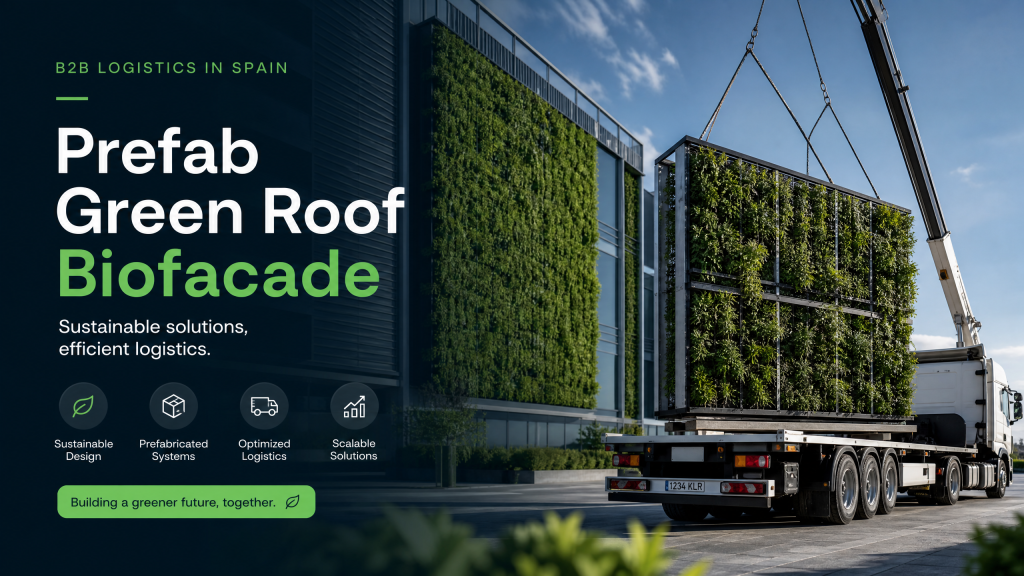
The Hidden Logistics Challenge Behind Europe’s Green Building Boom
Spain’s construction sector is experiencing a quiet revolution. Between 2020 and 2024, demand for green building certifications (LEED, BREEAM, and the EU’s Building Performance Directive) has grown by 47% across Spanish municipalities, according to data from the Spanish Green Building Council. Yet here’s the problem: while architects and developers are racing to specify prefabricated green roofs and bio-facades for their projects, the logistics infrastructure to move these living systems—complete with soil, plants, irrigation, and structural components—remains fragmented and unreliable.
Prefab green roof and bio-facade systems are not conventional construction materials. They arrive as semi-assembled units containing living plants, substrate layers, drainage systems, and sometimes integrated irrigation. They require climate-controlled transport, precise handling protocols, and rapid deployment windows. A single delay or temperature fluctuation can compromise plant viability, rendering a €50,000+ system non-functional before installation even begins.
For European tech startups and established manufacturers producing these systems—companies like Bauwerk Grün, Optigreen, and Zinco—the challenge isn’t product innovation. It’s getting their prefab green roof and biofacade B2B logistics solutions to Spanish architects and developers on time, in pristine condition, and at margins that make business sense.
Why Prefab Green Roofs and Bio-Facades Demand Specialized B2B Logistics
The Perishability Problem
Unlike steel beams or concrete panels, prefabricated green roofs are semi-living products. Once manufactured, they enter a biological clock. Sedum plants, moss, and substrate layers begin respiring, consuming moisture and nutrients. Most manufacturers guarantee a 4-14 day window between production and installation. Transport delays compress this window further.
Temperature sensitivity is acute. Optimal conditions are 15-22°C with 60-80% relative humidity. Overheating causes plant stress and substrate desiccation. Freezing damages cellular structure. Standard uninsulated logistics vehicles fail on both counts. The prefab green roof biofacade B2B logistics Spain market demands refrigerated or climate-controlled transport—a cost multiplier most generic 3PLs haven’t optimized for.
Weight and Dimensional Complexity
A fully-hydrated, planted green roof module can weigh 150-250 kg per square meter. A typical residential building retrofit might require 500-1,200 square meters of green roof coverage. That’s 75-300 metric tons of payload for a single project. Bio-facades add vertical complexity: modular planter boxes, irrigation risers, and structural brackets demand secure, level stacking to prevent component separation or plant damage during transit.
Standard pallet configurations don’t work. Manufacturers and distributors must use custom racks, climate-controlled containers, or specialized flatbeds with air-suspension systems to absorb road vibration.
Installation Window Pressure
Construction schedules are rigid. A green roof installation might occupy a 3-5 day window in a project timeline. If the prefab system arrives damaged or delayed, the entire project timeline fractures. Architects and developers can’t simply reschedule; subcontractors, crane rentals, and labor are already committed. This creates intense pressure on logistics partners to guarantee on-time, condition-perfect delivery.
The Geographic Advantage: Why Southern Spain (and Córdoba) is Emerging as a Green Building Hub
Córdoba’s strategic position in southern Spain offers unexpected advantages for prefab green roof and biofacade B2B logistics distribution. The city sits at the intersection of multiple high-growth markets:
- Andalusia’s construction boom: Seville, Málaga, and Granada are experiencing rapid urban densification and renovation projects targeting EU green building standards.
- Madrid corridor access: A 4-hour drive north connects to Spain’s largest architecture and development market.
- Portuguese market penetration: Lisbon and Porto are 7-8 hours west, with growing demand for sustainable construction materials.
- Mediterranean gateway: Access to southern France (Provence, Languedoc) and North African markets via ports at Málaga and Almería.
This geographic positioning makes Córdoba an ideal consolidation and distribution hub for European manufacturers of prefab green roof systems seeking to serve Spanish and southern European architects. Solavance, based in Córdoba with its own fleet and warehouse infrastructure, has positioned itself precisely at this intersection—offering specialized climate-controlled logistics for bulky, delicate hardware products that demand precision handling and rapid turnaround.
Key Stakeholders in the Prefab Green Roof and Bio-Facade Supply Chain
Manufacturers and System Providers
Companies like Optigreen (Germany-based, with modular systems for intensive and extensive green roofs) and Bauwerk Grün produce prefabricated modules in centralized facilities, typically in Germany, Austria, or the Netherlands. They require logistics partners who can handle B2B distribution to multiple architects, developers, and installation contractors across Spain without breaking the cold chain or compromising plant viability.
Architects and Design Firms
Spanish architecture practices—from boutique studios in Barcelona to large firms in Madrid—increasingly specify green roofs and bio-facades to meet LEED v4.1 or EU Building Performance Directive requirements. They need reliable, predictable supply chains. A delayed or damaged prefab system becomes their liability to the developer client.
Developers and Construction Companies
Residential and commercial developers view green roofs as both sustainability credentials and market differentiators. They demand logistics partners who integrate seamlessly with construction schedules, provide real-time tracking, and guarantee installation-ready delivery.
Installation Contractors and Green Roof Specialists
Spain has a growing ecosystem of green roof installation specialists. They rely on logistics partners to deliver systems in perfect condition, on schedule, and with complete documentation (plant health certificates, substrate composition reports, warranty information).
Comparative Analysis: Transport and Storage Options for Prefab Green Roof Systems
| Logistics Method | Temperature Control | Cost per Shipment (€) | Transit Time (Spain) | Plant Viability Risk | Best Use Case |
|---|---|---|---|---|---|
| Standard refrigerated truck (4-8°C) | Yes (too cold) | €800–1,200 | 2-3 days | High (frost damage) | NOT recommended |
| Climate-controlled van (15-22°C, 60-80% RH) | Yes (optimal) | €1,400–2,000 | 2-3 days | Very Low | Standard B2B shipments (500–2,000 m²) |
| Specialized flatbed with air suspension + thermal blankets | Passive (seasonal) | €1,100–1,600 | 2-3 days | Low (spring/autumn) | Large volume, temperate seasons |
| Insulated container + active humidity control | Yes (active) | €2,200–3,000 | 3-4 days | Minimal | Long-distance (Iberian Peninsula), high-value systems |
| Rail + climate-controlled container (Europe) | Yes (active) | €900–1,400 | 4-6 days | Low | Bulk European shipments (5,000+ m²) |
Key insight: For prefab green roof and biofacade B2B logistics in Spain, climate-controlled vans (15-22°C, 60-80% RH) represent the optimal balance of cost, speed, and plant viability. This is precisely the service model Solavance has developed for bulky, delicate hardware products destined for Spanish architects and developers.
Real-World Logistics Workflow: From Manufacturer to Installation Site
Stage 1: Pre-Shipment Coordination (5-7 Days Before Transport)
The architect or developer specifies green roof system requirements (extensive vs. intensive, plant species, substrate depth, load capacity). The manufacturer confirms production schedule and provides the logistics partner with:
- Exact dimensions and weight per module
- Plant species and water requirements
- Production completion date
- Installation deadline
- Delivery address and site access constraints
The logistics partner (ideally a B2B specialist like Solavance) confirms transport capacity, climate-control specifications, and delivery window. This coordination prevents surprises and allows the manufacturer to optimize production batching.
Stage 2: Warehouse Holding and Pre-Conditioning (1-3 Days)
Prefab systems arrive at the logistics hub in climate-controlled conditions. Before shipment, modules are inspected for damage, plant health is verified, and irrigation systems are tested. This is critical: a defective module discovered at the warehouse can be replaced before it reaches the construction site, avoiding costly project delays.
Modules are held in a holding facility maintained at 18-20°C and 70% RH. For extended holds (2-3 days), supplementary watering and light exposure may be required depending on plant species.
Stage 3: Transport to Site (2-3 Days)
Climate-controlled vehicles depart with real-time GPS tracking and temperature/humidity logging. The driver maintains detailed records of conditions throughout transit. For large shipments, multiple vehicles may be deployed with staggered departure times to match the installation contractor’s daily capacity.
Stage 4: Final-Mile Delivery and Installation Readiness (Same-Day Coordination)
Delivery is coordinated with the installation contractor and site manager. Modules are offloaded using appropriate equipment (cranes, forklifts with wide forks to prevent puncturing substrate). The logistics partner provides installation documentation, plant health certificates, and warranty paperwork.
Regulatory and Compliance Considerations for Prefab Green Roof Logistics in Spain
Plant Health and Phytosanitary Requirements
EU Regulation 2016/2031 governs the movement of plants and plant material within the EU. Prefab green roof systems containing live plants require phytosanitary certificates if sourced from non-EU manufacturers (e.g., from Turkey or North Africa). Spain’s Ministry of Agriculture enforces these requirements at entry points. Logistics partners must maintain documentation and coordinate with customs brokers to avoid delays.
Construction Waste and Substrate Disposal
Spanish Royal Decree 105/2008 regulates construction waste management. Damaged prefab systems or excess substrate from installation must be properly disposed of. Logistics partners should establish relationships with authorized waste management facilities, particularly in urban areas like Madrid and Barcelona where green building projects concentrate.
Building Performance Directive Compliance
The EU’s Building Performance Directive (EPBD recast, 2021/1952) requires member states to ensure new buildings are nearly zero-energy buildings (NZEB) by 2030. Spain’s transposition requires documentation that green roof and bio-facade systems meet thermal and moisture performance standards. Logistics partners should ensure that systems arrive with complete technical documentation and performance certification.
Actionable Strategies for Startups and Manufacturers
1. Establish a Dedicated Logistics Partner Early
Don’t wait until you have product-market fit. Identify a B2B logistics provider—ideally one with climate-control capabilities and experience in delicate, bulky hardware—before you scale manufacturing. Solavance’s model, for example, allows manufacturers to outsource the entire distribution logistics chain to southern Spain, leveraging Córdoba’s geographic centrality and the company’s fleet infrastructure.
This eliminates the need to hire your own logistics staff or invest in fleet vehicles, allowing you to focus on product development and sales.
2. Develop Modular, Stackable Designs
Work with your logistics partner to optimize module dimensions for standard pallet sizes and vehicle configurations. Prefab systems that can be safely stacked 3-4 units high reduce per-unit transport costs by 30-40%. Consult with specialists in prefab CLT and modular housing panels B2B logistics for