Spanish Farms Lose €2.1 Billion Annually to Preventable Crop Losses—Here’s How IoT Sensor Kits Are Changing the Game
According to a 2023 report from the Spanish Ministry of Agriculture, Fisheries and Food (MAPA), precision agriculture adoption across Spain remains at just 34%—despite the technology’s proven ability to reduce water consumption by 25–40% and increase yields by 15–30%. The barrier isn’t awareness. It’s logistics.
When a precision farming startup in Barcelona or Madrid develops a cutting-edge IoT sensor kit for soil moisture, temperature, and nutrient monitoring, getting those devices into the hands of 50,000+ Spanish farms and agricultural cooperatives requires more than a good product. It demands a partner who understands the unique challenges of distributing bulky, high-value hardware across fragmented rural markets—often to locations without traditional commercial infrastructure.
This article explores how European agritech startups can scale distribution of precision farming IoT sensor kits to farms and cooperatives across Spain and southern Europe, with a specific focus on leveraging specialized B2B logistics hubs positioned for agricultural markets.
The Precision Farming IoT Sensor Kit Market in Spain: Scale and Opportunity
Market Size and Growth Trajectory
Spain operates approximately 745,000 farms across 23.5 million hectares of agricultural land. The Spanish precision agriculture market is projected to grow at a CAGR of 12.4% through 2030, driven by EU sustainability mandates (Common Agricultural Policy reforms), water scarcity in regions like Andalusia and Murcia, and increasing labor costs.
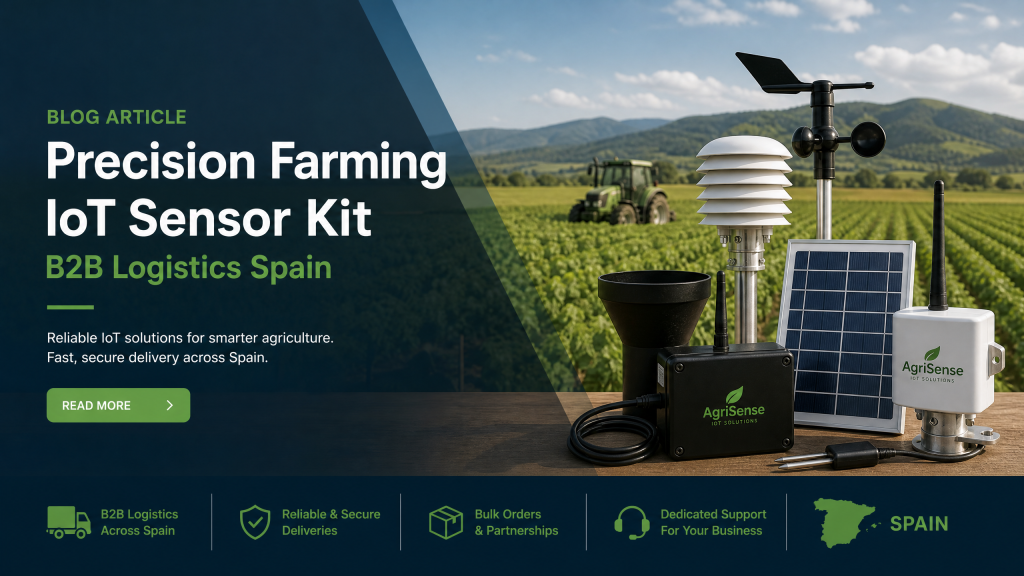
Precision farming IoT sensor kits—systems that monitor soil conditions, weather patterns, crop health, and irrigation needs in real-time—represent the fastest-growing segment within this market. These kits typically include:
- Soil sensors: Moisture, pH, nitrogen, phosphorus, potassium (NPK) monitoring
- Weather stations: Temperature, humidity, rainfall, wind speed, UV radiation
- Crop health sensors: NDVI (Normalized Difference Vegetation Index) cameras, multispectral imaging
- Gateway devices: LoRaWAN, NB-IoT, or cellular connectivity hubs
- Cloud platforms: Data aggregation, analytics dashboards, mobile apps
A typical farm-scale IoT sensor kit costs €800–€3,500 per deployment, with annual software subscriptions adding €200–€600. Agricultural cooperatives—which manage 35% of Spain’s farmland—often purchase kits in bulk (50–500 units), making them high-value B2B customers.
Why Distribution Logistics Matter More Than Product Quality
Spanish farms are geographically dispersed. Andalusia alone spans 8.4 million hectares across four provinces (Córdoba, Seville, Jaén, Granada). A startup selling precision farming IoT sensor kits faces three distribution bottlenecks:
- Last-mile complexity: Farms operate in rural areas with limited road infrastructure. A device destined for a 50-hectare olive farm near Montilla (Córdoba) may require a 2–3 hour drive from Madrid or Barcelona logistics hubs.
- Bulk handling requirements: IoT sensor kits contain fragile electronics. Unlike software, they require climate-controlled storage, careful packing, and timely delivery—a single damaged shipment can delay a cooperative’s entire planting cycle.
- Regulatory compliance: Agricultural products distributed in Spain must comply with AEPLA (Spanish Plant Health Authority) regulations, especially if kits include soil sampling or biological components. EU GDPR also applies to data collected from farm sensors.
Startups that underestimate these logistics challenges often face 15–25% damage rates, 30–45 day delivery times, and customer acquisition costs exceeding 40% of first-year revenue.
Key Players and Technologies in Precision Farming IoT Distribution
Leading Precision Farming IoT Platforms
Understanding the competitive landscape helps B2B logistics providers anticipate customer needs. Key players include:
| Platform | Sensor Types | Connectivity | Target Market | Typical Kit Cost |
|---|---|---|---|---|
| Semios (Canada, EU expansion) | Weather, pest/disease imaging, crop stress | LoRaWAN, cellular | Vineyards, tree crops, high-value perennials | €2,000–€3,500 |
| Agroptima (Spain-based) | Soil, weather, manual field scouting integration | Cellular, WiFi | Small-to-medium farms, cooperatives | €600–€1,200 |
| Taranis (Israel, EU operations) | Crop imaging (multispectral), pest/disease detection | Cloud-based (drone/satellite integration) | Large-scale grain, row crops | €1,500–€2,800 |
| Phytofy (Spain, greenhouse-focused) | Soil, climate, plant physiology sensors | LoRaWAN, 4G | Greenhouse operators, protected cultivation | €800–€1,500 |
| Netafim Connected Irrigation (Israel, global) | Soil moisture, irrigation controllers | Cellular, LoRaWAN | Irrigation-focused farms, all scales | €1,000–€2,200 |
Spain-based platforms like Agroptima and Phytofy have a distinct advantage in local market penetration, but they still rely on third-party logistics for physical distribution. European startups expanding into Spain often partner with specialized logistics providers rather than building in-house distribution teams.
Regulatory and Standards Framework
Any B2B logistics provider handling precision farming IoT kits must navigate:
- CE Marking (Directive 2014/30/EU): IoT devices must comply with electromagnetic compatibility standards. Logistics providers should verify CE compliance during receiving and quality checks.
- AEPLA and Phytosanitary Regulations: If sensor kits include soil sampling or biological components, they may require phytosanitary certificates for cross-border distribution (especially to Portugal, North Africa).
- GDPR and Data Residency: Agricultural IoT platforms collect sensitive farm data. Logistics providers must ensure devices are shipped with secure provisioning, and data storage complies with EU data residency requirements.
- RoHS 2 (Directive 2011/65/EU): Electronic components must be free of restricted hazardous substances. Logistics providers should audit supplier compliance.
The Córdoba Advantage: Strategic Positioning for Precision Farming IoT Distribution
Geographic and Logistical Benefits
Córdoba, located in central Andalusia, offers unique advantages for B2B distribution of precision farming IoT sensor kits:
- Proximity to agricultural regions: Córdoba is surrounded by Spain’s most intensive farming zones—olive groves (1.6 million hectares in Andalusia), vineyards, and grain cultivation. A warehouse hub in Córdoba can reach 80% of southern Spanish farms within 24 hours.
- Access to Portugal and North Africa: Córdoba sits 400 km from Lisbon (Portugal’s major agricultural market) and 500 km from Tangier (Morocco’s growing agritech sector). EU-Morocco agricultural trade agreements are expanding, creating cross-border B2B opportunities.
- Madrid corridor connectivity: Córdoba is positioned on major logistics corridors to Madrid (450 km north), Spain’s distribution hub for northern and central regions. A hub in Córdoba can serve both southern and central Spanish markets efficiently.
- Cooperative density: Córdoba province hosts over 400 agricultural cooperatives—some of Spain’s largest, like Cooperativa San Juan Bautista (12,000+ members)—making it an ideal distribution hub for bulk IoT sensor kit orders.
Infrastructure and Warehouse Capabilities
Precision farming IoT sensor kits require specialized warehouse conditions:
- Climate control: Temperature range 15–25°C, humidity 40–60% to prevent electronic component degradation
- Static-free handling: Anti-static mats, grounding equipment, and trained staff to prevent damage to sensitive sensors
- Inventory tracking: A robust warehouse management system (WMS) to track individual kit components, firmware versions, and provisioning status
- Kitting and customization: Ability to assemble kits with customer-specific configurations (e.g., soil-only vs. full weather station bundles)
Solavance operates a strategic warehouse hub in Córdoba equipped with these capabilities, including climate-controlled storage, static-free assembly areas, and integration with major logistics networks across Andalusia and southern Europe.
B2B Distribution Channels for Precision Farming IoT Sensor Kits
Direct-to-Farm Sales Model
Startups selling directly to individual farms (typically 100+ hectares) face high customer acquisition costs and fragmented orders. However, this channel offers:
- Direct feedback for product iteration
- Higher margins (no distributor markup)
- Stronger customer relationships for upselling software subscriptions
Logistics requirement: 5–20 unit orders, often to remote locations. A specialized B2B logistics partner with rural delivery expertise is essential. Solavance’s fleet includes vehicles optimized for farm access roads and remote deliveries across Andalusia.
Agricultural Cooperative and Purchasing Groups
Cooperatives represent 35% of Spanish farm sales and offer bulk-order opportunities (50–500 units per transaction). This channel provides:
- Predictable, high-volume orders
- Simplified logistics (single delivery point per cooperative)
- Potential for multi-year framework agreements
Logistics requirement: Bulk shipments (pallet quantities), often requiring coordination with cooperative warehouse staff. Cooperatives like COPAG (Córdoba) and Cooperativa San Juan Bautista have established receiving protocols and storage facilities.
Agri-Dealers and Equipment Distributors
Traditional farm equipment dealers (like Massey Ferguson distributors, John Deere dealers) increasingly stock precision agriculture IoT kits as value-added services. This channel offers:
- Established relationships with farms
- Technical support and installation bundling
- Cross-selling opportunities with tractors, implements
Logistics requirement: Smaller, frequent orders (10–50 units) to multiple dealer locations. Dealers often have limited warehouse space, so just-in-time delivery is critical.
Integrators and System Installers
Companies specializing in farm automation (irrigation systems, greenhouse climate control) increasingly bundle IoT sensor kits with their services. Examples include irrigation specialists offering smart irrigation systems with IoT capabilities or greenhouse operators deploying modular hydroponic greenhouse systems.
Logistics requirement: Project-based orders (100–1,000 units) with tight delivery schedules tied to farm construction or installation timelines. Installers need flexible logistics support, including staged deliveries and on-site inventory management.
Practical Logistics Strategy: From Startup to Scale
Phase 1: Pilot Distribution (Months 1–6)
Objective: Validate demand and refine logistics processes with 200–500 units.
Action items:
- Partner with 3–5 pilot cooperatives in Córdoba/Seville provinces to test delivery logistics and customer feedback
- Establish relationships with local agri-dealers (target 5–10 dealers in Andalusia)
- Conduct a logistics audit: measure damage rates, delivery times, and customer satisfaction
- Implement a basic WMS to track inventory and shipments
- Negotiate a flexible warehouse agreement with a specialized logistics provider like Solavance (typically 500–1,000 pallet positions)
Expected costs: €15,000–€25,000 (logistics setup, pilot inventory, WMS software)
Phase 2: Regional Expansion (Months 6–18)
Objective: Scale to 2,000–5,000 units annually across Andalusia and southern Spain.
Action items:
- Expand warehouse footprint: secure 2,000–3,000 pallet positions at the Córdoba hub
- Develop a formal distributor network: recruit 15–25 agri-dealers across Andalusia, Murcia, Extremadura
- Implement automated order-to-delivery workflows using advanced logistics software
- Establish a field support team (2–3 technicians) to handle installation and troubleshooting
- Create bulk pricing tiers for cooperatives (e.g., 50–100 units = 5% discount, 100+ units = 10% discount)
Expected costs: €40,000–€70,000 annually (expanded warehouse, distributor support, field technicians)
Phase 3: Multi-Country Scale (Months 18–36)
Objective: Extend distribution to Portugal, southern France, and North Africa (Morocco, Tunisia).
Action items:
- Leverage Córdoba’s proximity to Portugal and North Africa: establish secondary distribution hubs in Lisbon and Tangier
- Navigate cross-border regulations: obtain phytosanitary certificates, comply with local agritech standards (Portuguese DGAV, Moroccan ONCA)
- Partner with regional logistics providers (e.g., Palibex in