Industrial Heat Pumps Are Reshaping Spain’s Manufacturing Energy Footprint—But Distribution Remains the Biggest Bottleneck
Spain’s industrial sector is investing €2.3 billion annually in heat recovery and efficiency technologies, according to the Spanish Association of Industrial Engineers (AEII). Yet fewer than 18% of startups manufacturing high-temperature industrial heat pumps have successfully scaled beyond their home region within 36 months of launch. The barrier isn’t product quality or market demand—it’s logistics.
High-temperature industrial heat pumps are heavy, fragile, and require specialized handling. A single unit can weigh 800–2,500 kg and demands climate-controlled transport, precise installation coordination, and technical support across multiple regions. For a tech startup in Valencia or Barcelona, reaching food processors in Córdoba, textile manufacturers in Jaén, or dairy facilities in Extremadura means navigating a complex web of regional regulations, last-mile challenges, and customer expectations that standard logistics providers simply cannot meet.
This article explores how B2B startups manufacturing high-temperature industrial heat pumps can build sustainable distribution networks across Spain and southern Europe—and why specialized logistics partners like Solavance are essential to that growth.
Understanding the High-Temperature Industrial Heat Pump Market in Spain
What Are High-Temperature Industrial Heat Pumps, and Who Needs Them?
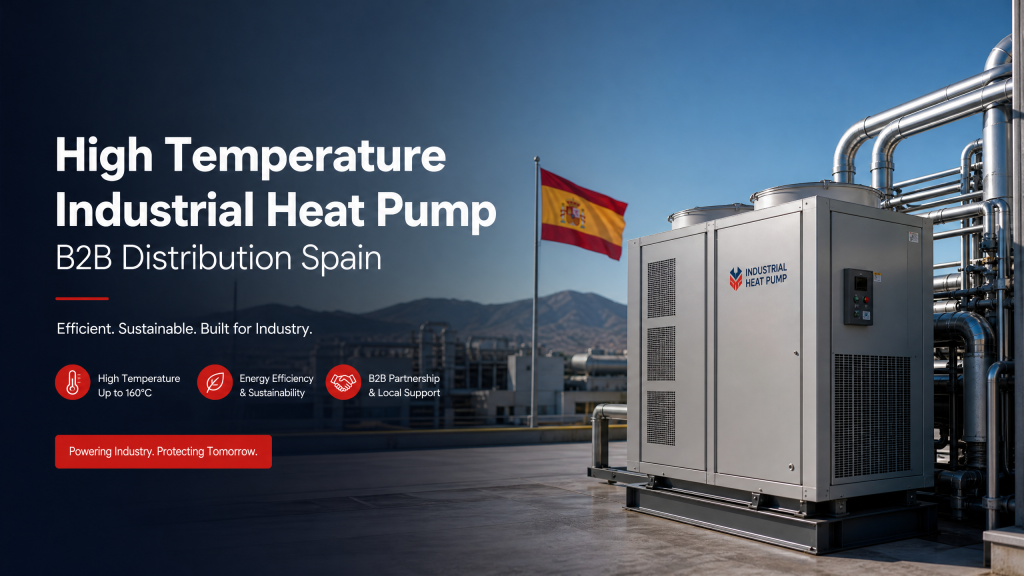
High-temperature industrial heat pumps are engineered systems that extract low-grade heat from industrial processes, ambient air, or waste streams and upgrade it to temperatures between 60°C and 120°C (or higher in specialized applications). Unlike traditional boilers that burn fossil fuels, these systems use electricity and refrigerant cycles to deliver heat efficiently—reducing energy consumption by 30–50% compared to conventional methods.
The primary B2B customers for high-temperature industrial heat pump solutions in Spain include:
- Food and beverage processors: Pasteurization, sterilization, and water heating in dairy, juice, and canned goods production
- Industrial laundries and textile manufacturers: Water heating for washing and drying cycles
- Pharmaceutical and chemical producers: Process heating and temperature control in manufacturing
- Commercial kitchens and hospitality chains: Large-scale water heating for cleaning and cooking
- Agricultural cooperatives: Grain drying, greenhouse climate control, and water heating
- Paper and pulp mills: Waste heat recovery and process heating
Spain’s food processing sector alone operates over 28,000 registered facilities, with approximately 6,200 in Andalusia. Each represents a potential customer for industrial heat pump technology—but only if the startup can deliver, install, and service the equipment reliably across dispersed geographic regions.
Why Spain’s Industrial Sector Is Adopting Heat Pump Technology Now
Three factors are driving rapid adoption:
1. EU Energy Efficiency Directive (EED) 2023/1791: Spain must reduce industrial energy consumption by 1.9% annually. Heat pumps are a primary compliance tool, and manufacturers are investing heavily to meet deadlines.
2. Rising electricity costs and carbon pricing: The EU’s Emissions Trading System (ETS) has increased operating costs for energy-intensive industries. Heat pumps reduce both energy bills and carbon liability, making ROI timelines 4–7 years instead of 10+.
3. Government incentives: Spain’s Recovery, Transformation and Resilience Plan (PRTR) allocates €500 million to industrial energy efficiency. Subsidies and tax credits make heat pump investments more accessible to mid-market manufacturers.
For startups, this creates a genuine market window—but only for those who can solve the distribution problem.
The Logistics Challenge: Why Standard Providers Fall Short
Weight, Fragility, and Installation Complexity
A typical commercial high-temperature industrial heat pump unit comprises a compressor unit (400–800 kg), heat exchanger modules (200–500 kg each), refrigerant piping, electrical controls, and mounting hardware. The complete system often exceeds 1,500 kg and requires:
- Specialized pallet racking and vibration-damping materials
- Climate-controlled transport (to prevent refrigerant condensation or thermal stress)
- Precise delivery scheduling aligned with customer installation teams
- On-site handling by trained technicians (not standard delivery personnel)
- Post-delivery technical support and commissioning
Standard parcel carriers like DPD or Seur are designed for packages under 50 kg. Freight forwarders can move the weight but lack the technical expertise and coordination capability. Regional logistics providers often have limited geographic coverage. The result: startups either hire their own drivers (capital-intensive and inflexible) or accept long delivery windows and poor customer satisfaction.
Regional Fragmentation and Regulatory Variation
Spain’s 17 autonomous communities each have slightly different regulations governing:
- Refrigerant handling and transport (ATEX/PED compliance)
- Pressure equipment certification (Real Decreto 56/2002)
- Electrical installation standards and inspection protocols
- Environmental disposal and recycling requirements
A shipment from Barcelona to Córdoba crosses multiple regulatory jurisdictions. Solavance’s strategic warehouse hub in Córdoba, positioned at the intersection of Andalusia, Extremadura, and the Madrid corridor, allows startups to navigate these variations efficiently. Rather than managing compliance across 17 regions independently, a startup can partner with a single provider who understands local requirements and maintains relationships with regional inspectors and certification bodies.
Last-Mile Delivery to Dispersed Industrial Sites
Unlike urban B2C deliveries, industrial heat pump installations typically occur at manufacturing facilities in smaller towns or rural areas. A textile factory in Jaén or a dairy cooperative in Córdoba province may be 40+ km from major highways. Standard logistics networks optimize for density and volume—not for reaching dispersed industrial zones reliably.
Solavance operates its own fleet of trucks specifically configured for bulky, high-value equipment. This allows for flexible routing, same-day or next-day delivery to industrial zones, and coordination with customer installation teams that standard carriers cannot provide.
Building a B2B Distribution Strategy for High-Temperature Industrial Heat Pumps
Step 1: Map Your Target Customer Geography and Density
Before selecting a logistics partner, startups must identify where their customers cluster. Use industrial directories, chamber of commerce databases, and sector associations to map potential buyers.
For high-temperature industrial heat pumps in Spain, the highest-density regions are:
| Region | Primary Industries | Estimated Addressable Facilities | Logistics Complexity |
|---|---|---|---|
| Andalusia (Córdoba, Jaén, Seville) | Food processing, olive oil, textiles, agriculture | 3,400+ | Medium (dispersed, regional hubs available) |
| Catalonia (Barcelona, Tarragona) | Chemical, pharmaceutical, food, textiles | 2,800+ | Medium (dense, but northern Spain requires longer routes) |
| Valencia Region | Ceramics, food processing, agriculture | 1,600+ | Medium (coastal access, good infrastructure) |
| Castilla-La Mancha | Food processing, wine, agriculture | 1,200+ | High (dispersed, limited logistics infrastructure) |
| Extremadura | Agriculture, food processing, cork | 900+ | High (rural, limited carrier options) |
Startups typically launch in their home region, then expand to adjacent high-density zones. If your manufacturing facility is in Córdoba or southern Spain, prioritize Andalusia and Extremadura first—this is where Solavance’s regional expertise and warehouse positioning create the most value.
Step 2: Choose Between Direct Distribution, Regional Partnerships, or Specialized Logistics Partners
Three distribution models exist for industrial heat pump startups:
Model A: Direct Distribution (In-House Fleet)
Startup owns and operates delivery vehicles and technicians. Advantages: full control, direct customer relationships, premium margins. Disadvantages: high capital investment (€150,000–€300,000 for trucks and equipment), operational complexity, geographic limitations, inflexible for demand fluctuations. Viable only for startups with 50+ annual unit sales and stable regional demand.
Model B: Regional Distribution Partnerships
Startup partners with established regional carriers or HVAC distributors. Advantages: lower capital investment, established networks, local relationships. Disadvantages: limited control over customer experience, margin dilution (20–35% commission), slower scaling, potential channel conflicts. Best for startups with 20–40 annual units and strong regional presence.
Model C: Specialized Logistics Partner (Recommended for Most Startups)
Startup outsources all distribution, warehousing, and last-mile delivery to a specialized partner like Solavance. Advantages: scalability without capital investment, technical expertise, regulatory compliance, flexibility to expand regions, access to existing customer relationships. Disadvantages: less direct customer contact, margin sharing. Ideal for startups with 15–100 annual units and ambitions to scale across multiple regions.
For most tech startups in the industrial heat pump space, Model C is optimal. It allows founders to focus on product development and sales while a specialized partner manages the logistics complexity that derails 40% of hardware startups in their first three years.
Step 3: Establish Inventory and Fulfillment Strategy
High-temperature industrial heat pump startups typically use one of two fulfillment models:
Build-to-Order (BTO): Manufacture each unit only after customer order. Advantages: minimal inventory carrying costs, reduced risk of obsolescence. Disadvantages: 6–12 week lead times, customer dissatisfaction, inability to capitalize on seasonal demand. Suitable for highly customized systems or startups with limited capital.
Stock-and-Deliver (SAD): Maintain 8–15 units in a regional warehouse, ship within 5–7 days of order. Advantages: faster delivery, better customer experience, ability to capture time-sensitive orders. Disadvantages: inventory carrying costs (€2,000–€4,000 per unit annually), working capital requirements. Suitable for standardized product lines and startups with stable demand forecasts.
Solavance operates a warehouse hub in Córdoba with climate-controlled storage specifically designed for industrial HVAC equipment. For a startup using the Stock-and-Deliver model, this eliminates the need to build or lease your own warehouse space in multiple regions. Instead, you maintain inventory at Solavance’s Córdoba facility, which serves Andalusia, Extremadura, and can reach Madrid and Portugal within 24 hours.
Step 4: Implement Tracking and Customer Communication Systems
B2B industrial customers expect real-time visibility into delivery status and installation scheduling. Startups should integrate with logistics platforms that provide:
- Real-time GPS tracking of shipments
- Automated notifications to customers (dispatch, in-transit, delivery window, completion)
- Integration with customer ERP or project management systems
- Documentation capture (photos, signatures, technical notes)
- Post-delivery service scheduling
Platforms like Samsara (fleet management and IoT), Fourkites (supply chain visibility), and Flexport (freight forwarding integration) can integrate with specialized logistics partners to create seamless customer experiences. Solavance’s tech stack includes real-time tracking and customer portal capabilities that startups can white-label or integrate via API.
Regulatory and Compliance Considerations for Industrial Heat Pump Distribution
Pressure Equipment Directive (PED) and ATEX Certification
High-temperature industrial heat pumps containing refrigerant at pressures above 0.5 liters × bar fall under Spain’s implementation of the EU Pressure Equipment Directive (PED 2014/68/EU). Key requirements:
- Units must carry CE marking and technical documentation
- Pressure vessels must be inspected and certified by notified bodies
- Transport of charged refrigerant units requires hazmat compliance (ADR)
- Installation must be performed by certified technicians
A specialized logistics partner like Solavance ensures compliance throughout the supply chain. This includes proper labeling, documentation handling, and coordination with certified installers. Standard freight forwarders often lack this expertise and can inadvertently create liability for the startup.
Energy Labeling and Product Information Requirements
Under the Ecodesign and Energy Information Regulation (EU 2021/341), industrial heat pumps must display standardized energy labeling and provide technical datasheets to customers. Logistics partners should verify that this documentation accompanies every shipment and is accessible to end customers.
Environmental and Waste Compliance
Spain’s Waste and Contaminated Soils Law (Ley 22/2011) requires proper handling and recycling of refrigerant and electronic components. Logistics partners should offer take-back programs or coordinate with certified recyclers for end-of-life equipment. This is increasingly important as customers evaluate sustainability credentials.
Pricing and Commercial Models for B2B Distribution
How Specialized Logistics Partners Charge for Industrial HVAC Distribution
Solavance and similar specialized logistics providers typically charge on a per-unit or per-shipment basis, rather than standard weight-based freight rates. For high-temperature industrial heat pumps, expect:
| Service Component | Typical Cost Range | Notes |
|---|---|---|
| Warehousing (per unit, per month) | €150–€300 | Climate-controlled, includes handling and documentation |
| Regional delivery (per unit, Andalusia) | €200–€500 | Includes last-mile to industrial sites, technical coordination |
| Cross-regional delivery (to Madrid, Portugal, southern France) | €600–€1,200 | Longer routes, may include overnight storage |
| Installation coordination and technical support | €300–€800 per unit | Scheduling, on-site supervision, handoff to customer teams |
| Returns and warranty management | €400–€1,000 per unit | Reverse logistics, inspection, repair coordination |