Spain’s Factories Are Drowning in Plastic Waste—But Only 29% Recycle On-Site
According to a 2023 report by Spain’s Ministry of Ecological Transition, industrial facilities across the country generate over 4.2 million tonnes of plastic waste annually, yet fewer than 3 in 10 factories have implemented on-site recycling capabilities. For European tech startups manufacturing in-situ plastic recycling machines, this gap represents a €180 million addressable market in Spain alone—but only if they can navigate the complex logistics of distributing heavy, specialized industrial equipment to fragmented B2B buyers across the country.
The challenge isn’t product innovation. Startups like Erema, Aimplas, and Ecoplast have proven that in-situ recycling technology works. The bottleneck is last-mile distribution. Factory procurement managers don’t buy plastic recycling machines the way they buy office supplies. These machines weigh 2-8 tonnes, require specialized handling, demand installation support, and must be coordinated with production schedules. A single failed delivery or damaged unit can cost a startup its reputation and margin simultaneously.
This is where strategic B2B logistics partnerships become non-negotiable for scaling in-situ plastic recycling machine distribution across Spain and southern Europe.
The Market Opportunity: Why Spanish Factories Are Ready to Buy
Spain’s industrial sector faces mounting regulatory and financial pressure to adopt circular economy practices. The EU’s Extended Producer Responsibility (EPR) directive, combined with rising landfill taxes (now exceeding €50/tonne in Madrid and Barcelona), has made on-site plastic recycling economically rational rather than merely ethical.
Key buyer segments include:
- Automotive component manufacturers (concentrated in Catalonia, Valencia, and Andalusia)
- Packaging and film producers (highest waste volume; 35% of Spain’s plastic waste)
- Electronics and appliance manufacturers (seeking ISO 14001 certification)
- Food processing facilities (facing retailer-imposed sustainability mandates)
- Construction material producers (recycled plastic composites for building applications)
What makes this market distinct is buyer behavior. Unlike consumer products, in-situ plastic recycling machine purchases involve 6-9 month sales cycles, multiple stakeholders (plant managers, sustainability officers, CFOs), and site visits before commitment. The buyer doesn’t just want a machine—they want proof that it will integrate seamlessly into their production line, generate measurable cost savings, and be supported reliably post-installation.
The Logistics Challenge: Why Standard Distributors Fail
In-situ plastic recycling machines present five distribution challenges that generic logistics providers consistently mishandle:
1. Weight and Dimensional Complexity
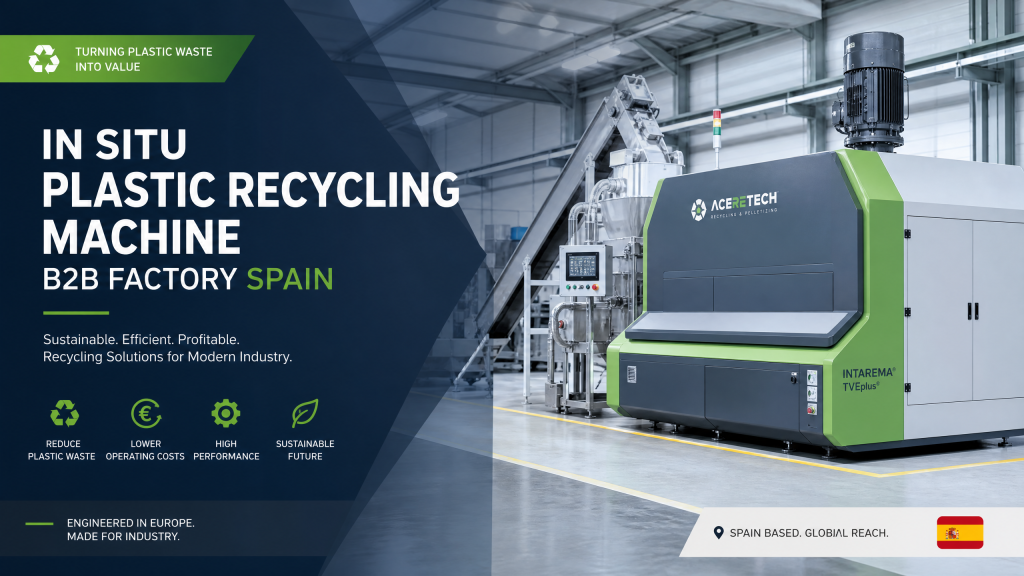
A typical industrial-grade in-situ recycling system (such as those manufactured by Erema’s Intarema series or Aimplas’ modular units) weighs 3-6 tonnes and occupies 12-18 cubic meters of warehouse space. Standard pallet networks designed for 500kg parcels are unsuitable. The equipment requires climate-controlled storage (moisture damages electrical components), specialized forklift handling, and often custom crating to prevent transit damage.
2. Installation and Site Coordination
Delivering the machine to a factory dock is 40% of the job. The remaining 60% involves on-site installation, electrical integration, operator training, and initial commissioning. A logistics partner who only handles transport creates liability gaps. Factories won’t accept delivery without a technician present. Startups can’t afford to send engineers from their home country for every installation.
3. Geographic Fragmentation
Spain’s manufacturing base is geographically dispersed. Unlike Germany (concentrated in Baden-Württemberg) or Italy (Veneto and Lombardy), Spanish factories are scattered across Catalonia, Valencia, Andalusia, and the central plateau. A single delivery route might span 800km. Consolidating multiple units for regional distribution requires warehousing capacity and route optimization that most startups lack.
3. Regulatory and Documentation Compliance
In-situ recycling machines are classified as industrial machinery under EU Directive 2006/42/EC. They require CE marking, technical documentation, and conformity certificates. Cross-border movements to Portugal, France, or North Africa demand customs pre-clearance and harmonized standards verification. A single documentation error delays delivery by weeks.
4. Returns and Service Logistics
If a machine fails during the warranty period or requires component replacement, the logistics partner must manage reverse logistics—collecting the equipment, transporting it to a service hub, coordinating repairs, and redelivering it. This requires both technical knowledge and flexible transport capacity.
Why Specialized B2B Logistics Partners Are Essential
Generic 3PL providers optimize for volume and speed. They’re designed for high-turnover, low-margin goods. In-situ plastic recycling machines demand the opposite: low-volume, high-touch, high-margin logistics. The economics only work with a partner who understands the niche.
A specialized B2B logistics provider for in-situ plastic recycling equipment should offer:
- Dedicated warehouse space with climate control and machinery-grade handling equipment
- Technical coordination capability to liaise between startups and factory procurement teams
- Regional consolidation hubs to optimize routes and reduce per-unit transport costs
- Installation support networks (either in-house or vetted partners) in key manufacturing regions
- Customs and regulatory expertise for multi-country distribution
- Reverse logistics infrastructure for warranty claims and service returns
In southern Spain, Solavance has positioned itself specifically for this niche. Based in Córdoba with a strategic warehouse hub, Solavance operates its own fleet of trucks and has developed partnerships with installation technicians across Andalusia. Córdoba’s location—equidistant from the manufacturing clusters of Valencia (350km), Catalonia (500km), and the central plateau (350km)—makes it an ideal consolidation point for in-situ plastic recycling machine distribution. The city also provides direct access to Portuguese markets (Lisbon, 450km) and North African ports (via Algeciras, 200km), critical for startups serving the broader Mediterranean region.
Building a Distribution Strategy: A Practical Framework
Phase 1: Market Entry (Months 1-3)
Before scaling, validate your market assumptions with 5-10 pilot installations in a single region. Work with your logistics partner to:
- Identify 2-3 anchor customers (large, visible factories whose success generates referrals)
- Map their production schedules and installation windows
- Coordinate delivery, installation, and training as a bundled service
- Document case studies with measurable ROI metrics (plastic waste reduction, cost savings, energy efficiency)
This phase proves product-market fit and generates testimonials that accelerate subsequent sales cycles.
Phase 2: Regional Consolidation (Months 4-9)
Once pilot installations are complete, expand to 2-3 additional regions. Your logistics partner should establish regional consolidation hubs where 2-3 machines can be staged, inspected, and coordinated for delivery within a 200km radius. This reduces per-unit transport costs by 35-45% compared to direct shipment from the factory.
Typical consolidation points in Spain:
- Andalusia hub: Córdoba or Seville (serving Málaga, Granada, Jaén, Córdoba provinces)
- Valencia hub: Liria or Requena (serving Valencia, Castellón, Cuenca)
- Catalonia hub: Barcelona or Sabadell (serving Barcelona, Girona, Tarragona)
- Central plateau hub: Toledo or Puertollano (serving Madrid, Castilla-La Mancha, Extremadura)
Phase 3: Operational Scale (Months 10+)
Once regional hubs are operational, systematize the installation and support process. Your logistics partner should manage:
- Inbound logistics from your manufacturing facility to regional hubs
- Last-mile delivery coordination with factory procurement teams
- Installation scheduling and technician dispatch
- Post-installation support and warranty management
- Reverse logistics for repairs and component replacements
At scale, this allows you to accept orders continuously without managing logistics operations directly.
Comparing Distribution Models: In-House vs. Specialized Partners
| Factor | In-House Logistics | Specialized B2B Partner | Generic 3PL |
|---|---|---|---|
| Initial Capital | €250k–€500k (warehouse, trucks, staff) | €15k–€40k (contracts, integration) | €5k–€15k (minimal) |
| Per-Unit Transport Cost | €800–€1,200 | €600–€900 | €1,500–€2,500 (unsuitable for heavy equipment) |
| Installation Support | High (direct control) | High (vetted partners) | None |
| Scalability (Year 1–2) | Limited (fixed capacity) | Highly flexible (partner scales with demand) | Flexible but quality degrades |
| Regulatory Expertise | Requires hiring specialists | Built-in (partner’s core competency) | Inconsistent |
| Geographic Coverage | Limited to 1–2 regions initially | Multi-region from day one | National but impersonal |
| Reverse Logistics | Complex to operationalize | Integrated into service model | Rarely offered |
| Best For | High-volume, mature companies | Startups scaling 10–50 units/year | Commodity products, not industrial equipment |
For in-situ plastic recycling startups, the specialized B2B partner model offers the optimal balance: low upfront capital, professional infrastructure, and niche expertise without the overhead of building logistics from scratch.
Key Buyer Segments and How to Reach Them
Automotive Component Suppliers
Spain has 2,800+ automotive suppliers, concentrated in Catalonia (Martorell, Granollers) and Valencia (Requena, Liria). These facilities generate massive plastic waste from injection molding and trim components. Decision-makers: Plant Managers and Sustainability Directors. Sales cycle: 4-6 months. Key message: ROI through waste-to-material cost reduction.
Packaging and Film Producers
Spain’s packaging industry generates 1.8 million tonnes of plastic waste annually—the highest of any sector. Buyers are concentrated in Catalonia, Valencia, and Madrid. Decision-makers: Operations Managers and Environmental Compliance Officers. Sales cycle: 3-4 months (faster; regulatory pressure is immediate). Key message: EPR compliance and landfill tax avoidance.
Food Processing Facilities
Large food processors (Grupo Bimbo, Nestlé Spain, Lactalis) are mandated by corporate sustainability targets to reduce plastic waste. These are high-value accounts with long-term contracts. Decision-makers: Sustainability Teams and Procurement Directors. Sales cycle: 6-9 months (complex approvals). Key message: Brand alignment and corporate ESG targets.
Electronics Manufacturers
Electronics assembly and appliance manufacturers (Bosch Siemens, Arçelik, Indesit) require ISO 14001 certification, which in-situ recycling directly supports. These are premium accounts. Decision-makers: Environmental and Quality Managers. Sales cycle: 5-7 months. Key message: Certification support and regulatory alignment.
Your logistics partner should have regional contacts in these sectors to facilitate introductions and pilot programs.
Optimizing the Customer Acquisition Funnel
Stage 1: Awareness (Months 1-2)
Target procurement and sustainability managers via LinkedIn, industry associations (AIMPLAS, ASEPLAS), and trade shows (Hispack, Empack). Content focus: ROI calculators and case studies from similar factories.
Stage 2: Consideration (Months 3-4)
Offer free site assessments. Your logistics partner can coordinate regional technicians to visit factories, audit current waste streams, and model recycling scenarios. This is low-cost for you but high-value for buyers.
Stage 3: Decision (Months 5-6)
Present a pilot installation proposal: machine on-site for 30 days, performance monitoring, and post-pilot purchase decision. Your logistics partner handles delivery and installation; you handle performance tracking.
Stage 4: Retention (Months 7+)
Once installed, transition to a service model: quarterly maintenance, operator training updates, and consumables supply. Your logistics partner manages reverse logistics for parts replacement.
Related Circular Economy Logistics Solutions in Spain
In-situ plastic recycling is one component of a broader circular economy infrastructure. If you’re scaling in-situ plastic recycling machines, complementary technologies create cross-selling opportunities:
- Smart waste compactors for municipalities and companies often precede recycling installations, consolidating waste streams for easier processing.
- Industrial accelerated composting systems for hotels and restaurants address organic waste in food-service supply chains, reducing total waste volume.
- Pneumatic waste collection systems for urbanizations and hospitals optimize waste logistics in multi-tenant facilities, improving recycling capture rates.
- Large-format industrial 3D printers for manufacturers represent the downstream application of recycled plastics, creating closed-loop material flows.
A logistics partner with expertise in multiple circular economy technologies can bundle services, reducing per-unit costs and increasing customer lifetime value.