Spanish SMEs Face a Productivity Crisis—and Cobots Are the Answer
Spain’s manufacturing sector employs over 2.3 million workers across small and medium enterprises (SMEs), yet 67% of Spanish manufacturers report labor shortages as their primary operational constraint. Meanwhile, automation adoption among Spanish SMEs sits at just 12%—significantly below the EU average of 28%. This gap represents both a crisis and an extraordinary market opportunity for collaborative robot (cobot) distributors targeting the B2B manufacturing segment across Spain and southern Europe.
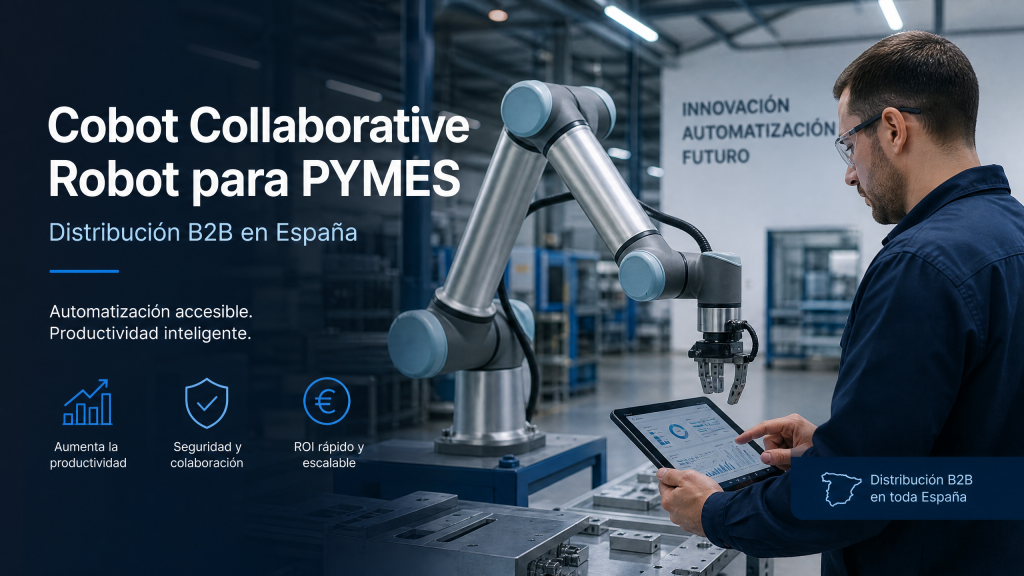
Collaborative robots—designed to work safely alongside human operators without protective cages—have emerged as the ideal entry point for SMEs hesitant about traditional industrial robotics. Unlike their industrial predecessors, cobots are affordable (€25,000–€150,000 per unit), easy to program, and require minimal infrastructure investment. For B2B cobot startups seeking to penetrate the Spanish market, the challenge isn’t product innovation—it’s distribution logistics.
This is where specialized B2B logistics partners become essential. Distributing heavy, precision-engineered collaborative robots to fragmented SME networks across Spain’s diverse geography demands expertise in equipment handling, compliance documentation, installation support, and reverse logistics. The wrong logistics partner can turn a promising cobot sale into a customer service nightmare.
The Spanish SME Manufacturing Landscape: Where Cobots Fit
Current Automation Gaps in Spanish Manufacturing
Spanish manufacturing is concentrated in three primary regions: Catalonia (automotive, chemicals), the Basque Country (machine tools, automotive), and Andalusia (food processing, textiles, metal fabrication). However, the fragmentation of SME production means that 94% of Spanish manufacturers employ fewer than 250 workers—the segment most resistant to automation investment.
The barriers are clear: traditional industrial robots require €500,000+ capital investment, specialized programming teams, and facility redesign. For a 50-person metalworking shop in Córdoba or a 30-person food packaging operation in Seville, this represents an impossible hurdle. Cobots change this equation entirely. A Universal Robots UR10e or ABB GoFa 5 can be deployed in days, operated by existing staff after minimal training, and relocated between tasks as production needs shift.
This flexibility makes cobots ideal for Spanish SMEs operating in:
- Metal fabrication and machining: Material handling, machine tending, finishing operations
- Food and beverage processing: Palletizing, packaging, quality inspection
- Automotive component suppliers: Assembly, welding assistance, part transfer
- Electronics manufacturing: PCB handling, component insertion, testing
- Textiles and apparel: Pattern cutting, seam finishing, quality control
Why B2B Cobot Distribution Differs from Consumer Tech Logistics
Distributing cobots to Spanish SMEs is fundamentally different from standard ecommerce fulfillment. Consider these operational realities:
- Weight and fragility: A UR10e weighs 1,395 kg and requires climate-controlled transport to prevent sensor calibration drift
- Documentation complexity: CE marking, technical specifications, safety certifications, and compliance documentation must accompany every unit
- Installation dependency: Many SME buyers lack the technical capacity to unbox, calibrate, and integrate cobots into existing workflows—logistics partners must coordinate on-site installation support
- Geographic dispersion: Spanish SMEs are scattered across rural and semi-urban areas, making last-mile delivery a logistics puzzle
- Reverse logistics risk: If a cobot fails under warranty, retrieving a 1,400 kg precision instrument from a remote factory requires specialized equipment and expertise
Strategic Positioning: Córdoba as a Cobot Distribution Hub
For B2B cobot startups targeting Spain and southern Europe, warehouse location is a competitive advantage. Córdoba, in the heart of Andalusia, offers unmatched strategic positioning:
- Central to Andalusian manufacturing: Córdoba sits within 150 km of Seville, Granada, Jaén, and Almería—regions with dense SME manufacturing clusters in food processing, textiles, and metal fabrication
- Madrid corridor access: The A-4 motorway connects Córdoba to Spain’s largest industrial hub in Madrid (400 km north), enabling same-day or next-day delivery to central Spain’s automotive and electronics suppliers
- Portuguese market gateway: Córdoba is 380 km from Lisbon, making it ideal for cobot distributors targeting Portuguese SMEs in the Alentejo and Tagus Valley regions
- North African proximity: Córdoba’s position enables export logistics to Morocco and Tunisia, where manufacturing is rapidly expanding
- Port access: Málaga and Almería ports provide international shipping routes for importing cobot units from European manufacturers or exporting to North African clients
This geographic advantage explains why specialized logistics providers like Solavance have positioned their warehouse hub in Córdoba. For cobot startups, partnering with a locally-based B2B logistics firm eliminates the need to establish multiple regional warehouses and enables rapid, cost-effective distribution across southern Spain and into Portugal and North Africa.
Key Cobot Manufacturers and Their Distribution Requirements
Market Leaders and Their Logistics Footprints
Understanding the leading cobot manufacturers helps illustrate the distribution landscape:
| Manufacturer | Key Models | Payload / Reach | Unit Weight | Typical SME Price Point | Distribution Challenge |
|---|---|---|---|---|---|
| Universal Robots (Denmark) | UR3e, UR5e, UR10e | 3-10 kg / 500-1300 mm | 500-1,395 kg | €35,000–€95,000 | High-value units require white-glove delivery and installation support |
| ABB (Switzerland) | GoFa 4, GoFa 5 | 4-5 kg / 1,580-1,710 mm | 855-1,050 kg | €45,000–€110,000 | Integrated vision systems require calibration before delivery |
| Techman Robot (Taiwan) | TM12, TM14 | 5-6 kg / 1,300 mm | 545-615 kg | €28,000–€65,000 | Lower weight reduces logistics cost but requires careful handling for vision sensors |
| Stäubli (Switzerland) | TX2-90 HE, TX2-130 HE | 6-8 kg / 1,300 mm | 750-950 kg | €50,000–€125,000 | High precision requires climate-controlled transport and specialized packaging |
| FANUC (Japan) | CRX-10iA, CR-35ia | 10-35 kg / 1,700-1,813 mm | 980-1,850 kg | €60,000–€150,000 | Heavy units demand specialized equipment for loading/unloading |
Each manufacturer has different packaging standards, documentation requirements, and installation protocols. A B2B logistics provider serving the cobot sector must maintain expertise across these variations and coordinate with authorized service partners for on-site support.
Building a B2B Cobot Distribution Network: Practical Steps
Step 1: Establish a Strategic Warehouse Partnership
Rather than building your own warehouse infrastructure, cobot startups should partner with established B2B logistics firms specializing in heavy equipment distribution. The ideal partner should offer:
- Climate-controlled storage: Temperature and humidity management (18-25°C, 45-55% humidity) prevents sensor drift and electronic component degradation
- Specialized handling equipment: Pallet jacks rated for 2,000+ kg, loading ramps, and docking facilities designed for precision equipment
- Documentation management: Experience with CE marking, technical file organization, customs documentation, and compliance tracking
- Installation coordination: Relationships with authorized service technicians who can perform on-site calibration and training
- Reverse logistics capability: Ability to retrieve, inspect, repair, and redeploy cobots under warranty or maintenance contracts
For distributors targeting Spanish and southern European SMEs, Solavance’s Córdoba-based warehouse offers exactly this infrastructure. Their experience distributing bulky, high-value hardware from European tech startups directly addresses the cobot sector’s logistics needs.
Step 2: Create Regional Service Networks
Cobots fail. Sensors malfunction. Calibration drifts. Cables break. Your distribution strategy must account for rapid response to customer issues. Build relationships with:
- Authorized service partners: Coordinate with cobot manufacturers’ certified service centers in Madrid, Barcelona, Seville, and Valencia
- Local systems integrators: Identify 2-3 SI firms in each region who can perform custom programming and integration work
- Technical training providers: Establish partnerships with vocational schools and training centers to offer cobot operator certification
This network transforms your distribution operation from “shipping boxes” into “providing complete solutions,” which dramatically increases customer retention and lifetime value.
Step 3: Develop Vertical-Specific Marketing Materials
Spanish SMEs don’t buy cobots generically—they buy solutions to specific production problems. Create targeted case studies and ROI calculators for:
- Food packaging operations: “Replace 2 FTE palletizers with one cobot; save €45,000 annually in labor while improving consistency”
- Metal fabrication shops: “Automate machine tending; reduce cycle time by 30% and eliminate operator fatigue injuries”
- Automotive suppliers: “Deploy collaborative assembly; achieve ISO/TS 16949 compliance with real-time quality tracking”
These materials should address the specific regulatory and operational concerns of Spanish manufacturers, including compliance with Spanish labor law (Estatuto de los Trabajadores) and safety standards (RD 1435/1992).
Step 4: Implement a B2B Financing Partnership
Most Spanish SMEs cannot deploy €50,000–€100,000 in capital equipment without financing. Establish relationships with:
- Equipment financing firms: Spanish banks like Sabadell, Bankia, and BBVA offer equipment leasing with 3-5 year terms
- EU subsidy programs: Programs like PERTE (Proyectos Estratégicos para la Recuperación y Transformación Económica) provide grants for industrial automation in Spanish SMEs
- Regional development agencies: Andalusian Agency for Enterprise Development (IDEA) offers subsidized loans for manufacturing modernization
By helping customers access financing and subsidies, you remove the primary barrier to cobot adoption and dramatically increase conversion rates.
Logistics Optimization: Managing Cobot Distribution at Scale
Transportation and Route Planning
Distributing cobots across Spain’s fragmented SME base requires sophisticated route planning. Consider these factors:
- Consolidation strategy: Group orders geographically to maximize truck utilization. A single truck can carry 4-6 cobots, depending on packaging. Route optimization software like Routific or Sennder can reduce per-unit transport costs by 20-30%
- Last-mile challenges: Many Spanish SMEs operate in industrial parks outside city centers, requiring specialized access knowledge. Logistics partners familiar with regional geography (like Solavance in Córdoba) have significant advantages
- Delivery windows: Coordinate delivery with customer production schedules to minimize disruption. This requires real-time communication and flexibility—not standard in generic logistics
Documentation and Compliance
Each cobot shipment requires:
- CE Declaration of Conformity (per Machinery Directive 2006/42/EC)
- Technical file documentation (safety analysis, risk assessment, test reports)
- Safety manual in Spanish (required by Spanish law)
- Customs documentation for cross-border shipments (if sourcing from non-EU manufacturers)
- Insurance certificates for high-value equipment
A specialized B2B logistics provider will manage this documentation trail, ensuring compliance and reducing customer friction.
Installation Support and Training Coordination
The cobot itself is only 40% of the value delivered to an SME customer. The remaining 60% comes from successful integration, programming, and staff training. Your logistics partner should coordinate:
- Pre-delivery site assessments (electrical requirements, space constraints, safety considerations)
- On-site installation and calibration by authorized technicians
- Operator training (typically 2-3 days for basic programming and safety protocols)
- Post-delivery support calls and troubleshooting
This end-to-end approach transforms logistics from a cost center into a profit center, enabling margin expansion and customer lock-in.
Competitive Benchmarking: How Cobot Distribution Differs from Related Industries
Understanding how cobot logistics differs from adjacent sectors helps clarify best practices. Cobot distribution shares characteristics with several industries but has unique requirements:
Similarity to AGV/AMR warehouse robotics: Both involve heavy, precision-engineered equipment requiring climate-controlled storage and specialized handling. However, cobots typically deploy in production areas (not warehouses), requiring different installation support. For deeper insights into warehouse robotics logistics, see our guide on AGV and AMR Warehouse Robots: B2B Distribution and Fulfillment for Logistics Companies in Spain.
Difference from food robotics: While Food Robotics and Automated Kitchen Systems: B2B Distribution to Restaurant Chains in Spain also targets SMEs with automation solutions, food robots typically require hygienic certification and food-safety compliance that cobots don’t. Cobot logistics is more standardized.
Similarity to industrial inspection drones: Both involve high-value hardware with complex documentation requirements. However, drones are lighter and require