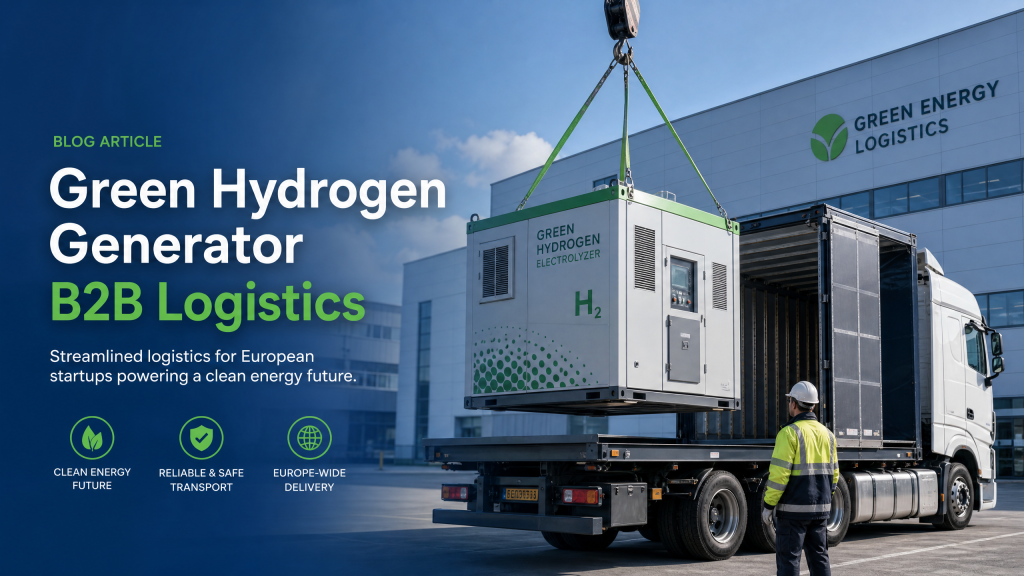
The Hidden Logistics Challenge Behind Europe’s Green Hydrogen Boom
The European green hydrogen market is projected to reach €155 billion by 2050, with electrolyzer capacity expected to grow from 1.4 GW in 2023 to over 500 GW by 2030. Yet behind every hydrogen generator shipped across Europe lies a logistics puzzle that most B2B hardware startups are fundamentally unprepared to solve.
Green hydrogen generators aren’t like solar panels or battery systems. They’re typically 2–8 tons of precision-engineered equipment, requiring specialized handling, climate control, vibration dampening, and compliance with overlapping EU regulations across multiple jurisdictions. A single miscalculation in transport—improper securing, humidity exposure, or route planning through regions with strict hazmat restrictions—can result in equipment damage, regulatory fines, or delayed project deployments that cost clients thousands per day.
For European tech startups manufacturing hydrogen generation equipment—whether PEM (proton exchange membrane) electrolyzers, alkaline systems, or integrated green H2 solutions—logistics isn’t a back-office function. It’s a competitive differentiator and a direct threat to revenue if mishandled.
This guide addresses the complete logistics lifecycle for distributing heavy hydrogen generators across Europe’s B2B market, with specific strategies for startups operating from southern Spain’s strategic logistics corridor.
Understanding Green Hydrogen Generator Logistics Complexity
Why Standard 3PL Providers Fall Short
Most European 3PL (third-party logistics) providers excel at moving palletized goods, consumer electronics, or standard industrial equipment. Green hydrogen generators demand something fundamentally different:
- Weight and dimensional complexity: Generators often exceed 5 tons and occupy 4–6 cubic meters, requiring custom securing and load planning
- Precision equipment handling: Internal components like membranes, catalysts, and electrodes cannot tolerate vibration, temperature swings, or humidity spikes
- Multi-jurisdictional compliance: Hydrogen equipment falls under ATEX (Atmosphères Explosibles) directives in EU-27 countries, plus separate UK, Swiss, and Norwegian standards
- Limited route options: Some regions classify hydrogen equipment as hazardous goods, restricting transport through city centers or specific corridors
- Documentation overhead: Each shipment requires technical datasheets, CE certifications, IMEI classifications, and destination-specific declarations
A generic logistics provider might get your generator to a warehouse on time. A specialized B2B hardware logistics partner ensures it arrives in the exact condition required for immediate B2B client deployment—a critical difference when your buyer is an industrial facility or energy infrastructure operator with zero tolerance for equipment downtime.
The Regulatory Maze: ATEX, ADR, and Beyond
Green hydrogen generators occupy a gray zone in European transport regulation. While hydrogen gas itself is classified as hazardous (Class 2, Division 2.1 under ADR—the European Agreement concerning the International Carriage of Dangerous Goods by Road), the generators themselves are typically classified as equipment containing or designed to produce hydrogen.
Key regulatory frameworks affecting hydrogen generator logistics in Europe:
- ATEX Directive (2014/34/EU): Applies to equipment intended for use in potentially explosive atmospheres. Most hydrogen generation systems require ATEX certification, limiting which transport routes and facilities can handle them
- ADR (European Agreement on Dangerous Goods by Road): Governs transport of hazardous materials. Hydrogen generators may fall under Class 2 or Class 8 (corrosive substances) depending on the electrolyte used
- PED (Pressure Equipment Directive 2014/68/EU): If your generator includes pressurized tanks or vessels, PED compliance is mandatory
- EMC Directive (2014/30/EU): Electromagnetic compatibility requirements for electrical equipment
- National variations: France, Germany, and Italy each maintain additional transport restrictions; Spain has specific requirements for Andalusia and port regions
Non-compliance can result in fines up to €50,000 per shipment, equipment seizure, and loss of client trust. A specialized logistics partner with expertise in hydrogen equipment should maintain updated compliance calendars and route certifications.
Transport Modes and Infrastructure for Hydrogen Generator Distribution
Road Transport: The Primary B2B Distribution Channel
For B2B hydrogen generator logistics across Europe, road transport via specialized truck fleets remains the dominant mode. Unlike air freight (prohibitively expensive and heavily restricted for hydrogen equipment) or rail (limited route flexibility for last-mile delivery), road offers the best balance of cost, compliance, and control.
Key specifications for hydrogen generator transport vehicles:
- Air suspension systems: Minimize vibration transmission to sensitive internal components
- Climate control capability: Maintain 15–25°C and 30–60% relative humidity during transit
- Lashing points and custom restraint systems: Standard tie-down systems are inadequate; hydrogen generators require engineered load securing with shock-absorbing materials
- ATEX-certified vehicle interiors: For certain generator types, the transport vehicle itself may need ATEX compliance
- GPS and real-time monitoring: Allows continuous temperature, humidity, and shock tracking throughout transit
Solavance operates a dedicated fleet of climate-controlled, air-suspended trucks from its Córdoba hub specifically configured for heavy, precision industrial equipment like hydrogen generators. The strategic location in southern Spain—with direct access to Andalusia’s industrial zones, the Madrid corridor for central European distribution, Portuguese entry points, and North African export routes—makes Córdoba an ideal logistics hub for European hydrogen equipment startups.
Multi-Modal Strategies for Regional Distribution
For startups targeting multiple European markets simultaneously, a hub-and-spoke approach using Córdoba as a consolidation point can reduce costs and improve delivery times:
- Consolidation: Collect multiple smaller shipments at the Córdoba warehouse, then dispatch full truckloads to regional distribution centers in France, Germany, Italy, or the UK
- Cross-docking: Receive generators from manufacturing facilities, perform quality checks and compliance verification, then immediately transfer to outbound vehicles with minimal storage time
- Last-mile flexibility: Partner with regional 3PLs for final-mile delivery to end-client facilities, while maintaining control over the critical long-haul transport phase
Storage and Warehouse Management for Hydrogen Generation Equipment
Environmental Control Requirements
Unlike standard industrial goods, hydrogen generators require precise environmental conditions even in storage:
| Parameter | Ideal Range | Risk if Exceeded | Monitoring Frequency |
|---|---|---|---|
| Temperature | 15–25°C | Membrane degradation, catalyst deactivation, seal failure | Continuous (automated sensors) |
| Relative Humidity | 30–60% | Corrosion of metal components, electrolyte leakage, electrical shorts | Continuous (automated sensors) |
| Vibration | <0.5g acceleration | Internal component misalignment, membrane rupture, performance degradation | Event-based (shock sensors) |
| Light Exposure | Minimal (UV-filtered) | Polymer degradation, electrolyte decomposition | Visual inspection on receipt/dispatch |
| Atmospheric Composition | Standard air, no corrosive gases | Accelerated corrosion, safety hazards | Initial facility certification |
Solavance’s Córdoba warehouse facility includes dedicated climate-controlled zones with redundant HVAC systems, real-time environmental monitoring, and automated alerts for any deviation from specification. This level of control is non-negotiable for hydrogen generator storage, as a single day of improper conditions can compromise equipment performance or safety certification.
Inventory Management and Compliance Documentation
For B2B hydrogen generator distribution, inventory management extends beyond physical tracking. Each unit requires:
- Digital twin documentation: Linked to batch numbers, manufacturing dates, and test certificates
- Compliance certificate storage: ATEX, CE, PED, and destination-country-specific approvals must be retrievable within minutes
- Chain of custody records: Every movement—from manufacturing facility to warehouse to transport to client delivery—must be logged with timestamps and responsible parties
- Damage assessment protocols: Standardized procedures for documenting any physical damage or environmental exposure during storage
Modern warehouse management systems (WMS) like Blue Yonder or SAP Extended Warehouse Management can be configured for hydrogen equipment tracking, but require customization for the regulatory complexity. Alternatively, specialized solutions like TraceLink (originally developed for pharmaceutical supply chains) offer pre-built compliance workflows applicable to hydrogen equipment.
Practical Logistics Strategies for Hydrogen Equipment Startups
Strategy 1: Direct-to-Client Model with Specialized Transport
For high-value hydrogen generators (€50,000+), direct shipment from manufacturing to end-client facilities minimizes handling and reduces storage costs. This requires:
- Pre-delivery coordination with the client to confirm receiving dock specifications and environmental controls
- Dedicated vehicle assignment (no multi-stop consolidation) with continuous monitoring
- On-site installation support or client training from the transport provider
- Post-delivery verification that equipment meets performance specifications before final payment
Cost impact: +15–25% higher per-unit transport cost, but offset by reduced warehouse holding costs and faster cash conversion for high-value contracts.
Strategy 2: Regional Hub Consolidation with Cross-Docking
For startups with multiple smaller orders across different European regions, consolidating at Córdoba before regional distribution reduces per-unit costs by 20–30%:
- Collect 3–5 units from manufacturing over 1–2 weeks
- Perform quality verification and compliance checks at the Córdoba hub
- Consolidate into a single full-truckload shipment to a regional distribution center (e.g., Frankfurt for Central Europe, Lyon for Southern Europe)
- Partner with local 3PLs for final-mile delivery to individual clients
This model works best when client delivery windows are flexible (3–4 week lead times acceptable) and order values are €15,000–€50,000 per unit.
Strategy 3: Rental and Leasing Model Logistics
Some hydrogen equipment startups are shifting toward rental or lease models rather than outright sales. This requires a different logistics approach:
- Depot network: Maintain regional storage facilities in key markets (Germany, France, UK, Spain) to support rapid deployment for short-term rentals
- Reverse logistics: Plan for equipment retrieval and reconditioning after rental periods
- Maintenance integration: Coordinate logistics with preventive maintenance schedules to optimize vehicle utilization
- Regulatory compliance tracking: Ensure recertification requirements are met before each new deployment
This model requires higher upfront logistics infrastructure investment but enables recurring revenue and stronger client relationships. Solavance can support both forward and reverse logistics for rental fleets, with dedicated reconditioning facilities in Córdoba.
Cost Benchmarking and Budget Planning
Typical Logistics Costs for Green Hydrogen Generators in Europe
Understanding cost drivers helps startups price their B2B offerings competitively while maintaining healthy margins:
| Logistics Component | Cost per Unit (€) | Variables | Optimization Potential |
|---|---|---|---|
| Long-haul transport (500–1,500 km) | €2,500–€4,500 | Distance, vehicle type, consolidation | Consolidation saves 20–30% |
| Climate-controlled storage (30 days) | €800–€1,500 | Facility type, volume, duration | Higher volume rates available |
| Compliance documentation and certification | €300–€800 | Destination country, equipment complexity | Batch processing reduces per-unit cost |
| Last-mile delivery and installation support | €1,200–€2,800 | Client location, technical complexity | Client self-installation reduces cost 40% |
| Insurance and risk management | €400–€1,000 | Equipment value, transport distance | Bundled policies offer 15% savings |
| Total per-unit cost | €5,200–€10,600 | Average: €7,200 (12–18% of typical generator selling price) | |
For a startup selling hydrogen generators at €40,000–€80,000 per unit, logistics represents a manageable 9–18% of revenue. However, inefficient logistics planning can inflate these costs by 40–50%, directly impacting profitability on lower-margin contracts.
Technology and Monitoring Solutions for Hydrogen Generator Shipments
Real-Time Tracking and Environmental Monitoring
IoT-enabled monitoring devices have become essential for hydrogen equipment logistics. Leading solutions include:
- Sensitech ShockWatch and Companion: Provides real-time temperature, humidity, and shock data with cloud-based dashboards. Particularly valuable for verifying that equipment arrived within specification before client acceptance
- Orbcomm IoT solutions: Satellite-based tracking for remote deliveries and cross-border shipments where cellular coverage is unreliable
- Custom IoT integrations: Some hydrogen equipment