
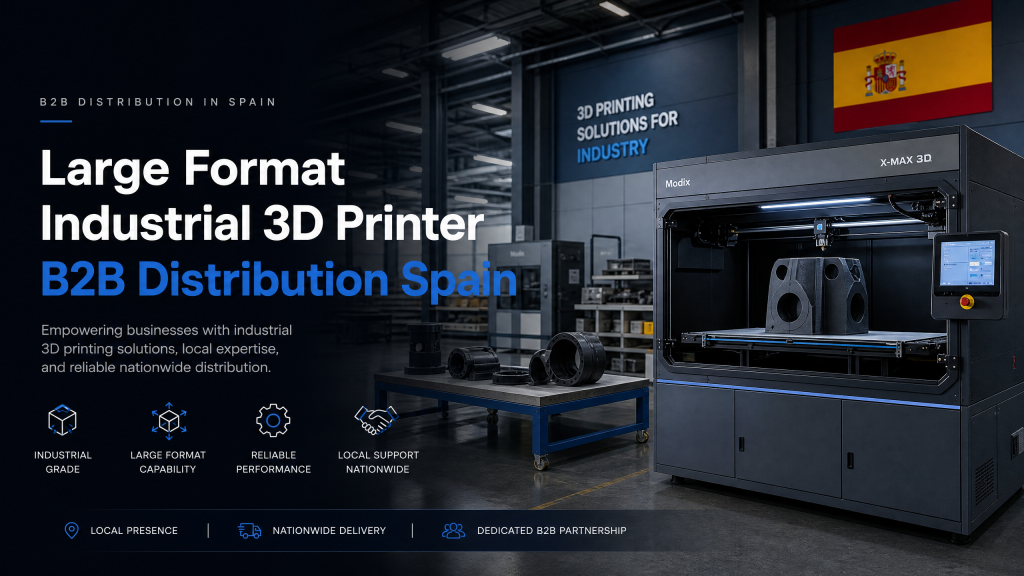
Spain’s Industrial 3D Printing Sector Is Growing—But Distribution Logistics Remain a Critical Bottleneck
The European industrial 3D printing market reached €2.47 billion in 2023, with Spain representing one of the fastest-growing regional hubs for manufacturing adoption. Yet despite this growth, fewer than 12% of European industrial 3D printer startups have established reliable B2B distribution networks into the Spanish manufacturing sector. The core issue: large-format industrial 3D printers—machines weighing 2–8 tons, requiring climate-controlled transport, specialized installation, and post-sale technical support—demand logistics expertise that generic courier networks simply cannot provide.
For hardware startups manufacturing metal and polymer 3D printers, getting your product into the hands of Spanish manufacturers, automotive suppliers, and aerospace fabricators requires more than a shipping label. It demands a partner who understands the unique regulatory, technical, and operational demands of industrial equipment distribution across southern Europe.
This article explores how industrial 3D printing companies can successfully distribute large-format printers to B2B clients across Spain, the logistics infrastructure required, and why specialized partners like Solavance have become essential to scaling this niche market.
The Market Opportunity: Why Spanish Manufacturers Are Investing in Large-Format 3D Printing
Spain’s manufacturing base—particularly in Catalonia, the Basque Country, and Andalusia—is increasingly turning to additive manufacturing to solve three critical business problems:
- Rapid prototyping cycles: Automotive and aerospace suppliers need to reduce time-to-market for custom components from weeks to days.
- On-demand production: Spare parts manufacturing for industrial equipment no longer requires long production runs, reducing inventory costs.
- Complex geometry manufacturing: Lattice structures, internal cooling channels, and topology-optimized designs are impossible with traditional subtractive machining.
Large-format industrial 3D printers—specifically metal laser sintering (DMLS), electron beam melting (EBM), and fused deposition modeling (FDM) systems with build chambers exceeding 400mm × 400mm—address these needs directly. Companies like EOS, 3D Systems, and Stratasys dominate the premium segment, but European startups are rapidly gaining market share with specialized solutions targeting specific verticals (aerospace fasteners, medical implants, custom tooling).
However, the distribution challenge remains acute. A large-format industrial 3D printer is not a desktop device you can drop-ship via parcel courier. It’s a precision instrument requiring:
- Climate-controlled transport (18–22°C, 40–60% humidity for many systems)
- Shock-dampening and vibration isolation during transit
- Specialized installation and calibration on-site
- Regulatory compliance for electrical equipment (CE marking, machinery directives)
- Post-delivery technical support and training
This is where most startups stumble. They build excellent machines but lack the logistics infrastructure to deliver them reliably.
Understanding the B2B Distribution Landscape for Industrial 3D Printers in Spain
The Traditional OEM Distribution Model vs. Direct-to-End-User Models
Established 3D printer manufacturers (EOS, Stratasys, 3D Systems) typically use a hybrid distribution approach:
- Authorized reseller networks: Regional distributors handle sales, demos, and after-sales support.
- Direct sales teams: For enterprise accounts, manufacturers maintain direct relationships.
- Service and logistics partners: Third-party logistics companies handle transport and installation.
For startups, this traditional model is expensive and slow. Building a reseller network requires 18–24 months of relationship development and margin negotiation. Instead, many European industrial 3D printing startups are adopting a direct-to-end-user model, where they control the entire customer relationship—including logistics.
This approach offers several advantages:
- Higher gross margins (no reseller markup)
- Direct customer feedback for product iteration
- Control over brand positioning and installation quality
- Faster market entry into new regions
The trade-off is operational complexity. Startups must either build their own logistics capability or partner with specialized providers who understand industrial equipment distribution.
Key Regulatory and Compliance Requirements
Any industrial 3D printer sold in Spain or the EU must comply with:
- CE Marking (Machinery Directive 2006/42/EC): Mandatory for all industrial machinery. Requires technical documentation, risk assessment, and declaration of conformity.
- Electrical Safety (Low Voltage Directive 2014/35/EU): All electrical components must meet safety standards.
- EMC Directive (2014/30/EU): Electromagnetic compatibility testing required.
- REACH Regulation: If your printer uses specific chemical materials (resins, powders), substance declarations are mandatory.
- Transport Regulations: If powders or resins are classified as hazardous, ADR (European Agreement concerning the International Carriage of Dangerous Goods by Road) compliance is required.
These aren’t abstract bureaucratic requirements—they directly impact logistics decisions. A printer containing hazardous materials requires certified hazmat transport. Missing a single compliance step can result in shipment delays, customer rejection, or regulatory fines.
The Logistics Infrastructure Required for Large-Format 3D Printer Distribution
Transport and Handling Specifications
Large-format industrial 3D printers fall into the “bulky, high-value, innovative hardware” category—exactly the niche Solavance specializes in serving. Here’s what the transport chain must include:
| Transport Parameter | Requirement | Impact on Logistics Partner |
|---|---|---|
| Weight per unit | 2–8 tons (typical for large-format systems) | Requires heavy-duty vehicles; cannot be combined with light parcels |
| Dimensions | 1.2m × 1.5m × 2.0m (typical for DMLS systems) | Custom crating required; standard pallets insufficient |
| Environmental control | 18–22°C, 40–60% humidity during transit | Climate-controlled vehicles or insulated containers mandatory |
| Vibration tolerance | <0.5G acceleration during transport | Shock-dampening suspension systems; careful route planning |
| Insurance value | €150,000–€800,000+ per unit | Specialized all-risk insurance; tracking and documentation critical |
| Delivery window | Typically 2–4 hours (customer availability) | Scheduled logistics; no standard “next-day” delivery |
Standard parcel couriers (DPD, GLS, DHL) cannot meet these specifications. You need a logistics partner with:
- Heavy-duty vehicles (18-ton trucks with air suspension)
- Climate control capability
- Specialized crating and packaging expertise
- Real-time GPS tracking
- Trained personnel for loading/unloading
- On-site installation coordination
Strategic Warehouse and Hub Positioning
For B2B 3D printer distribution into Spain and southern Europe, warehouse location is critical. Solavance’s hub in Córdoba, Andalusia, offers a strategic advantage often overlooked by startups:
- Central to Andalusia: Access to manufacturing clusters in Seville, Granada, and Málaga (automotive, aerospace, renewable energy)
- Gateway to Portugal: Portuguese manufacturing sector is rapidly adopting 3D printing; Córdoba is 4 hours from Lisbon
- Madrid corridor access: 2.5 hours north to Spain’s largest industrial concentration
- North African gateway: Proximity to Ceuta and Melilla enables distribution to Moroccan and Algerian manufacturers
- Mediterranean ports: Málaga and Almería ports (2–3 hours away) for international consolidation
This geographic positioning means a 3D printer stored at Solavance’s Córdoba warehouse can reach 80% of Spanish manufacturers within 24 hours and most of southern Europe within 48 hours—a critical factor for customers with tight production schedules.
Practical Distribution Strategy: From Startup to Scaled B2B Operations
Phase 1: Entry and Validation (Months 1–6)
When an industrial 3D printer startup first enters the Spanish market, the goal is to establish proof of concept with 5–10 initial customers. This phase requires flexibility, not scale.
Recommended approach:
- Partner with a specialized logistics provider (like Solavance) for individual shipments rather than committing to a dedicated warehouse
- Use a “hub and spoke” model: store demo units at the logistics partner’s facility; ship to customers on-demand
- Leverage the partner’s technical expertise to coordinate on-site installation and initial training
- Collect detailed feedback on customer pain points, installation challenges, and support requirements
Cost structure: €2,500–€4,500 per shipment (transport + handling + basic installation coordination) vs. €8,000–€12,000 if attempting in-house logistics.
Phase 2: Scaling and Consolidation (Months 6–18)
Once you’ve validated product-market fit and have 15–30 customers in Spain, consolidate your logistics operations:
- Dedicated warehouse space: Negotiate a dedicated bay at your logistics partner’s hub for inventory storage, pre-delivery testing, and crating
- Standardized delivery SLAs: Define consistent delivery windows, installation protocols, and post-delivery support procedures
- Bundled service packages: Combine transport, installation, training, and 30-day technical support into a single offering
- Regional distribution partnerships: Begin identifying potential resellers or integrators in adjacent markets (Portugal, France, Italy)
Cost structure: €1,200–€2,000 per shipment (economies of scale); warehouse fees approximately €800–€1,200/month for a dedicated bay.
Phase 3: Regional Expansion (18+ Months)
With an established operational footprint in Spain, expand into adjacent markets:
- Use Córdoba as a distribution hub for Portugal, southern France, and North Africa
- Establish secondary hubs in Madrid (for northern Spain, France, Central Europe) or Barcelona (for Mediterranean markets)
- Transition to a reseller-enabled model while maintaining direct relationships with key accounts
- Implement inventory management software (see below) to optimize stock levels across hubs
Technology and Tools for Managing Industrial 3D Printer B2B Distribution
Beyond physical logistics, successful distribution requires digital infrastructure. Here are the key tools and platforms used by leading industrial hardware distributors:
Inventory and Order Management
TraceLink (formerly Agile Software): Supply chain visibility platform used by major industrial equipment manufacturers. Integrates with ERP systems to track inventory across multiple hubs, manage serial numbers, and automate compliance documentation. Cost: €5,000–€15,000/month depending on transaction volume.
Kinaxis RapidResponse: Demand planning and supply chain orchestration tool. Particularly useful for managing the long lead times typical in industrial 3D printer manufacturing. Enables scenario modeling for different distribution scenarios.
Shopify Plus (with custom B2B extensions): While traditionally e-commerce focused, many industrial hardware startups use Shopify Plus as their B2B order management backbone, integrated with custom quoting engines and delivery scheduling tools. Cost: €2,000–€5,000/month.
Compliance and Documentation
Dassault Systèmes 3DEXPERIENCE: PLM (Product Lifecycle Management) platform that manages CE marking documentation, technical files, and compliance records. Ensures every unit shipped includes proper documentation.
DocuSafe or similar compliance management systems: Centralize all regulatory documentation, certificates, and compliance records. Critical for audits and customer verification.
Logistics Optimization
Route4Me or Samsara: Real-time fleet management and route optimization. For a logistics partner like Solavance managing multiple 3D printer deliveries across Spain, these tools optimize delivery routes, reduce fuel costs, and provide customer tracking.
Comparative Analysis: In-House vs. Outsourced Logistics for Industrial 3D Printer Distribution
| Factor | In-House Logistics | Specialized Partner (e.g., Solavance) |
|---|---|---|
| Initial capital investment | €200,000–€500,000 (vehicles, warehouse, staff) | €0–€50,000 (partnership setup) |
| Monthly fixed costs | €15,000–€35,000 (salaries, maintenance, rent) | €2,000–€5,000 (hub fees, variable transport) |
| Cost per shipment | €1,500–€2,500 (at scale) | €1,200–€2,000 (volume discounts available) |
| Regulatory compliance expertise | Must hire or train internally | Built into partner’s operations |
| Geographic flexibility | Limited to your hub locations | Access to partner’s
 Uncategorized
Rehabilitation Exoskeletons and Robotic Therapy Platforms: B2B Distribution to Clinics in SpainRehabilitation Exoskeletons and Robotic Therapy Platforms: B2B Distribution to Clinics in Spain Rehabilitation Exoskeletons and Robotic Therapy Platforms: B2B Distribution to Clinics in Spain According  Uncategorized
Prefab CLT and Modular Housing Panels: B2B Logistics for Developers and Builders in SpainPrefab CLT and Modular Housing Panels: B2B Logistics for Developers and Builders in Spain Prefab CLT and Modular Housing Panels: B2B Logistics for Developers and  Uncategorized
Shallow Geothermal Systems for Residential Use: B2B Distribution to Installers in SpainShallow Geothermal Systems for Residential Use: B2B Distribution to Installers in Spain Shallow Geothermal Systems for Residential Use: B2B Distribution to Installers in Spain Spain’s  Uncategorized
Smart Autonomous Fridges for Offices and Hotels: B2B Distribution and Fulfillment in SpainThe Office Snacking Crisis: Why Smart Autonomous Fridges Are Becoming Essential B2B Infrastructure Spanish companies lose an estimated €2.1 billion annually to employee downtime related  Uncategorized
Smart IoT Vending Machines with Cashless Payment: B2B Distribution to Companies and Hospitals in SpainCashless Vending Machines Are Becoming Standard Infrastructure—But Distribution Remains a Bottleneck Spain’s cashless vending machine market is projected to grow at 18.3% annually through 2027,  Uncategorized
In-Situ Plastic Recycling Machines for Factories: B2B Distribution in SpainSpain’s Factories Are Drowning in Plastic Waste—But Only 29% Recycle On-Site According to a 2023 report by Spain’s Ministry of Ecological Transition, industrial facilities across  |