Introduction: Simplifying EU VAT for Amazon Sellers with the One-Stop Shop (OSS)
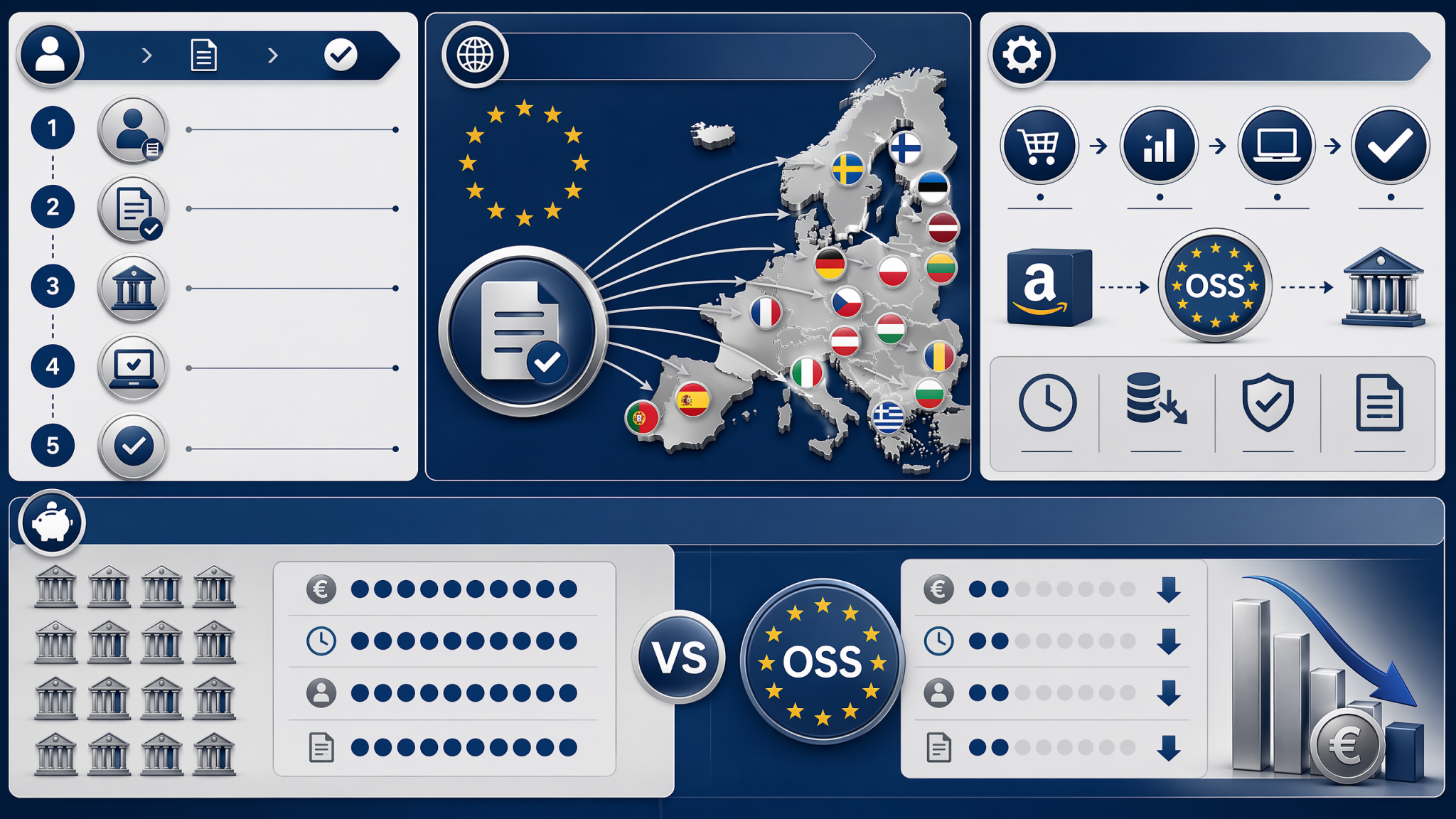
The intricate world of cross-border e-commerce within the European Union has been significantly reshaped by the introduction of the One-Stop Shop (OSS) scheme in July 2021. This pivotal initiative was designed to streamline Value Added Tax (VAT) obligations for businesses engaged in selling goods and services to consumers across EU member states, offering a much-needed simplification to VAT compliance. For Amazon sellers, who have historically grappled with the complexities of EU VAT, often necessitating multiple VAT registrations in various countries, the OSS one stop shop Amazon sellers VAT EU presents a potential solution to alleviate this administrative burden. However, its implementation and the benefits it confers are not uniformly straightforward, particularly for those leveraging sophisticated fulfillment programs like Amazon FBA.
This comprehensive guide is meticulously crafted for professional e-commerce entrepreneurs in 2026, aiming to demystify the intricacies of the EU OSS VAT Amazon FBA. We will meticulously explain the operational mechanics of the scheme, delineate its various components, identify who stands to benefit most, and critically examine its inherent limitations. Furthermore, we will explore the nuanced landscape of one stop shop ecommerce Europe, drawing clear distinctions between OSS vs VAT registration Amazon, and furnish actionable insights to ensure robust compliance and optimized VAT processes for your business.
The Three Pillars of the OSS Framework: Tailored Solutions for Diverse Sellers
The OSS framework is intelligently structured around three distinct schemes, each meticulously designed to cater to varying types of sellers and transactional scenarios:
1. The Union Scheme: The Cornerstone for EU-Established Businesses
This scheme represents the most frequently utilized component of the OSS for businesses firmly established within the European Union. It encompasses:
- Eligibility: Primarily for businesses established in an EU member state, and non-EU businesses that maintain a fixed establishment within the EU.
- Scope: Covers intra-EU distance sales of goods (i.e., goods dispatched from one EU country and transported to B2C customers in another EU country) and B2C services rendered by EU-established businesses.
- Registration: Businesses are required to register in the EU country where their primary establishment is located.
- Filing Requirements: Quarterly returns are submitted via the MSI portal, complementing regular domestic VAT returns for local sales.
2. The Non-Union Scheme: Facilitating Non-EU Service Providers
This scheme, an evolution of the erstwhile Mini One Stop Shop (MOSS), is specifically tailored for businesses that do not possess an establishment within the EU.
- Eligibility: Designed for businesses lacking any form of establishment (including a fixed establishment) within the EU.
- Scope: Encompasses B2C services supplied by non-EU businesses to EU customers (e.g., digital services, consulting, SaaS subscriptions, e-books, professional services).
- Registration: Non-EU businesses have the prerogative to select any EU member state as their MSI. Many U.S.-based sellers, for instance, strategically choose countries with English-language portals, such as Ireland, to simplify the registration process.
- Filing Requirements: Quarterly returns are mandatory, even in periods where no eligible sales have transpired.
3. The Import One-Stop Shop (IOSS) Scheme: Streamlining Imports of Low-Value Goods
The IOSS scheme was a novel introduction, specifically addressing distance sales of low-value goods imported into the EU from territories outside the EU. For more details, see our guide on selling across Europe from a single warehouse.
- Eligibility: Applicable to both EU and non-EU companies engaged in B2C distance sales of goods imported into the EU from outside its customs territory. Non-EU businesses are typically required to appoint an EU-established intermediary to facilitate their participation.
- Scope: Pertains to low-value goods (consignments with an intrinsic value of €150 or less) imported from outside the EU. Its primary function is to enable VAT collection at the point of sale, thereby circumventing the need for VAT payment at the point of import.
- Registration: Businesses can designate any EU member state as their MSI.
- Filing Requirements: Monthly returns are required, with payments due by the end of the month following the reporting period.
OSS for Amazon Sellers: Unpacking the Benefits and Navigating the Limitations

For a substantial number of Amazon sellers, the OSS scheme represents a pivotal opportunity to significantly simplify their VAT compliance obligations. The paramount advantage lies in its capacity to consolidate VAT reporting for cross-border B2C sales into a singular return, effectively eliminating the cumbersome requirement for multiple VAT registrations across the EU. This is particularly advantageous for sellers who exclusively ship directly from a single home country warehouse to customers dispersed across various EU member states.
However, the efficacy and applicability of the OSS scheme for Amazon sellers, especially those who strategically leverage Amazon FBA (Fulfillment by Amazon) programs, are not devoid of complexities and inherent limitations. A thorough understanding of these nuances is absolutely critical for ensuring robust compliance and avoiding potential pitfalls.
When OSS is Most Advantageous for Amazon Sellers
- Direct Shipping from a Single EU Country: If an Amazon seller centralizes all their inventory in one EU country (e.g., their country of establishment) and dispatches goods directly to consumers in other EU member states, the Union OSS scheme can dramatically simplify VAT reporting once the €10,000 aggregate threshold is surpassed. This scenario perfectly aligns with the scheme’s core objective of reducing administrative burden for one stop shop ecommerce Europe.
- Selling Digital Services: For Amazon sellers offering digital products or services to EU consumers, both the Non-Union scheme (for non-EU sellers) and the Union scheme (for EU sellers) provide an efficient mechanism to streamline VAT compliance, ensuring that the correct VAT is collected and remitted.
- Non-EU Sellers of Low-Value Goods: Non-EU Amazon sellers importing low-value goods (under €150) into the EU can strategically utilize the IOSS. This allows them to collect VAT at the point of sale, thereby preventing unexpected charges for customers upon delivery and potentially accelerating customs clearance processes, enhancing customer satisfaction.
When OSS Doesn’t Eliminate All VAT Obligations: The Critical Distinctions
Despite its nomenclature, the One-Stop Shop does not serve as a universal panacea, completely eradicating all VAT registration requirements for Amazon sellers. This is a prevalent misconception, particularly among those actively engaged in Amazon FBA programs. Understanding the distinction between OSS vs VAT registration Amazon is paramount.
Amazon FBA and Multi-Country Warehousing: A Persistent Need for Local VAT
One of the most significant limitations of the OSS for Amazon sellers emerges when they opt to store goods in multiple EU countries. Participation in programs such as Amazon’s Pan-European FBA inevitably leads to the distribution of your inventory across various Amazon warehouses situated in different EU member states (e.g., Germany, France, Italy, Spain, Poland, Czech Republic). In such instances, the physical presence of your goods within a particular country unequivocally triggers a local VAT registration requirement in each of those countries. This obligation persists irrespective of your participation in the OSS scheme. For more details, see our guide on sole trader vs limited company Spain Amazon seller tax.
The OSS is exclusively designed to cover distance sales where goods are dispatched from one EU country and subsequently transported to another. It explicitly does not negate the fundamental requirement to register for VAT in countries where you physically hold inventory. Consequently, an Amazon FBA seller utilizing Pan-EU FBA would still be compelled to register for VAT in every country where Amazon stores their products. While cross-border sales originating from these warehouses to other EU countries can indeed be reported via OSS, domestic sales occurring within the country where the warehouse is located, or the intricate movements of goods between warehouses, continue to necessitate adherence to local VAT compliance and reporting protocols.
Business-to-Business (B2B) Sales: Outside the OSS Scope
The OSS scheme is unequivocally and exclusively designed for Business-to-Consumer (B2C) transactions. It holds no applicability for B2B sales. For B2B transactions conducted within the EU, the reverse charge mechanism typically comes into play. This implies that if you sell to a VAT-registered business in another EU member state, the onus of the VAT obligation shifts to the buyer, who is then responsible for accounting for both the input and output VAT. These specific transactions are not to be reported through the OSS.
Domestic Sales: Local Reporting Remains
Sales executed to customers within the same country where your business is established, or where your goods are physically stored, are categorized as domestic sales. These sales must be meticulously reported on your local VAT return and are not eligible for reporting through the OSS. The OSS is, by its very definition, intended solely for cross-border transactions.
Registering for the OSS Scheme: A Step-by-Step Guide
The registration process for the One-Stop Shop is meticulously managed through your designated Member State of Identification (MSI). The specific parameters governing your choice of MSI are contingent upon your business’s establishment status:
- EU-Established Businesses: If your business is formally established in an EU member state, your MSI will typically be the country where your headquarters is situated. In scenarios involving multiple fixed establishments, you are permitted to select one, with the understanding that this selection becomes binding for the current calendar year plus the two subsequent calendar years.
- Non-EU Businesses (Non-Union Scheme): For businesses that do not possess a fixed establishment within the EU, the flexibility exists to select any EU member state as their MSI. This chosen state will then issue a VAT number specifically designated for the OSS scheme.
- Non-EU Businesses (Import Scheme – IOSS): In the context of the IOSS, non-EU businesses may be required to appoint an EU-established intermediary to facilitate their registration and manage their VAT obligations. Registration can then be completed in any member state where your chosen intermediary is established.
It is highly advisable to complete your registration prior to commencing any taxable cross-border sales. Registration typically becomes effective from the first day of the calendar quarter immediately following your registration date. For example, if you complete your registration in March, your eligibility for OSS participation would officially commence on April 1st. Should you inadvertently make a qualifying sale before registering, there may be provisions for retroactive registration, provided you promptly notify your MSI. For more details, see our guide on VAT accounting Pan-European Amazon sellers multiple countries.
Important Note: Once you successfully register for the OSS, you are legally obligated to utilize the scheme for all qualifying supplies across all relevant EU member states. It operates on an “all-or-nothing” basis; you do not have the discretion to selectively apply OSS for certain countries while excluding others.
Filing, Deadlines, and Meticulous Record-Keeping: Ensuring Ongoing Compliance
For both the Union and Non-Union schemes, OSS returns are mandated on a quarterly basis, with the submission deadline set for the end of the month immediately following the conclusion of each quarter. For instance, the return for the first quarter (January to March) is due by April 30th. It is imperative to understand that returns must be filed even if your qualifying sales for that particular period amounted to zero. Furthermore, payments must be remitted concurrently with the filing of the return. Failure to make timely payments can result in punitive measures, including penalties or even expulsion from the OSS scheme. For more details, see our guide on VAT cross-border ecommerce Europe guide.
In the case of the IOSS scheme, returns are filed monthly, and payments are due by the end of the month following the reporting period. According to Eurostat logistics data, these strategies are increasingly important.
Meticulous record-keeping constitutes another critical facet of OSS compliance. Businesses are legally required to maintain detailed records of all transactions declared under the OSS scheme for a substantial period of ten years. These records must be readily accessible in an electronic format and made available upon request by the tax authorities of either the MSI or the member state of consumption. For more details, see our guide on Amazon Pan-European program VAT multiple warehouses worth it. For more details, see our guide on Amazon selling models: Vendor vs Seller Central. For more details, see our guide on importing to Europe and surviving tariff increases.
Conclusion: Navigating EU VAT as an Amazon Seller in a Dynamic Landscape
The One-Stop Shop (OSS) scheme unequivocally represents a monumental leap forward in simplifying VAT compliance for cross-border e-commerce within the European Union. For Amazon sellers, particularly those who operate by shipping directly from a single EU country, or non-EU sellers specializing in digital services or low-value goods, the OSS offers the profound advantage of drastically reducing administrative burdens and significantly streamlining operational processes.
However, it is absolutely imperative to acknowledge that the OSS is not a universal remedy for all VAT complexities. For sellers who strategically utilize Amazon FBA and consequently store inventory across multiple EU countries, the necessity for local VAT registrations remains an undeniable reality. The intricate interplay between OSS and existing local VAT obligations demands astute management and a crystal-clear comprehension of the prevailing regulations.
As the e-commerce landscape continues its relentless evolution, staying abreast of the latest VAT regulations is paramount for discerning professional entrepreneurs. By thoroughly understanding the nuances of the OSS scheme, discerning its multifaceted benefits, and recognizing its inherent limitations, Amazon sellers can proactively ensure unwavering compliance, strategically optimize their tax approaches, and confidently propel the growth of their cross-border business ventures within the dynamic EU market. According to Amazon Seller Central guidelines, these strategies are increasingly important.