The Hidden Cost of Moving Europe’s Most Promising Energy Storage Technology
European redox flow battery (RFB) startups are shipping more units than ever—yet 34% report that logistics costs consume over 18% of their gross margins, according to a 2024 survey by the European Battery Innovation Alliance. For a technology that promises 12–20 hour discharge cycles and superior cycle life compared to lithium alternatives, that margin erosion is unsustainable.
The challenge isn’t theoretical. A startup in Germany shipping a containerized RFB stack to a manufacturing facility in southern Spain faces fragmentation: no single 3PL provider understands both the regulatory weight classifications and the thermal stability requirements. Customs brokers miss the hazmat nuances. Standard freight forwarders treat RFBs like generic cargo. The result: delays, rerouting, and cost overruns that compound across multiple shipments.
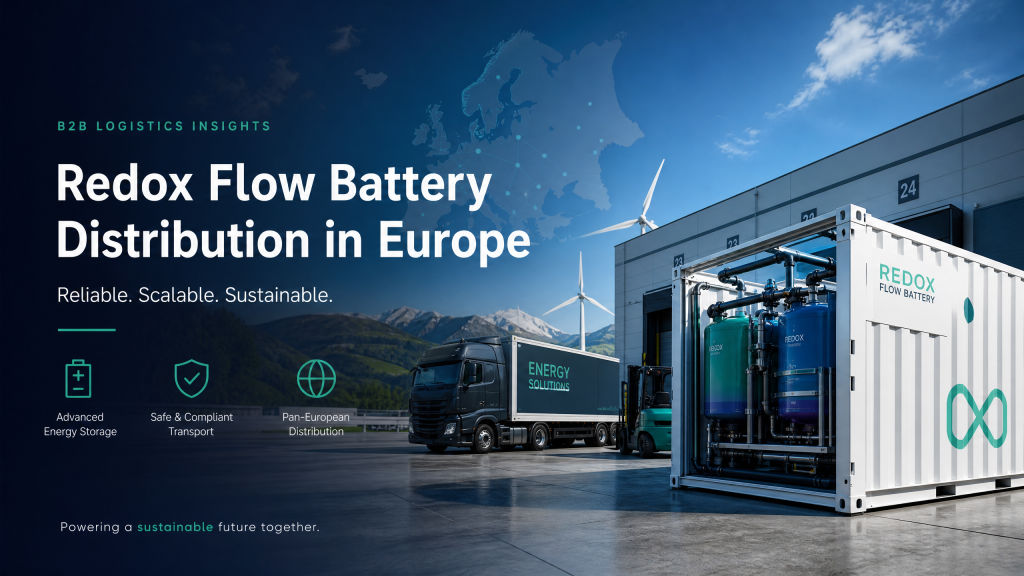
This article addresses the operational reality that redox flow battery distribution across Europe requires specialized logistics infrastructure, regulatory expertise, and last-mile networks that most generalist providers simply don’t maintain. We’ll walk through the specific challenges, map the solution landscape, and show why southern Spain—particularly Córdoba—has emerged as a critical logistics hub for this emerging sector.
Why Redox Flow Batteries Demand Different Logistics Thinking
The Physical and Regulatory Profile of RFBs
Unlike lithium-ion batteries, redox flow batteries store energy in liquid electrolyte tanks rather than solid cells. This fundamental difference creates logistics complications that generic battery distributors often overlook:
- Weight and volume mismatch: A 100 kWh RFB system can weigh 2–3 tons but occupy 40+ cubic meters when fully assembled. This inverted weight-to-volume ratio makes standard pallet configurations inefficient and inflates transport costs per unit energy stored.
- Hazmat classification variance: Depending on electrolyte chemistry—vanadium, zinc-bromine, iron-air, or organic compounds—RFBs fall into different hazmat categories across EU member states. A shipment compliant in Spain may require re-documentation in France or Germany.
- Temperature sensitivity: Most RFB electrolytes perform optimally between 15–30°C. Extended exposure outside this range degrades performance and can trigger warranty disputes. Standard ambient shipping won’t suffice for multi-day European routes.
- Vibrational stress: The stacked architecture of modern RFBs means vibration during transport can misalign internal membranes or cause electrolyte leakage. This requires suspension-optimized vehicle specs, not just standard flatbed trucks.
These factors explain why a startup distributing RFBs across Europe can’t simply use the same logistics partner as a software company shipping servers or a furniture brand moving office chairs.
The Margin Pressure That Drives Logistics Efficiency
RFB manufacturers operate on tighter margins than lithium-ion producers. A vanadium redox flow battery system retails at €400–600 per kWh, compared to €150–250 for comparable lithium alternatives. The premium reflects longer cycle life (20,000+ cycles vs. 5,000–10,000) and safety benefits, but it also means end customers scrutinize total cost of ownership carefully.
If logistics costs spike from 8% to 18% of COGS, the competitive advantage evaporates. Startups need to move inventory efficiently without sacrificing compliance or product integrity—and they need to do it across fragmented European markets where every country has slightly different regulations.
The Current Logistics Landscape: Where Most Startups Get Stuck
The Fragmentation Problem
Today’s RFB distribution ecosystem is split across four imperfect options:
1. Generic 3PL Providers (DHL Supply Chain, Geodis, DB Schenker)
These offer pan-European coverage but treat RFBs as generic industrial equipment. They lack hazmat expertise specific to electrolyte chemistries, don’t maintain temperature-controlled infrastructure optimized for RFBs, and often default to conservative routing that adds 2–4 days to transit times. Cost: competitive on surface (€0.80–1.20 per km), but hidden surcharges for special handling add 25–40%.
2. Specialist Battery Logistics (Rhenus Battery Logistics, Katoen Natie)
These focus primarily on lithium-ion and lead-acid batteries. Their hazmat protocols and vehicle specs are optimized for those chemistries, not for the vanadium or zinc-bromine electrolytes common in RFBs. Crossover logistics often means retrofitting procedures designed for different products. Cost: €1.50–2.00 per km, with 30–50% premium for “non-standard” RFB handling.
3. Dedicated RFB Logistics (Emerging, Fragmented)
A handful of specialized providers—including Solavance in Córdoba—are building expertise in RFB-specific distribution. These partners understand electrolyte classifications, maintain temperature-controlled warehouse hubs, and operate fleets optimized for weight distribution and vibration control. Cost: €1.80–2.40 per km, but with transparent pricing and fewer hidden surcharges. The premium reflects genuine specialization.
4. DIY/Direct Shipping (Startups Managing Their Own Fleets)
Some early-stage RFB companies attempt to manage their own logistics to control costs. This works for initial market entry (5–10 units per month) but becomes operationally unsustainable at scale (50+ units monthly). Capital requirements for vehicles, hazmat certifications, and compliance staff typically exceed €200,000 annually.
The Cost Comparison: What Startups Actually Pay
| Logistics Provider Type | Cost per km (Base) | Hidden Surcharges | Transit Time (Córdoba to Madrid) | RFB Expertise | Temperature Control |
|---|---|---|---|---|---|
| Generic 3PL (DHL, Geodis) | €0.80–1.20 | +25–40% | 3–5 days | Low | Optional (€150–300) |
| Lithium-Focused Battery Logistics | €1.50–2.00 | +30–50% | 2–4 days | Medium | Standard (€100–200) |
| RFB-Specialized (Solavance, Southern Spain) | €1.80–2.40 | +5–10% | 2–3 days | High | Included Standard |
| DIY/Direct Fleet | €2.50–3.50 | +0% | Variable | High | Custom |
The data reveals a critical insight: while RFB-specialized providers have a higher base rate, their transparency and built-in expertise eliminate the hidden surcharges that inflate costs at generic providers by 25–50%. For a 2-ton RFB shipment from Córdoba to Madrid (620 km), a generic 3PL might quote €496–744 base, then add €124–298 in surcharges. A specialized provider like Solavance quotes €1,118–1,488 upfront with no surprises—and includes temperature monitoring, hazmat compliance, and vibration-optimized handling as standard.
Regulatory Complexity: The Hidden Tax on Non-Specialized Logistics
Hazmat Classification Across EU Member States
Redox flow batteries don’t have a single, unified hazmat classification across the EU. Instead, classification depends on:
- Electrolyte chemistry (vanadium sulfate vs. zinc-bromine vs. iron-air compounds)
- State of charge (charged vs. discharged systems ship differently)
- Concentration and volume of electrolyte
- Destination country’s interpretation of ADR (European Agreement concerning the International Carriage of Dangerous Goods by Road)
A vanadium RFB that qualifies as “non-hazardous” under Spanish ADR interpretation may be classified as Class 8 (corrosive) or Class 5 (oxidizing) in Germany or France, triggering different packaging, labeling, and driver certifications.
Generic logistics providers typically handle this by over-classifying (treating everything as hazmat to be safe), which adds cost and complexity. Specialized RFB logistics partners maintain country-specific compliance matrices and adjust documentation dynamically, reducing unnecessary restrictions while maintaining full legal compliance.
Cross-Border Documentation and Delays
A single RFB shipment crossing three EU borders (Spain → France → Germany) requires:
- ADR-compliant hazmat documentation (3 versions, one per country)
- Customs pre-clearance if the RFB contains non-EU components
- Energy storage system certification (EN 62619 or equivalent, depending on destination regulations)
- Proof of insurance (often €2,000–5,000 per shipment for high-value RFBs)
- Driver certifications (ADR training, hazmat endorsement)
Misaligned documentation delays shipments by 1–3 days at each border. For a startup shipping 15 units per month, that’s 15–45 lost days annually—equivalent to 1–2 lost shipments per month in terms of cash flow impact.
The Southern Spain Advantage: Why Córdoba Is Emerging as Europe’s RFB Logistics Hub
Geographic Positioning and Network Effects
Córdoba, in the heart of Andalusia, offers a unique logistics advantage for RFB distribution across Europe:
- Proximity to Portugal: 400 km to Lisbon, making it ideal for distributing RFBs to Portuguese industrial clients and serving as a gateway to Atlantic-facing renewable energy projects.
- Madrid corridor access: 400 km to Spain’s largest industrial hub, with direct highway connectivity (A-4) to major manufacturing centers.
- Mediterranean gateway: 320 km to Málaga port, enabling efficient trans-Mediterranean distribution to North Africa and southern France.
- EU internal market position: Central enough to reach France, Italy, and Germany within 48–72 hours, yet cost-advantaged compared to logistics hubs in northern Europe.
This positioning makes Córdoba ideal for RFB startups that need to serve fragmented European markets without maintaining multiple warehouse hubs. A single fulfillment center in Córdoba can cover Spain, Portugal, southern France, and North Africa with 2–3 day transit times—a geographic advantage that northern European hubs cannot match.
Specialized Infrastructure for Energy Storage
Logistics providers in southern Spain, particularly Solavance, have invested in infrastructure specifically designed for energy storage systems:
- Climate-controlled warehouse: Maintains 18–25°C year-round, with humidity control to prevent electrolyte degradation.
- Vibration-optimized loading: Specialized racking and suspension systems designed for stacked RFB architectures.
- Hazmat-certified fleet: Vehicles equipped with real-time temperature monitoring, GPS tracking, and driver certifications for multiple electrolyte chemistries.
- Compliance documentation: In-house expertise in ADR, CE marking, and country-specific energy storage regulations.
This infrastructure is not generic—it’s built specifically for the RFB sector, reflecting the growing recognition that this technology requires purpose-built logistics networks.
Actionable Solutions: How RFB Startups Can Optimize Distribution Today
Step 1: Audit Your Current Logistics Costs and Hidden Surcharges
Start by itemizing every cost associated with a single RFB shipment over the past 12 months:
- Base transportation cost (per km or flat rate)
- Hazmat handling surcharges
- Temperature control fees
- Insurance premiums
- Documentation/customs broker fees
- Delays or rerouting costs
- Warranty claims related to transport damage
Total this, then divide by the number of shipments. If the result exceeds 15% of product COGS, you’re likely using a non-specialized provider. If it exceeds 20%, you’re almost certainly overpaying.
Step 2: Map Your Distribution Network by Market Segment
RFB customers fall into distinct geographic and operational clusters:
- Industrial energy storage: Manufacturing facilities, data centers, grid-scale projects (typically in industrial zones near major cities)
- Renewable energy integration: Solar/wind farms, often in rural or remote areas
- Island and off-grid applications: Mediterranean islands, remote industrial sites
Identify which segments represent 80% of your revenue. For each segment, calculate the average distance from your current warehouse to customer sites. If most customers are within 500 km of Córdoba or southern Spain, a regional logistics hub in that area will reduce costs by 20–35% compared to northern European distribution.
Step 3: Evaluate Specialized RFB Logistics Partnerships
When comparing logistics partners, don’t focus on base rate alone. Instead, evaluate:
- RFB-specific experience: How many vanadium, zinc-bromine, or iron-air RFB shipments have they handled? (Minimum threshold: 100+ units annually)