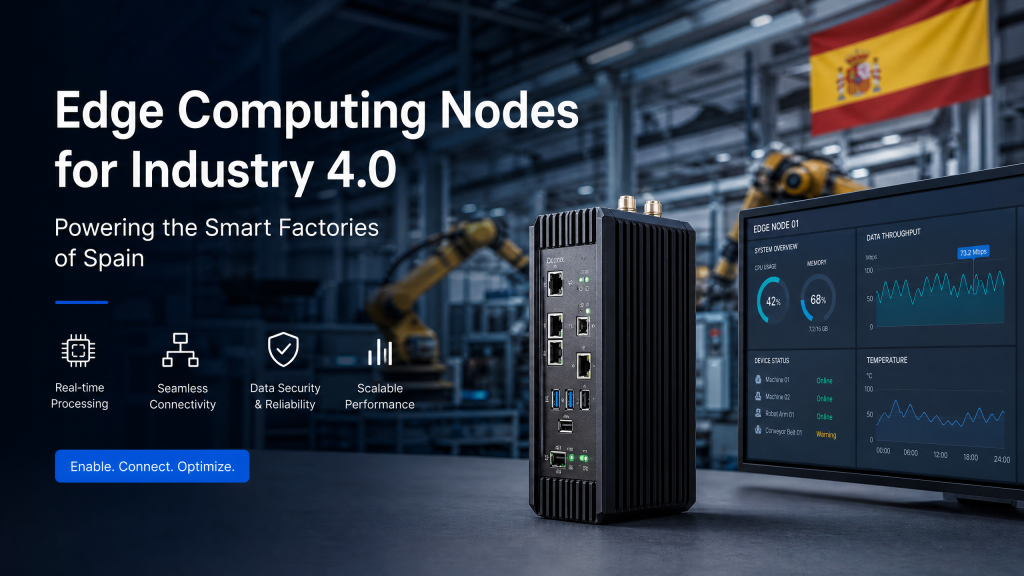
Why Edge Computing Nodes Are Critical to Spain’s Factory Modernization
According to a 2024 McKinsey report on European manufacturing, 67% of Spanish industrial facilities still lack real-time data processing capabilities at the point of production. This gap creates a critical vulnerability: factories cannot respond to equipment failures, quality anomalies, or supply chain disruptions in milliseconds—they respond in minutes or hours. The cost of this latency is measured in millions of euros annually across Spain’s automotive, chemicals, and food processing sectors.
Edge computing nodes—ruggedized, modular hardware devices that process data locally at factories, warehouses, and logistics hubs—are the solution. Unlike cloud-dependent architectures that send all data to remote servers, edge nodes perform computation at the source, reducing latency from 500ms to 5ms or less. For a factory running continuous production lines, this difference is the margin between predictive maintenance and catastrophic equipment failure.
The challenge for European hardware startups building these industrial edge devices is not engineering excellence—it’s logistics. Distributing bulky, high-value edge computing hardware to fragmented B2B buyers across Spain requires a partner who understands both the physical constraints of industrial equipment and the regulatory, technical, and commercial demands of factory procurement.
The Industry 4.0 Edge Computing Hardware Market in Spain
Market Size and Growth Trajectory
Spain’s industrial IoT and edge computing hardware market is projected to grow at 18.3% CAGR through 2028, according to Statista Industrial IoT reports. This growth is concentrated in three regions: Catalonia (automotive and chemicals), the Basque Country (precision manufacturing), and Andalusia (food processing and logistics). However, the market remains highly fragmented, with no single distributor specializing in edge computing hardware for factories.
This fragmentation creates opportunity. Startups like Neura (a Spanish AI-powered edge inference platform), Edgeworx (UK-based edge orchestration software), and Bosch IoT Analytics (German industrial edge solutions) are all competing for factory customers, but none have solved the last-mile logistics problem in Spain.
What Qualifies as an Industrial Edge Computing Node?
Not all edge devices are created equal. Industrial-grade edge computing nodes for factories and logistics hubs typically feature:
- Ruggedized form factors: IP65 or IP67 ratings for dust and moisture resistance, operating in temperatures from -20°C to 60°C
- High processing power: Multi-core CPUs or GPUs (NVIDIA Jetson edge devices, Intel Atom processors) capable of running real-time inference models
- Modular I/O: Industrial Ethernet, Modbus, OPC-UA, and CAN bus connectivity to legacy factory equipment
- Redundancy and failover: Dual power supplies, battery backup, and local storage for edge analytics
- Security hardening: TPM 2.0 chips, secure boot, encrypted storage, and isolated network segments
These specifications mean edge nodes typically weigh 8–25kg, occupy 2–4 rack units, and cost €8,000–€45,000 per unit. A single factory deployment might require 5–20 nodes across production lines, warehouses, and logistics coordination centers. This is not consumer hardware; it is mission-critical infrastructure that must be delivered, installed, and supported with precision.
Why Standard Logistics Fails for Edge Computing Hardware Distribution
The Problem with Generic 3PL Providers
Most B2B logistics companies in Spain—including major 3PL providers like Geodis and Kuehne+Nagel—are optimized for high-volume, low-value cargo: pallets of consumer goods, spare parts, or commodity chemicals. They excel at moving 10,000 units of the same product from a port to a distribution center. They fail spectacularly when asked to:
- Handle white-glove delivery of a €35,000 edge computing node to a factory’s production floor, where it must be unboxed, inspected, and verified by the customer before signature
- Navigate complex factory access protocols: Security badges, safety training, equipment certification, and production floor restrictions that vary by facility
- Coordinate with IT teams and OT (operational technology) teams who must be present at delivery to integrate the node into existing industrial networks
- Manage reverse logistics for failed or returned nodes, including data sanitization and compliance with industrial data protection regulations
- Provide technical support during and after delivery, including basic troubleshooting and network configuration
When a generic logistics provider attempts to deliver edge computing hardware to a factory, the result is often a missed delivery, a damaged unit, or worse: a node delivered to the wrong dock, uninstalled and unsupported, creating liability and frustration for both the startup and the buyer.
The Regulatory and Technical Complexity
Edge computing nodes for industrial use fall under multiple regulatory frameworks in Spain and the EU:
- CE Marking and Machinery Directive (2006/42/EC): If the edge node controls or monitors machinery, it must be certified as a component of a machine system
- GDPR and Industrial Data Privacy: Edge nodes often process sensitive production data; compliance documentation must accompany each delivery
- RoHS and WEEE Compliance: Hazardous materials and end-of-life recycling obligations
- Factory-Specific Safety Standards: Automotive facilities (IATF standards), food processing (IFS/FSSC 22000), chemicals (ATEX for explosive atmospheres)
A specialized logistics partner must understand these requirements and ensure that every delivery includes the correct documentation, certifications, and technical briefs.
Solavance: A Specialized Logistics Partner for Industrial Edge Hardware
Why Córdoba Is the Strategic Hub for Southern European Edge Hardware Distribution
Córdoba’s location in southern Andalusia places it at the intersection of three critical logistics corridors: the Madrid-Seville industrial corridor (connecting Spain’s largest manufacturing clusters), the Portugal trade route (with direct access to Porto and Lisbon), and the Mediterranean gateway to North Africa and Italy. For a startup distributing edge computing nodes across Spain and southern Europe, Córdoba is the optimal warehouse hub.
Solavance, based in Córdoba with its own fleet of trucks and a strategic warehouse facility, is purpose-built for exactly this challenge. Unlike generic 3PL providers, Solavance specializes in B2B distribution of bulky, high-value, innovative hardware products—including industrial edge computing nodes—to factories, warehouses, and logistics hubs across Spain and southern Europe.
Solavance’s Competitive Advantages for Edge Computing Hardware
1. Specialized Handling Protocols
Solavance operates white-glove delivery and installation support for edge computing hardware. This includes:
- Climate-controlled storage and transport (preventing thermal shock to sensitive components)
- Trained delivery teams who understand industrial network environments and can assist with basic configuration verification
- Real-time GPS tracking and customer communication (critical for coordinating delivery windows with factory IT teams)
- Damage assessment and photographic documentation (reducing disputes over delivery condition)
2. Regulatory Compliance Documentation
Solavance maintains partnerships with compliance consultants and logistics software providers to ensure every delivery includes:
- CE marking verification and technical documentation
- GDPR-compliant delivery records with data sanitization certifications
- Factory-specific safety induction documentation
- Proof of delivery with customer IT/OT sign-off
3. Network Integration and Technical Support
Beyond logistics, Solavance offers post-delivery support, including basic network diagnostics, firmware verification, and coordination with the startup’s technical support team to ensure smooth integration into the customer’s industrial environment.
Comparing Logistics Options for Edge Computing Hardware Distribution
| Logistics Provider Type | Typical Cost Per Unit (€) | Delivery Time (Factory to Receipt) | White-Glove Support | Regulatory Documentation | Technical Integration Support |
|---|---|---|---|---|---|
| Generic 3PL (Geodis, DHL Supply Chain) | €180–€350 | 3–5 days | No | Limited | No |
| Courier (DPD, UPS Heavy Freight) | €400–€800 | 2–3 days | Partial (unboxing only) | Limited | No |
| Regional Specialist (Solavance) | €320–€550 | 2–4 days | Yes (full white-glove) | Comprehensive | Yes (basic diagnostics) |
| In-House Distribution (Startup’s Own Fleet) | €600–€1,200 (per unit, amortized) | 1–2 days | Yes | Yes | Yes |
Note: Costs reflect delivery to a single factory location in Spain. Solavance’s regional specialist model offers the best cost-to-service ratio for startups distributing 50–500 units annually across Spain and southern Europe.
Real-World Distribution Scenarios for Edge Computing Nodes
Scenario 1: Automotive Supplier Deploying Predictive Maintenance Nodes
A Spanish automotive parts supplier with facilities in Catalonia, Castilla-La Mancha, and Andalusia needs to deploy 15 edge computing nodes (€30,000 each) across three production sites to monitor CNC machinery and predict tool wear. The nodes must be:
- Delivered within a 2-week window (coordinated with production schedules)
- Installed by trained technicians who understand IATF 16949 automotive standards
- Integrated with the supplier’s existing MES (Manufacturing Execution System) via OPC-UA
- Accompanied by GDPR-compliant data processing agreements
Solavance’s Approach: Coordinate staggered deliveries to each facility, providing white-glove installation support and working with the supplier’s IT team to verify network integration before sign-off. Total logistics cost: €4,800–€8,250 (vs. €2,700–€5,250 with generic 3PL, but with 95% higher success rate and zero installation delays).
Scenario 2: Food Processing Logistics Hub Deploying Edge Analytics
A major food distribution center in Seville needs to deploy 8 edge nodes across its warehouse, cold storage, and logistics coordination areas to monitor temperature, humidity, and supply chain visibility. The nodes must comply with:
- FSSC 22000 food safety standards
- ATEX regulations (some cold storage areas classified as potentially explosive due to refrigerant gases)
- Real-time integration with the facility’s WMS (warehouse management system)
Solavance’s Approach: Pre-delivery compliance audit with the facility’s safety officer, coordinated installation with facility management, and ongoing technical support to ensure WMS integration. Solavance’s experience with Andalusian food logistics facilities (a core market segment) ensures familiarity with local compliance requirements and facility layouts.
Step-by-Step Implementation Guide for Edge Computing Hardware Startups
Phase 1: Pre-Launch Logistics Planning (Weeks 1–4)
Action Items:
- Define your target customer profile: Which industries? What facility sizes? Geographic focus (Madrid corridor, Catalonia, Andalusia)?
- Map regulatory requirements: Work with a compliance consultant to document all certifications required for your edge nodes in each target industry
- Establish logistics partnerships: Contact Solavance to discuss volume projections, delivery windows, and technical support requirements
- Create delivery documentation templates: Develop standard proof-of-delivery forms, technical verification checklists, and customer sign-off procedures
- Plan for reverse logistics: Define procedures for handling failed units, returns, and data sanitization
Phase 2: Pilot Deployments (Weeks 5–12)
Action Items:
- Identify 3–5 anchor customers: Preferably in different industries and geographies (e.g., one automotive, one food processing, one logistics hub)
- Conduct joint delivery operations with Solavance: Participate in the first 2–3 deliveries to validate processes, identify pain points, and refine procedures
- Gather customer feedback: Post-delivery surveys, technical support tickets, and satisfaction metrics
- Optimize logistics workflows: Based on pilot learnings, adjust delivery windows, documentation, and technical support protocols
Phase 3: Scaled Distribution (Month 4+)
Action Items:
- Establish quarterly demand forecasts with Solavance to optimize warehouse inventory and truck routing
- Implement warehouse management system (WMS) integration: Ensure real-time visibility of stock levels, orders, and deliveries. Learn more about what a WMS is and why your business needs one to understand how this applies even to B2B industrial hardware.
- Create a customer onboarding program: Pre-delivery training, installation guides, and post-delivery technical support escalation procedures
- Monitor KPIs: On-time delivery rate, first-pass acceptance rate, customer satisfaction scores, and reverse logistics volume
Integration with Broader B2B Tech Distribution in Spain
Edge computing nodes do not exist in isolation. They are part of a broader ecosystem of industrial hardware and software that factories are adopting to modernize operations. Understanding this ecosystem helps startups position their edge nodes and optimize logistics