Spain’s Rural Connectivity Crisis: Why 5G Infrastructure Matters for B2B Growth
According to the Spanish National Markets and Competition Commission (CNMC), 23% of Spain’s rural municipalities still lack adequate 4G coverage, and 5G deployment remains concentrated in urban centers. This creates a paradox: while European tech startups innovate at record pace, the infrastructure to connect them to rural B2B clients—municipalities, industrial zones, agricultural cooperatives, and manufacturing hubs—remains fragmented and poorly served.
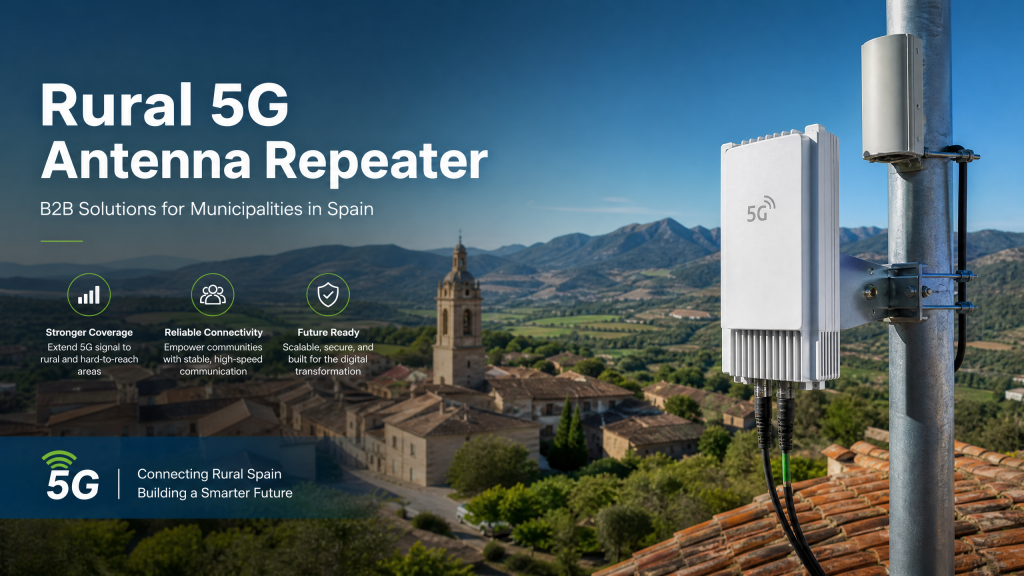
For connectivity hardware startups, this gap represents both a challenge and an opportunity. Rural municipalities across Andalusia, Castilla-La Mancha, and Extremadura are actively seeking 5G antenna and repeater solutions to bridge the digital divide, yet few logistics partners understand the specialized requirements of distributing bulky, high-value, mission-critical hardware to geographically dispersed B2B buyers.
This article explores how European connectivity startups can efficiently distribute 5G antennas and rural repeaters to municipalities and industrial zones across Spain using a strategic southern European logistics hub—and why Córdoba’s position as a distribution epicenter makes it the ideal launch pad for this niche market.
The Market Opportunity: 5G Infrastructure Demand in Rural Spain
Municipal and Industrial Demand for Rural 5G Connectivity
Spain’s rural regions are not waiting passively for private telecom operators to solve connectivity. Municipalities are investing directly in infrastructure through European Regional Development Fund (ERDF) grants and national digitalization programs. Industrial zones, logistics parks, and agri-tech clusters require reliable 5G connectivity to support IoT sensors, autonomous systems, and real-time data processing.
Key demand drivers include:
- Smart City Initiatives: Municipalities in Andalusia are deploying IoT networks for traffic management, environmental monitoring, and emergency services.
- Agricultural Digitalization: Farms and cooperatives need 5G repeaters to support precision agriculture systems and drone operations across dispersed land parcels.
- Industrial Zone Connectivity: Manufacturing clusters and logistics hubs require ultra-reliable low-latency communication (URLLC) for autonomous vehicles and real-time production monitoring.
- Cross-Border Infrastructure: Portugal and North African regions increasingly coordinate with Spanish municipalities on regional connectivity projects.
The European Commission’s Digital Europe Programme allocates €1 billion annually to rural broadband and 5G infrastructure, with Spain receiving substantial allocations. This creates a multi-year procurement cycle that favors specialized B2B distributors with deep municipal relationships and logistics expertise.
Why Startups Struggle with Rural 5G Distribution
Most European connectivity startups excel at product innovation but lack the infrastructure to reach fragmented B2B buyers in rural Spain. Challenges include:
- Geographic Dispersion: Rural municipalities are spread across hundreds of kilometers, making direct sales and delivery economically inefficient.
- Regulatory Complexity: 5G equipment must comply with Spanish telecommunications regulations, AEPD data protection standards, and municipal procurement laws.
- Installation Support: Antennas and repeaters require site surveys, technical documentation, and installation coordination—services that startups rarely provide in-house.
- Bulk Logistics: 5G hardware is bulky, fragile, and high-value, requiring specialized handling, insurance, and tracking.
- Payment Terms: B2B municipal buyers operate on 60–90 day payment cycles, straining startup cash flow.
These barriers explain why rural 5G deployment lags urban expansion—not due to lack of demand, but due to distribution inefficiency.
Strategic Distribution: How to Reach Spanish Municipalities and Industrial Zones
The Role of a Specialized B2B Logistics Hub
A specialized logistics partner serving the 5G antenna repeater rural B2B municipality Spain market must offer more than generic warehousing. The ideal partner combines:
- Geographic Centrality: A hub positioned to serve Andalusia, Extremadura, Castilla-La Mancha, and cross-border regions efficiently.
- Technical Expertise: Understanding of hardware specifications, compliance requirements, and installation workflows.
- Fleet Capability: Own trucks for specialized handling of bulky, high-value equipment.
- Municipal Network: Existing relationships with municipalities, procurement offices, and industrial park operators.
- Regulatory Knowledge: Familiarity with Spanish telecommunications law, AEPD compliance, and EU procurement directives.
Córdoba, located in central Andalusia with direct access to Madrid via the A-4 corridor, Portugal via the A-66, and North African ports via southern Mediterranean routes, offers strategic positioning for this exact market. A 5G hardware distributor based in Córdoba can reach 80% of Spain’s rural municipalities within 24–48 hours by road.
Solavance, a Córdoba-based B2B logistics specialist with its own fleet and warehouse hub, has developed exactly this capability. By partnering with connectivity startups, Solavance handles inventory management, compliance documentation, route optimization, and last-mile delivery to rural municipalities across southern Spain and Portugal.
Key Distribution Channels for Rural 5G Infrastructure
Successful 5G antenna and repeater distribution in rural Spain follows multiple channels:
Direct Municipal Sales: Municipalities issue public tenders for 5G infrastructure through official procurement portals (Plataforma de Contratación del Sector Público). Startups that partner with established distributors can bid competitively without maintaining their own sales team.
Industrial Zone Operators: Private industrial park management companies (e.g., AEPLA members) procure 5G infrastructure on behalf of tenant companies. A logistics partner with relationships in this segment can aggregate orders and optimize delivery routes.
Telecom Integrators and System Integrators: Companies like Telefónica Tech and smaller regional integrators subcontract hardware distribution to specialized partners. This channel reduces sales friction for startups without direct integrator relationships.
Agricultural Cooperatives and Agri-Tech Clusters: Rural cooperatives increasingly invest in shared 5G infrastructure to support precision farming. Cooperatives benefit from bulk purchasing and consolidated logistics.
Regional Development Agencies: Entities managing ERDF funds often coordinate procurement across multiple municipalities, creating opportunities for bulk orders and long-term framework agreements.
Compliance and Regulatory Requirements for 5G Hardware Distribution
Spanish and EU Telecommunications Standards
5G antennas and repeaters are subject to strict regulatory frameworks. A competent B2B logistics partner must ensure compliance at every step:
- CE Marking: All 5G equipment must bear CE marking, confirming compliance with the Radio Equipment Directive (RED 2014/53/EU).
- Spanish National Cybersecurity Scheme (SCNS): Critical infrastructure operators must use equipment from approved suppliers, verified through the National Cybersecurity Authority (CCN).
- AEPD Data Protection: 5G infrastructure handling personal data must comply with GDPR and Spain’s Organic Law on Data Protection (LOPDGDD).
- Technical Specifications: Equipment must meet AEPTEL (Spanish telecommunications authority) frequency allocation and power limits.
- Environmental Compliance: Waste electrical and electronic equipment (WEEE) directives require proper end-of-life handling and recycling documentation.
Startups shipping 5G hardware to Spain should verify that their logistics partner maintains updated compliance documentation, including certificates of conformity, technical datasheets, and WEEE registration. Solavance maintains a compliance database for all hardware it distributes, reducing risk for startups entering the Spanish market.
Municipal Procurement and Tender Requirements
Rural municipalities in Spain procure 5G infrastructure through formal tender processes governed by Law 9/2017 on Public Sector Contracts. Key requirements include:
- Tender Registration: All public contracts above €40,000 must be registered on the Plataforma de Contratación del Sector Público (national e-procurement portal).
- Technical Specifications: Tenders require detailed product specifications, compatibility certifications, and installation manuals in Spanish.
- Warranty and Support: Municipalities typically require 3–5 year warranties and on-site technical support availability.
- Insurance and Liability: Distributors must carry liability insurance covering equipment damage and installation defects.
- Payment Terms: Municipal budgets operate on annual cycles; payment typically occurs 60–90 days after invoice.
A specialized logistics partner serves as an intermediary, translating startup technical specifications into municipal procurement language and managing warranty/support coordination.
Comparative Analysis: Distribution Approaches for 5G Hardware Startups
The following table compares distribution strategies for connectivity startups entering the Spanish rural 5G market:
| Distribution Approach | Startup Investment | Time to Market | Geographic Coverage | Regulatory Complexity | Best For |
|---|---|---|---|---|---|
| Direct Sales + In-House Logistics | €150,000–€300,000 (warehouse, fleet, staff) | 6–12 months | Limited to startup base region | High (startup manages all compliance) | Startups with €2M+ annual revenue |
| Partnership with Specialized B2B Hub (e.g., Solavance) | €10,000–€30,000 (integration, initial inventory) | 4–8 weeks | Spain + Portugal + cross-border | Low (partner manages compliance) | Startups seeking rapid market entry |
| Telecom Integrator Reseller Network | €5,000–€15,000 (partner enablement) | 8–16 weeks | Dependent on integrator reach | Medium (shared responsibility) | Startups with strong product differentiation |
| Regional Distributor Agreement | €20,000–€50,000 (inventory commitment) | 12–20 weeks | Regional (e.g., Andalusia only) | Medium (distributor handles local compliance) | Startups targeting specific regions first |
| Direct Municipal Tender Response | €5,000–€10,000 (compliance documentation) | Varies by tender cycle (3–6 months) | Per-tender basis | High (startup manages each tender) | Startups with established municipal relationships |
For most European connectivity startups, partnership with a specialized B2B logistics hub like Solavance offers the optimal balance of speed, cost, and geographic reach. This approach allows startups to enter the Spanish market within weeks rather than months, with minimal upfront investment and full regulatory compliance handled by the logistics partner.
Practical Implementation: Steps to Launch 5G Distribution in Rural Spain
Phase 1: Product Qualification and Compliance (Weeks 1–4)
Action Items:
- Verify CE marking and RED compliance for all 5G hardware models.
- Obtain technical datasheets in Spanish and English, including frequency bands, power specifications, and installation requirements.
- Confirm WEEE registration with Spanish environmental authorities.
- Prepare product liability insurance documentation and warranty terms.
- Identify key product differentiators (e.g., coverage range, power efficiency, form factor) relevant to rural municipalities.
Partner Role: A logistics partner like Solavance validates compliance documentation and advises on municipal procurement requirements specific to your product category.
Phase 2: Logistics Partnership and Warehouse Integration (Weeks 4–8)
Action Items:
- Negotiate inventory management agreement with logistics partner, including storage, handling, and fulfillment rates.
- Establish SKU coding and inventory tracking systems aligned with partner’s warehouse management system (WMS).
- Arrange initial inventory shipment (typically 50–200 units for market entry).
- Define fulfillment workflows: order receipt, picking, packing, carrier coordination, and delivery tracking.
- Develop Spanish-language marketing materials and product documentation for municipalities.
Partner Role: Solavance integrates inventory into its Córdoba warehouse hub, manages customs clearance if shipping from outside Spain, and coordinates with its fleet for regional distribution.
Phase 3: Municipal Market Outreach (Weeks 8–16)
Action Items:
- Register on the Plataforma de Contratación del Sector Público as an approved vendor.
- Identify priority municipalities and industrial zones through regional development agency contacts.
- Prepare tender responses and technical specifications in Spanish.
- Attend municipal procurement forums and industry trade shows (e.g., Smart City Expo, Hispack).
- Establish relationships with system integrators and telecom resellers active in rural regions.
Partner Role: Logistics partners with existing municipal relationships can facilitate introductions and advise on procurement timelines and requirements.
Phase 4: Fulfillment and Support Scaling (Ongoing)
Action Items:
- Monitor inventory levels and reorder based on demand forecasts.
- Track delivery performance metrics: on-time delivery rate, damage rates, customer satisfaction.
- Coordinate technical support and warranty claims with municipalities.
- Optimize logistics costs through route consolidation and carrier negotiation.
- Expand product line based on municipal feedback and market demand.
Partner Role: Logistics partners provide performance dashboards, carrier management, and customer support coordination.
Real-World Example: 5G Infrastructure for Agricultural Zones
Consider a connectivity startup offering compact 5G repeaters designed for rural agricultural zones. The product targets farming cooperatives and agri-tech clusters across Andalusia and Extremadura.
Challenge: The startup has strong product-market fit but lacks relationships with agricultural cooperatives and municipal procurement offices. Direct logistics (warehousing and fleet) would cost €200,000+ annually and serve only a small geographic area.