Spain’s Retail Tech Revolution: Why Self-Checkout Kiosks Are Moving Faster Than Supply Chains Can Handle
According to a 2024 report from the Spanish Retail Federation (Federación de Comercio Minorista), 67% of supermarket chains across Spain are actively evaluating or deploying self-checkout and contactless payment solutions—yet only 23% have reliable B2B logistics partners to handle the physical distribution of these bulky, high-value systems. This gap represents both a critical pain point and a significant opportunity for European hardware startups looking to scale their smart retail technology across the Iberian Peninsula.
The challenge isn’t just about moving boxes. Self-checkout kiosks, digital shelf-edge labels, mobile payment terminals, and smart retail analytics platforms are complex, fragile, and often custom-configured for each retail location. They require specialized handling, installation support, and last-mile coordination that standard parcel logistics simply cannot provide. For startups and established tech vendors alike, finding the right B2B distribution partner in Spain has become as critical as the product itself.
This article explores the real logistics requirements, strategic positioning, and practical solutions for distributing self-checkout kiosks and smart retail technology to supermarkets, retail chains, and independent retailers across Spain and southern Europe.
The Current State of Smart Retail Adoption in Spain
Market Size and Growth Drivers
Spain’s smart retail technology market is projected to reach €2.8 billion by 2026, growing at a compound annual rate of 14.2%. This growth is driven by three primary factors:
- Labor cost pressures: Spanish retail chains are increasingly turning to automation to offset rising wage costs and staffing shortages in major urban centers.
- Post-pandemic consumer behavior: Contactless and self-service solutions remain preferred by 58% of Spanish consumers, according to Nielsen Consumer Intelligence data from 2024.
- Regulatory compliance: The European Union’s Digital Services Act and evolving data protection standards are pushing retailers toward transparent, auditable transaction systems.
The primary adopters in Spain include:
- Mercadona (Spain’s largest supermarket chain, with 1,600+ locations)
- Carrefour Spain (operating 300+ stores across the country)
- Lidl Iberia (expanding its tech-enabled store format)
- Regional chains like Eroski, Día, and Alcampo
- Independent retailers and convenience stores seeking competitive differentiation
However, these chains don’t purchase directly from startups. They work through established distribution channels, system integrators, and regional logistics partners. This is where the B2B distribution gap becomes apparent.
Current Logistics Bottlenecks
Most European tech startups attempting to enter the Spanish retail market face predictable obstacles:
- Lack of warehouse infrastructure: Standard logistics hubs in Madrid or Barcelona are optimized for fast-moving consumer goods, not delicate hardware requiring configuration and testing.
- Installation coordination complexity: Self-checkout kiosks require site surveys, electrical specifications verification, network integration, and staff training—none of which are handled by traditional parcel carriers.
- Regional fragmentation: Spain’s retail landscape is highly fragmented outside the major metropolitan areas. Reaching retailers in Andalusia, Extremadura, or the Balearic Islands requires local knowledge and routing optimization that most national 3PL providers don’t prioritize.
- Cross-border complications: For startups based in France, Germany, or Portugal, moving inventory into Spain and then distributing it involves multiple regulatory touchpoints and customs considerations.
Key Technologies and Platforms in Smart Retail Distribution
Leading Self-Checkout and Smart Retail Solutions
To understand the logistics requirements, it’s essential to know what’s actually being distributed. The primary technologies entering the Spanish market include:
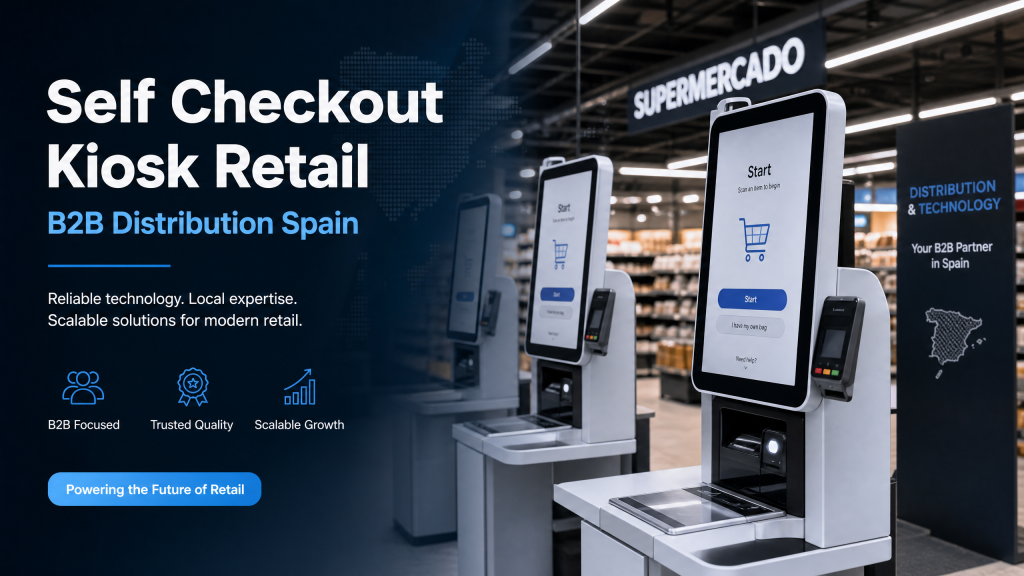
NCR Corporation’s Fastlane Series — The most widely deployed self-checkout platform globally. These kiosks are modular but weigh between 80–150 kg per unit and require specialized power and network configurations. NCR typically works with regional system integrators in Spain, not direct-to-retailer startups.
Diebold Nixdorf’s ProNova Line — A competing self-checkout solution gaining traction in European supermarkets. Similar weight and configuration requirements to NCR systems.
Easypaisa and Ingenico Payment Systems — Mobile payment terminals and contactless kiosk integration platforms increasingly used by mid-sized Spanish retailers. These are lighter (5–20 kg) but require careful handling and pre-configuration.
Zebra Technologies’ RFID and Digital Shelf-Edge Systems — Lighter but more numerous per deployment. A single supermarket might deploy 200–500 digital price tags across its store, each requiring inventory tracking, configuration, and installation coordination.
For B2B logistics partners, the challenge is that these technologies often arrive in mixed batches: some items are modular and standardized, while others are custom-configured for specific retail locations. This requires a hybrid warehouse operation combining standard fulfillment with technical assembly and quality assurance.
Why Córdoba’s Strategic Location Matters for Retail Tech Distribution
Córdoba, in the heart of Andalusia, offers a geographic advantage that Madrid-centric or Barcelona-centric logistics providers simply cannot match for smart retail distribution across southern Europe:
- Access to Andalusia’s retail corridor: Málaga, Seville, Granada, and Córdoba itself represent Spain’s second-largest retail market concentration outside Madrid. Direct access to this region reduces delivery times by 40–60% compared to routing from northern hubs.
- Portugal gateway: Córdoba is 250 km from the Portuguese border. For tech startups serving both Spain and Portugal (a combined market of 50+ million consumers), a southern hub eliminates the need for separate distribution infrastructure.
- North Africa connectivity: Córdoba provides efficient routing to Ceuta and Melilla, Spanish enclaves in North Africa with growing retail sectors. It also serves as a staging point for companies expanding into Morocco’s retail market.
- Madrid corridor efficiency: Despite being 400 km south of Madrid, Córdoba’s central position allows cost-effective same-day or next-day delivery to central Spain via optimized routing.
This geographic positioning is why specialized logistics providers like Solavance, based in Córdoba, have become essential partners for tech startups. A Madrid-based 3PL would struggle to serve Andalusian retailers cost-effectively. A Barcelona provider would face similar challenges. Córdoba’s location enables a distribution model that works for both large chains and the fragmented retail landscape of southern Spain.
B2B Distribution Models for Self-Checkout Kiosk Startups
Model Comparison: Direct vs. Hub-Based Distribution
| Distribution Model | Startup Warehouse | Lead Time (Spain) | Cost per Unit | Scalability | Best For |
|---|---|---|---|---|---|
| Direct from Factory | None (ship from EU manufacturer) | 7–12 days | €180–250 | Low (high admin overhead) | Single large orders; pilot deployments |
| Startup-Owned Hub (Madrid) | 500–1,000 sqm warehouse | 2–4 days (Madrid area); 4–7 days (regions) | €120–160 | Medium (fixed costs scale poorly until 300+ units/month) | Established startups with €500k+ monthly revenue |
| 3PL Hub (Córdoba/Southern Spain) | Shared warehouse (variable space) | 1–3 days (Andalusia); 3–5 days (central Spain) | €85–130 | High (variable costs, no fixed overhead) | Growth-stage startups; multi-country expansion |
| Regional Partner Network | Multiple small hubs (4–6 locations) | 1–2 days (any region) | €95–150 | Very High (but complex to manage) | Mature companies with 1,000+ units/month |
For most smart retail tech startups, the 3PL hub model (particularly one positioned in Córdoba or southern Spain) offers the optimal balance of cost, speed, and scalability during the critical growth phase.
Installation and Configuration Services
Self-checkout kiosk distribution isn’t just logistics—it’s a service ecosystem. The most successful B2B distribution partners now offer:
Pre-deployment configuration: Testing units before they leave the warehouse, uploading retailer-specific payment processor integrations, and verifying network compatibility. This reduces on-site installation time by 60% and failure rates by 40%.
White-glove installation coordination: Scheduling installation windows that don’t conflict with retail hours, providing technician support remotely or on-site, and managing any last-minute site modifications.
Staff training coordination: Arranging training sessions with retail staff (often via video call or in-person for larger deployments) and providing multilingual documentation.
Warranty and returns management: Handling defective units, managing returns logistics, and processing replacements without disrupting the retailer’s operations.
Solavance, as a specialized B2B logistics partner for hardware tech products, includes these services as part of its core offering. For a startup without in-house installation expertise, this is a critical differentiator.
Regulatory and Compliance Considerations
Spanish and EU Standards for Retail Technology
Before distributing self-checkout kiosks in Spain, ensure compliance with:
CE Marking and EMC Directive (2014/30/EU): All electronic payment terminals and kiosks must carry CE marking and comply with electromagnetic compatibility standards. This must be verified before warehouse entry.
Payment Services Directive 2 (PSD2): Any system handling payments must comply with Strong Customer Authentication (SCA) requirements. This affects both the hardware and the software configuration.
GDPR and Data Protection: Self-checkout systems collect transaction data, biometric data (if using facial recognition), and customer information. Your distribution partner must ensure systems are configured to comply with GDPR before deployment. This includes secure data handling during logistics and installation.
Spanish Tax Authority (Agencia Tributaria) Requirements: Self-checkout systems must be registered with Spain’s tax authority and configured to produce compliant receipts and transaction records. Non-compliance can result in retailer fines.
Accessibility Standards (UNE-EN 301 549): Retail technology must be accessible to users with disabilities. This affects both hardware design and software configuration.
A professional B2B logistics partner will have documented processes for verifying compliance before goods leave the warehouse. This is not optional—it’s a liability issue.
Real-World Distribution Scenario: A Case Study Framework
Deploying 50 Self-Checkout Kiosks Across Andalusia
Consider a realistic scenario: a European fintech startup has secured a contract to deploy 50 self-checkout kiosks across Andalusian supermarkets over 8 weeks. Here’s how the distribution process works with a specialized 3PL partner:
Week 1–2: Inventory Intake and Configuration
- 50 kiosks arrive at the Córdoba warehouse from the EU manufacturer.
- Each unit is unboxed, tested, and configured with retailer-specific payment processor integrations and network settings.
- Units are photographed, tracked in the 3PL’s inventory management system, and staged in climate-controlled storage.
- Installation schedules are confirmed with retail locations.
Week 3–8: Phased Deployment
- Batches of 5–10 units are packed with installation guides, power cables, and network documentation.
- Scheduled pickups occur 2–3 days before each installation window.
- The 3PL coordinates with installation technicians (either the startup’s team or local partners) to ensure site readiness.
- After installation, units are registered in the startup’s system and the retailer’s point-of-sale platform.
- Post-installation support is provided for 2–4 weeks.
Cost Breakdown (Estimated):
- Warehouse intake, testing, and configuration: €2,500 (€50 per unit)
- Storage (8 weeks): €1,200 (€24 per unit)
- Packing and dispatch (50 units): €3,000 (€60 per unit)
- Installation coordination: €2,000 (€40 per unit)
- Total: €8,700 (€174 per unit)
For comparison, shipping 50 units directly from the manufacturer would cost €9,000–12,000 with no configuration, no installation support, and significant retailer dissatisfaction due to on-site troubleshooting delays.
Integration with Broader Smart Retail Ecosystems
Self-checkout kiosks rarely exist in isolation. They’re part of larger retail tech ecosystems that include inventory management, customer analytics, and supply chain integration. For logistics partners, this means understanding the broader context.
For example, if your startup is also distributing smart autonomous fridges for offices and hotels in Spain, you’re managing two different product categories with different handling, installation, and support requirements. A specialized 3PL partner can consolidate this across your product line, reducing overall costs and complexity.
Similarly, if you’re working with smart IoT vending machines with cashless payment systems for B2B distribution across Spain, the logistics infrastructure overlaps significantly with self-checkout kiosk distribution. Both require configuration, testing, and installation coordination. A single partner can handle both efficiently.
Selecting the Right B2B Logistics Partner for Smart Retail Tech
Critical Evaluation Criteria
When evaluating a B2B logistics provider for self-checkout kiosk