Spain’s Food Waste Crisis: Why Industrial Composting Systems Are Now Non-Negotiable for Hotels and Restaurants
Spain generates approximately 9.2 million tonnes of food waste annually, with the hospitality and food service sectors accounting for roughly 30% of that total. Yet fewer than 15% of Spanish hotels and restaurants currently have dedicated organic waste treatment systems in place. This gap represents both a regulatory risk and a competitive disadvantage—especially as EU Directive 2018/851 tightens organic waste management requirements and consumer expectations around sustainability intensify.
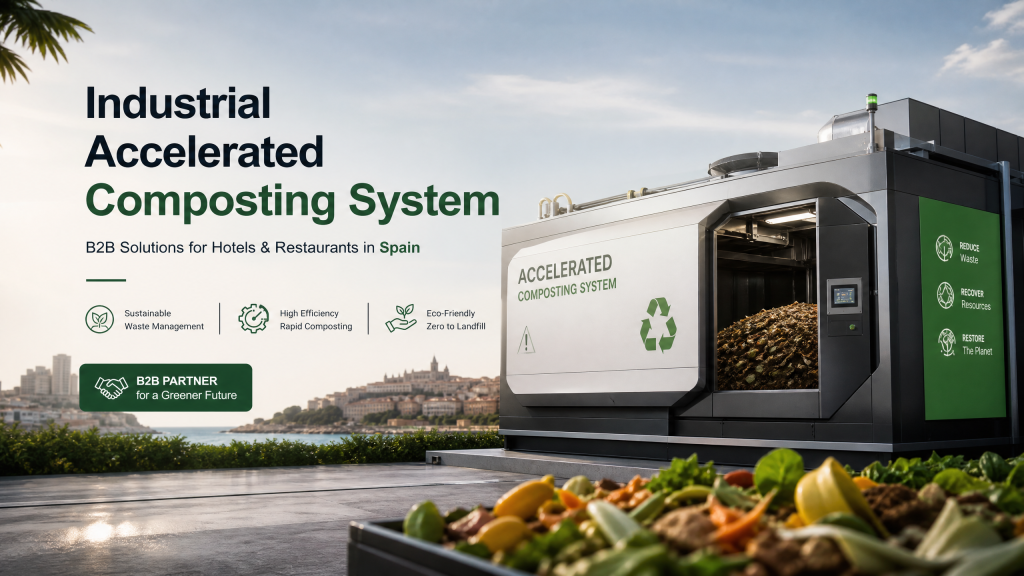
Industrial accelerated composting systems are no longer a niche sustainability feature. They’re becoming operational infrastructure for forward-thinking hospitality businesses. For biotech startups and hardware manufacturers developing these systems, the challenge isn’t product innovation—it’s getting the right equipment into the right kitchens, reliably and cost-effectively.
This is where specialized B2B logistics partners like Solavance become critical. Distributing bulky, high-value composting hardware across Spain’s fragmented hotel and restaurant landscape requires expertise in last-mile delivery, installation support, and supply chain coordination that generic logistics providers simply don’t offer.
The Market Opportunity: Why Hotels and Restaurants Are Ready to Buy
Regulatory Pressure and Sustainability Mandates
Spain’s National Waste Management Plan (2022–2026) mandates separate collection of biowaste for all food businesses with production capacity above 10 tonnes per week by 2024. Hotels with on-site restaurants, catering operations, and food courts now face fines of €300–€3,000 per violation. This isn’t theoretical—enforcement has begun in major cities including Madrid, Barcelona, and Seville.
Industrial composting systems solve this compliance problem internally. Rather than contracting external waste management, hotels can process organic waste on-site, reducing collection costs by 40–60% while maintaining full audit trails.
Cost Savings and Operational Efficiency
A mid-sized hotel (150–200 rooms) with a full-service restaurant generates 8–12 tonnes of organic waste monthly. At €45–€65 per tonne for external disposal, annual waste management costs typically range from €4,300 to €9,400. An industrial composting system with a 500–1,000 kg daily capacity can reduce this to €800–€1,200 annually in residual disposal fees, while generating compost for landscaping or local agricultural partners.
For restaurant groups operating 5–15 locations, the cumulative savings justify capital investment in composting infrastructure. ROI typically occurs within 18–24 months.
Brand Differentiation and Guest Expectations
Sustainability certifications (ISO 14001, Green Key, Travelife) now directly influence booking decisions among corporate travel managers and conscious consumers. Hotels displaying on-site composting systems gain marketing advantage—both in sustainability reporting and in organic search visibility for eco-conscious keywords.
Industrial Accelerated Composting Technologies: What’s Available
Key Technologies in the Spanish Market
Several hardware manufacturers now offer industrial-grade composting systems suitable for hospitality environments:
Lomi Industrial (Danish manufacture, EU-wide distribution) produces modular in-vessel composting units that process 50–200 kg daily. These systems use heated aeration and carbon-neutral processing, reducing composting time from 90 days to 4–6 weeks. Typical cost: €12,000–€18,000 per unit, with electricity consumption around 2–3 kWh daily.
BioComp Systems (Spanish startup, Barcelona-based) manufactures accelerated composting reactors specifically designed for hospitality kitchens. Their flagship model, the BC-500H, processes 500 kg daily and uses aerobic fermentation with integrated odor management. Cost: €16,500–€22,000. The advantage: local technical support and faster spare parts delivery across Spain.
Redkite Composters (UK manufacture) offers modular stacking systems for high-volume operations (restaurants with multiple kitchens or hotel chains). Their industrial line scales from 200 kg to 2 tonnes daily. Cost: €8,500–€35,000 depending on capacity. These are increasingly popular in Andalusia and the Madrid corridor due to competitive pricing and energy efficiency.
Comparative Analysis: System Selection for Different Hospitality Segments
| System | Daily Capacity | Processing Time | Capital Cost (€) | Annual Operating Cost (€) | Best For |
|---|---|---|---|---|---|
| Lomi Industrial | 50–200 kg | 4–6 weeks | 12,000–18,000 | 1,200–1,800 | Small hotels (50–100 rooms), standalone restaurants |
| BioComp BC-500H | 500 kg | 3–4 weeks | 16,500–22,000 | 1,600–2,200 | Mid-size hotels (150–250 rooms), restaurant groups (3–5 locations) |
| Redkite Industrial (2-tonne) | 2,000 kg | 2–3 weeks | 28,000–35,000 | 2,500–3,500 | Large hotel chains (300+ rooms), catering operations, food courts |
The selection depends on waste volume, available space, and integration with existing kitchen infrastructure. Most Spanish hospitality businesses in the mid-market segment (100–300 rooms) opt for the BioComp or Lomi systems due to balance between capacity and installation simplicity.
The B2B Distribution Challenge: Why Generic Logistics Fails
Why Industrial Composting Systems Require Specialist Logistics
Industrial composting hardware isn’t like ordering office furniture or kitchen appliances. These systems present specific logistics challenges:
- Physical dimensions and weight: A 500 kg daily-capacity composter typically measures 2.4m × 1.8m × 1.6m and weighs 800–1,200 kg. Standard courier services can’t handle this; specialized heavy goods vehicles are required.
- Installation requirements: Unlike plug-and-play equipment, composting systems need electrical integration, ventilation ducting, plumbing connections, and often foundation preparation. Delivery must coordinate with on-site installation teams.
- Technical documentation and compliance: Each system requires CE certification documentation, electrical safety certificates, and operational manuals. Logistics partners must ensure these travel with the hardware.
- Last-mile delivery complexity: Spanish hotels and restaurants operate in dense urban centers, narrow streets, and heritage buildings. Delivery routes must account for access restrictions, parking limitations, and narrow service entrances.
- Regional fragmentation: Spain’s hospitality sector is geographically dispersed. Andalusia, the Madrid corridor, and the Mediterranean coast require different logistics strategies. A single national distributor can’t optimize all routes equally.
This is precisely why startups manufacturing industrial composting systems struggle with go-to-market execution. The product is sound; the distribution is the bottleneck.
Solavance’s Strategic Advantage for This Niche
Solavance, based in Córdoba, occupies a unique position for distributing industrial composting systems across Spain and southern Europe. Córdoba’s central location in Andalusia provides direct access to:
- Andalusia’s major hospitality clusters (Seville, Granada, Málaga, Córdoba)
- The Madrid corridor via the A-3 and A-4 highways
- Portugal’s growing sustainable hospitality sector
- North African markets (Morocco, Tunisia) for future expansion
Solavance operates its own fleet of heavy goods vehicles, eliminating reliance on third-party courier networks. This means composting systems can be transported on dedicated vehicles with proper securing, climate control (if needed), and scheduled delivery windows that align with hotel kitchen operations. Installation coordination is handled directly, reducing delivery-to-operation time from weeks to days.
Practical Distribution Strategy for Biocomposting Startups
Step 1: Segment Your Target Market
Don’t attempt to sell to all Spanish hospitality businesses simultaneously. Instead, focus on specific segments:
- Tier 1 (Quick wins): Hotels with existing sustainability certifications (ISO 14001, Green Key) and restaurant groups already managing separate waste streams. These buyers understand ROI and have budget allocated.
- Tier 2 (Regulatory-driven): Hotels and restaurants in compliance-heavy regions (Catalonia, Basque Country, Madrid) where enforcement of organic waste separation is active. These buyers are motivated by regulation, not sustainability passion.
- Tier 3 (Volume plays): Hotel chains and restaurant groups with 10+ locations. These require customized solutions and fleet management, but offer significant recurring revenue.
Start with Tier 1 and Tier 2 in Andalusia and the Madrid region. This allows Solavance to optimize logistics routes and build case studies before expanding to less accessible markets.
Step 2: Build a Channel Partner Network
Direct sales to individual hotels is expensive. Instead, develop partnerships with:
- Sustainability consultants and ESG advisors who work with hotel groups
- Kitchen equipment suppliers (Rational, Electrolux, Hobart distributors in Spain) who can bundle composting systems with other capital equipment
- Waste management companies (Urbaser, Cespa, local municipal contractors) who can recommend composting systems as part of integrated waste solutions
- Hotel purchasing cooperatives (Hosbec, Cehat) that negotiate bulk purchasing agreements
Channel partners handle lead generation and sales; Solavance handles logistics, delivery coordination, and installation support. This model scales faster than direct sales.
Step 3: Establish Clear Logistics Workflows
Work with your logistics partner to document:
- Pre-delivery site surveys (electrical capacity, space availability, access routes)
- Delivery scheduling (off-peak hours to minimize kitchen disruption)
- Installation coordination with electricians and plumbers
- Post-delivery training and documentation handover
- Warranty and support escalation procedures
This removes friction from the buyer’s experience and reduces post-sale support costs. A hotel manager should never wonder whether their composting system will arrive on time or whether installation will actually happen.
Step 4: Create Financing Options
Capital cost ($16,000–$35,000) is a barrier for independent hotels and smaller restaurant groups. Partner with equipment financing providers (Telefónica Factoring, Banco Sabadell’s equipment leasing division) to offer:
- 36–60 month lease agreements with operational maintenance included
- Purchase-with-performance contracts where the hotel pays based on waste reduction metrics
- Group purchasing discounts through hotel cooperatives
When a hotel can finance a composting system for €400–€600 monthly and recover that cost in waste savings within 18 months, purchase hesitation disappears.
Integration with Broader Circular Economy Logistics
Industrial composting systems don’t exist in isolation. They’re part of a broader circular economy infrastructure that’s rapidly developing across Spain. Consider how your composting system integrates with related technologies:
Smart waste compactors (which we’ve covered in detail in our article on Smart Waste Compactors for Municipalities and Companies: B2B Distribution in Spain) can work alongside composting systems to optimize non-organic waste streams. A hotel using both technologies achieves comprehensive waste optimization.
Similarly, Pneumatic Waste Collection Systems: B2B Logistics for Urbanizations and Hospitals in Spain represent an alternative (or complementary) approach to waste management infrastructure. Some large hotel complexes use pneumatic collection for general waste while maintaining on-site composting for organic material.
For hotels operating ghost kitchens or dark kitchen operations, Modular Cooking Systems for Dark Kitchens: B2B Distribution to Ghost Kitchen Operators in Spain often come bundled with waste management requirements. These operators are particularly receptive to composting solutions because waste management is a critical operational constraint.
Finally, understanding Advanced Logistics and Fulfillment Strategies to Scale Ecommerce in Europe is valuable for startups planning to expand beyond Spain into Portugal, France, or Italy. The same logistics principles apply; only the geography changes.
Real-World Case Study: Distribution to a 15-Hotel Chain in Andalusia
A Barcelona-based biotech startup manufacturing accelerated composting systems recently partnered with Solavance to distribute systems to a 15-hotel chain across Andalusia. The chain operates properties in Seville, Córdoba, Málaga, and Granada—a geographic spread that would normally require multiple logistics providers.
The deployment strategy:
- Months 1–2: Site surveys at all 15 properties. Solavance conducted electrical capacity audits, measured kitchen space, and identified delivery access routes. This data informed which composting model (Lomi, BioComp, or Redkite) was optimal for each property.
- Month 3: Equipment manufacturing and staging at Solavance’s Córdoba warehouse hub. All 15 systems were delivered to the warehouse, inspected, and staged for sequential deployment.
- Months 4–6: Rolling deployment to each property. Solavance coordinated delivery windows with each hotel’s operations team, managed installation contractors, and handled staff training. Because Córdoba is central to all four cities, no delivery exceeded 3 hours driving time.
- Month 7+: Ongoing support, spare parts logistics, and performance monitoring.
Result: All 15 systems were operational within 6 months. The hotel chain reduced organic waste disposal costs by €18,000 annually while gaining marketing advantage through sustainability certifications. The startup gained a reference customer that accelerated sales to other hotel groups.
This success was possible because Solavance understood the specific logistics challenges of industrial composting distribution—something a generic courier or freight company would have struggled with.
Regulatory and Compliance Considerations
Before distributing industrial composting systems in Spain, ensure compliance with:
- CE Marking: All composting systems must carry CE certification under Machinery Directive 2006