Introduction: Navigating the Complex European Logistics Landscape
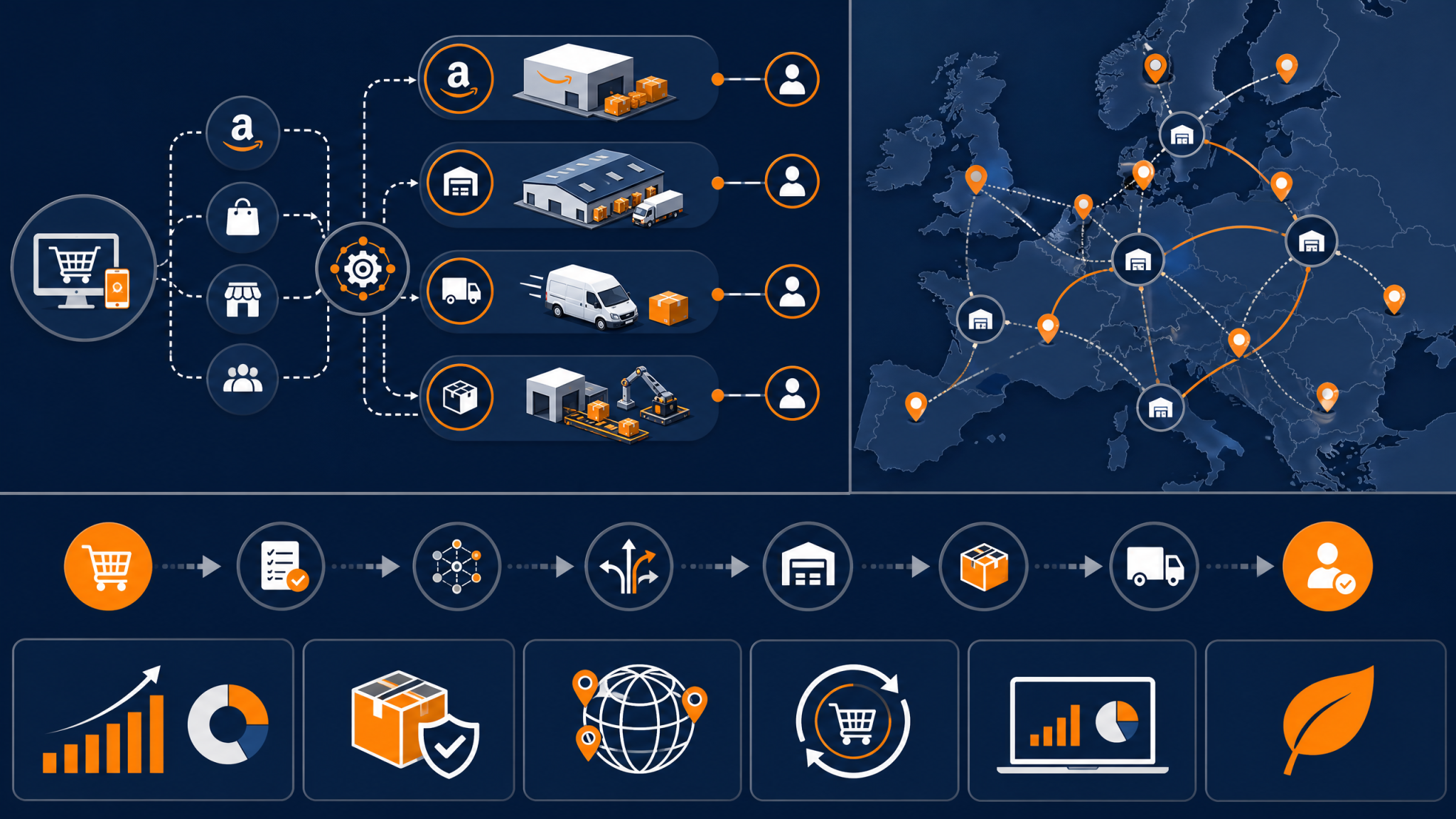
The European e-commerce market in 2026 is a dynamic and constantly evolving ecosystem that presents both immense opportunities and significant challenges for entrepreneurs. As businesses seek to expand their reach and capitalize on the purchasing power of European consumers, the need for **advanced e-commerce fulfillment strategies in Europe** becomes paramount. It is no longer sufficient to simply sell products; the way they are stored, packaged, and delivered can be the deciding factor between success and stagnation. According to Amazon Seller Central guidelines, these strategies are increasingly important.
This article serves as a comprehensive guide for e-commerce entrepreneurs seeking to master logistics in Europe. We will delve into the complexities of different fulfillment models, comparing the advantages and disadvantages of **Amazon FBA vs 3PL Europe**, and explore how to build a **fulfillment strategy to scale on Amazon** and beyond. From the particularities of **e-commerce logistics in Spain** to cross-border considerations, our goal is to provide practical and actionable insights to maximize margins and scalability in a competitive market.
The European E-Commerce Landscape in 2026: Challenges and Opportunities
Europe, with its diversity of cultures, languages, and regulations, offers a massive but fragmented consumer market. E-commerce sellers must navigate a myriad of challenges, including:
- Customs and Tax Regulations: The complexities of VAT, import tariffs, and customs declarations vary significantly across EU countries and the United Kingdom.
- Cross-Border Logistics: Managing shipments across borders requires a deep understanding of transportation networks and local delivery partners.
- Consumer Expectations: European customers expect fast and reliable deliveries, often with free or low-cost shipping options.
- Local Infrastructure: The quality and availability of logistics infrastructure can vary drastically from one region to another.
However, these challenges also present opportunities for those who adopt **advanced e-commerce fulfillment strategies in Europe**. Supply chain optimization can lead to greater customer satisfaction, lower operating costs, and sustained competitive advantage. For example, understanding the nuances of **e-commerce logistics in Spain** can open a lucrative market, but requires a fulfillment strategy adapted to local delivery preferences and infrastructure.
Core Fulfillment Models: A Detailed Comparison
The choice of fulfillment model is one of the most critical decisions for any e-commerce business. Here, we analyze the two main models and their implications for the European market. For more details, see our guide on Amazon Global Selling from a single warehouse in Spain.
Amazon FBA vs 3PL Europe: Which is the Best Option?
The question of **Amazon FBA vs 3PL Europe** is central to many sellers. Both offer robust solutions, but their strengths and weaknesses differ significantly.
Amazon FBA (Fulfillment by Amazon)
Advantages:
- Access to Amazon’s Network: FBA provides access to Amazon’s vast network of fulfillment centers, enabling efficient storage and distribution across Europe.
- Prime Shipping: FBA products are eligible for Amazon Prime, which often results in higher conversion rates and customer satisfaction due to fast and free shipping options.
- Customer Service: Amazon manages customer service for FBA orders, reducing the operational burden for sellers.
- Scalability: FBA is highly scalable, making it easy to manage demand spikes without significant investment in your own infrastructure.
Disadvantages:
- Costs: FBA fees can be high, especially for slow-moving or oversized products. Long-term storage costs can erode margins.
- Limited Control: Sellers have limited control over the fulfillment process, packaging, and brand experience.
- Inventory Requirements: Amazon has strict inventory requirements, and excess stock can generate additional fees.
- Amazon Dependence: Over-reliance on FBA can make a business vulnerable to changes in Amazon’s policies.
3PL (Third-Party Logistics) in Europe
Advantages:
- Flexibility and Customization: 3PLs offer greater flexibility in packaging, branding, and value-added services.
- Cost Reduction: For certain volumes and product types, a 3PL can be more cost-effective than FBA, especially if favorable rates are negotiated.
- Diversification: Using a 3PL reduces dependence on a single platform, allowing sellers to diversify their sales channels.
- Local Expertise: Many 3PLs have deep experience in **e-commerce logistics in Spain** and other specific markets, which can be invaluable for localized expansion.
Disadvantages: For more details, see our guide on Amazon MCF vs 3PL Shopify 2026.
- Integration: System integration between the 3PL and the seller’s e-commerce platform can be complex.
- Management: Requires more active management by the seller to coordinate with the 3PL and ensure service standards are met.
- Initial Costs: There may be higher upfront costs for setup and integration.
- Performance Risk: Service quality depends heavily on the choice of 3PL partner.
Other Fulfillment Considerations
In addition to FBA and 3PL, other models include: For more details, see our guide on TikTok Shop fulfillment Spain requirements. For more details, see our guide on WMS warehouse management system ecommerce guide.
- MFN (Merchant Fulfilled Network) / SFP (Seller Fulfilled Prime): Where the seller manages fulfillment directly. SFP allows eligible sellers to offer Prime from their own warehouse, but with very strict performance requirements.
- MCF (Multi-Channel Fulfillment): An Amazon service that allows sellers to use Amazon’s fulfillment network for orders placed on other sales channels (own websites, eBay, etc.). It is a key tool for a **fulfillment strategy to scale on Amazon** and beyond.
Designing Your Advanced Fulfillment Strategy to Scale
A **fulfillment strategy to scale on Amazon** and in the European market requires careful planning and constant adaptation. There is no one-size-fits-all solution; the ideal strategy often involves a hybrid model. For more details, see our guide on when to switch from Amazon FBA to 3PL.
Hybrid Models: The Best of Both Worlds
The combination of FBA and 3PL is an increasingly popular **advanced e-commerce fulfillment strategy in Europe**. For example:
- Use FBA for high-volume, fast-moving products that benefit from Prime visibility.
- Employ a 3PL for niche products, oversized items, or markets where FBA is not as efficient or cost-effective (such as **e-commerce logistics in Spain** for specific products).
- Use MCF to centralize inventory across all sales channels through Amazon’s network, simplifying management.
Technology Integration and Automation
Technology is the engine of **advanced e-commerce fulfillment strategies in Europe**. Implementing robust systems is crucial: For more details, see our guide on cold chain fulfillment frozen products Spain. For more details, see our guide on kitting assembly Amazon FBA profit margins. For more details, see our guide on most profitable niches on Amazon Europe in 2026.
- Warehouse Management Systems (WMS): To optimize storage, picking, and packing.
- Order Management Systems (OMS): To centralize and process orders from multiple channels.
- Automation: From warehouse robotics to shipping and returns automation, automation reduces errors and accelerates operations.
Data-Driven Decision Making
For a **fulfillment strategy to scale on Amazon**, data analysis is indispensable. Monitor key metrics such as: For more details, see our guide on unit economics and real margins on Amazon FBA.
- Delivery Speed: Average time from order to delivery.
- Order Accuracy: Rate of orders delivered correctly.
- Fulfillment Costs: Cost per unit for storage, picking, packing, and shipping.
- Return Rates: Identify patterns and causes of returns.
This data will allow you to adjust your strategy, optimize inventory location, and negotiate better rates with carriers and 3PLs.
Optimization for Key European Markets
Each European market has its own idiosyncrasies that must be considered in your **fulfillment strategy to scale on Amazon** and other channels.
E-Commerce Logistics in Spain
“`html
Spain is a growing market with unique characteristics: For more details, see our guide on reduce Amazon FBA costs hidden fees.
- Delivery Preferences: Spanish consumers value home delivery, but pickup points are also common.
- Infrastructure: Transportation networks are efficient in major cities, but can be more challenging in rural areas.
- Regulations: It is vital to comply with local VAT and customs regulations. A 3PL with experience in **e-commerce logistics in Spain** can be an invaluable asset.
Germany, France, Italy, and the United Kingdom
These markets represent a significant portion of European e-commerce. Consider:
- Germany: Strong emphasis on efficiency and sustainability. Returns are common and must be managed efficiently.
- France: Preference for pickup points and a strong brand identity.
- Italy: A growing market with logistical challenges in some regions, but with high potential.
- United Kingdom: Post-Brexit, customs and VAT are critical considerations for EU sellers.
Returns Management and Reverse Logistics
An **advanced e-commerce fulfillment strategy in Europe** is not complete without a solid reverse logistics strategy. Returns are an inevitable part of e-commerce, and efficient management can turn a cost into an opportunity to improve customer satisfaction.
- Simplified Processes: Facilitate the return process for customers with prepaid shipping labels and convenient pickup points.
- Inspection and Refurbishment: Establish clear processes to inspect returned products, refurbish them if possible, and replenish inventory quickly.
- Data Analysis: Use return data to identify root causes and improve product quality or descriptions.
The Future of Logistics in Europe: Trends and Predictions
Looking ahead, several trends will shape **advanced e-commerce fulfillment strategies in Europe**:
- Sustainability: Pressure to reduce the carbon footprint of logistics will increase, driving the adoption of electric vehicles, eco-friendly packaging, and optimized routes.
- Artificial Intelligence and Machine Learning: These technologies will increasingly be used for demand forecasting, route optimization, and inventory management.
- Drone and Autonomous Vehicle Delivery: Although still in their early stages, these technologies have the potential to revolutionize last-mile delivery.
- Micro-Fulfillment Centers: Smaller, automated warehouses located in urban areas to accelerate last-mile delivery.
Conclusion: Mastering Logistics for Success in Europe
Success in European e-commerce in 2026 depends on a well-executed **advanced e-commerce fulfillment strategy in Europe**. By understanding the complexities of **Amazon FBA vs 3PL Europe**, adapting your **fulfillment strategy to scale on Amazon** and other channels, and paying attention to the particularities of markets like **e-commerce logistics in Spain**, entrepreneurs can build a resilient and profitable business.
Investment in technology, data-driven decision making, and a willingness to adopt hybrid models are key. By staying agile and proactive, your business will be well positioned to thrive in the dynamic and lucrative European market.