The Hidden Logistics Challenge Behind Spain’s Warehouse Robotics Boom
Spain’s manufacturing and logistics sector is experiencing a quiet revolution. According to a 2023 report by the Spanish Association of Robotics (AER), warehouse automation investments grew 34% year-over-year, with AGV (Automated Guided Vehicles) and AMR (Autonomous Mobile Robots) representing the fastest-growing segment. Yet behind this growth lies a critical bottleneck: most European robotics startups lack the specialized B2B distribution infrastructure to reach Spanish 3PLs, manufacturers, and distribution centers efficiently.
The problem is straightforward. A Barcelona-based robotics startup with an innovative AMR platform can build exceptional technology, but getting that hardware into the hands of a logistics operator in Seville or a manufacturer in Valencia requires more than a sales call. It requires a partner who understands both the technical requirements of warehouse automation systems and the regulatory, logistical, and commercial complexities of B2B hardware distribution across southern Europe.
This article explores how AGV and AMR robotics companies can successfully distribute their systems to B2B clients in Spain, and how specialized logistics partners like Solavance are reshaping the supply chain for high-value, bulky automation hardware.
Understanding AGVs and AMRs: The Technology Landscape for Spanish Logistics
What’s the Difference Between AGVs and AMRs?
The distinction between AGVs and AMRs matters significantly in B2B distribution planning, because the logistics requirements are fundamentally different.
AGVs (Automated Guided Vehicles) follow predetermined paths, typically marked by magnetic tape or embedded wire guidance systems. They’re deterministic, predictable, and excel in high-volume, repetitive warehouse tasks like moving pallets between loading docks and storage areas. Companies like Jungheinrich (the German leader in AGV systems) have dominated this space for decades.
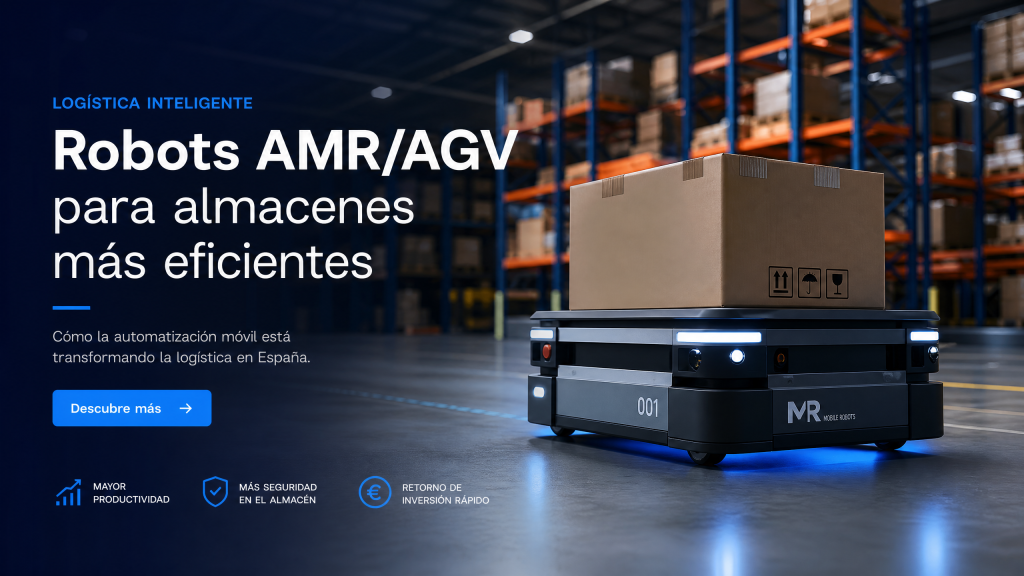
AMRs (Autonomous Mobile Robots) are newer and more flexible. They use LiDAR, computer vision, and AI-powered navigation to move independently around warehouses without fixed infrastructure. They can adapt to changing layouts, work alongside human staff, and handle more complex, varied tasks. Startups like Mobile Industrial Robots (MiR), founded in Denmark but now serving hundreds of Spanish logistics operations, represent the cutting edge of this technology.
From a distribution standpoint, AGVs are bulkier, heavier, and require more careful handling and installation support. AMRs are more modular but demand sophisticated software integration and ongoing technical support post-delivery.
The Spanish Market Opportunity
Spain’s logistics sector employs over 1.2 million people and generates €180 billion annually. The country’s geographic position—serving as a gateway to Portugal, North Africa, and the Mediterranean—makes it a critical hub for European supply chains. Yet warehouse automation penetration remains lower than in Germany, the Netherlands, or France, creating a significant greenfield opportunity for AGV and AMR providers.
The primary buyers in this space are:
- 3PLs and contract logistics operators: Companies like Grupo Logístico Lapesa and DHL Supply Chain Spain are actively upgrading their warehouse infrastructure.
- E-commerce fulfillment centers: Driven by continued growth in online retail, especially post-pandemic.
- Automotive and industrial manufacturers: Particularly in the Basque Country, Catalonia, and Andalusia regions.
- Food and beverage distributors: Cold chain logistics is a growing segment requiring specialized automation.
Why Traditional Distribution Channels Fail for Warehouse Robotics Hardware
The B2B Hardware Distribution Problem
Most tech startups assume that B2B sales and logistics work like B2C e-commerce. They don’t. When a Spanish manufacturer needs to evaluate and install an AMR system, they need:
- Safe, damage-free transportation of equipment weighing 500kg–2,000kg+
- On-time, predictable delivery to a specific receiving dock with proper documentation
- Coordination with local installation partners and technical support teams
- Compliance with Spanish labor regulations, insurance requirements, and import/export documentation
- Flexibility to handle last-minute changes, site assessments, or pilot deployments
Standard courier services (DHL, UPS, FedEx) can’t handle this. They optimize for speed and volume, not for specialized, high-value equipment. Freight forwarders exist, but most lack the specialized knowledge to properly handle robotics hardware or coordinate the B2B sales cycle.
This is where specialized B2B logistics partners become essential. A company like Solavance, based in Córdoba with a strategic warehouse hub and its own fleet of trucks, can bridge this gap by combining logistics expertise with deep knowledge of the robotics and automation sector.
How Specialized B2B Logistics Partners Enable AGV and AMR Distribution
Córdoba’s Strategic Advantage for Southern European Robotics Distribution
Córdoba’s location in southern Spain is often overlooked by startups focused on Madrid or Barcelona. However, for AGV and AMR distribution, it’s strategically optimal. Córdoba sits at the intersection of multiple logistics corridors:
- The Madrid corridor: Direct access to Spain’s largest manufacturing and logistics hub, just 400km north.
- Andalusian industrial belt: Seville, Granada, and Jaén host major 3PLs, automotive suppliers, and food processors.
- Portuguese market: Lisbon and Porto are accessible in 8–10 hours, opening the Iberian peninsula.
- Mediterranean ports: Málaga and Almería provide access to North Africa and international markets.
For robotics startups, this means a single warehouse hub in Córdoba can serve Spain and southern Europe with significantly lower transit times and costs than routing everything through northern Europe.
Core Services That Specialized Logistics Partners Provide
1. Technical Handling and Storage
AGVs and AMRs aren’t just cargo—they’re sensitive systems with batteries, electronics, and mechanical components. Proper storage requires climate control, electrical safety compliance, and secure handling. Solavance’s warehouse infrastructure is designed to handle high-value, bulky hardware with the care that robotics equipment demands.
2. Last-Mile Coordination and Installation Support
Getting an AMR to a warehouse is only half the battle. The customer needs coordination with local technicians, site assessment, electrical connections, and software integration. Specialized logistics partners can act as the on-ground coordinator, ensuring smooth handoff between the startup’s technical team and the customer’s operations staff.
3. Documentation, Compliance, and Regulatory Navigation
Spanish labor law, CE marking requirements, electrical safety standards (IEC 61508 for industrial robots), and insurance documentation are non-negotiable. A B2B logistics partner with experience in the industrial automation sector knows these requirements and can ensure compliance before equipment leaves the warehouse.
4. Reverse Logistics and Pilot Program Support
Many customers want to pilot AGV or AMR systems before committing to full deployment. Specialized logistics partners can handle temporary deployments, equipment swaps, and reverse logistics if a trial doesn’t proceed to purchase—a service that standard freight forwarders struggle with.
Practical Comparison: Distribution Approaches for AGV/AMR Startups in Spain
| Distribution Approach | Setup Cost | Time to Market | Scalability | Customer Support Quality | Best For |
|---|---|---|---|---|---|
| Direct Sales + Standard Freight Forwarder | Low (~€5k) | 2–3 weeks | Limited (no infrastructure) | Poor (no local presence) | One-off sales, low complexity |
| Regional Distributor Partnership | Medium (€20–50k) | 4–8 weeks | Moderate (dependent on partner) | Variable (partner dependent) | Established products, broad market reach |
| Specialized B2B Logistics Partner (Solavance Model) | Medium (€15–40k) | 3–4 weeks | High (dedicated infrastructure) | Excellent (specialized expertise) | Innovative hardware, complex B2B sales cycles, pilot programs |
| Build Own Distribution Center | Very High (€200k+) | 6–12 months | Very High (full control) | Excellent (direct control) | Mature companies, high volume, long-term strategy |
For most robotics startups in the €2–20M revenue range, partnering with a specialized B2B logistics provider offers the best balance of cost, speed, and scalability.
Actionable Steps for AGV/AMR Startups to Launch in Spain
Step 1: Identify Your Target Customer Profile
Don’t try to sell to all Spanish logistics companies at once. Instead, define your ideal customer:
- What size warehouse do they operate? (Square meters, throughput volume)
- What specific pain point does your AGV or AMR solve? (Labor shortage, throughput bottleneck, safety compliance)
- What’s their typical capex budget for automation?
- Which regions are they concentrated in?
For example, if your AMR excels at small-parcel sorting in e-commerce fulfillment centers, focus on 3PLs in the Madrid and Barcelona regions before expanding to Andalusia. This geographic focus makes logistics planning infinitely simpler.
Step 2: Partner with a Specialized B2B Logistics Provider Early
Don’t wait until you have 10 orders to think about distribution. Partner with a company like Solavance at the pilot stage. They can help you understand:
- What documentation and compliance requirements apply to your specific product
- How to price your product accounting for logistics costs (many startups underestimate this)
- Which customer segments are easiest to serve logistically
- How to structure pilot programs and temporary deployments
A good logistics partner becomes part of your go-to-market strategy, not an afterthought.
Step 3: Invest in Technical Documentation and Training Materials
Spanish customers expect detailed technical documentation in Spanish or English, installation guides, and training protocols. Your logistics partner can’t sell your product if the customer doesn’t understand how to use it. Create:
- Installation and setup guides (step-by-step, with photos/diagrams)
- Safety compliance documentation (CE marking, electrical safety certifications)
- Training materials for customer technicians
- Maintenance and troubleshooting protocols
Step 4: Structure Pilot Programs and POC Deployments
Most B2B logistics customers won’t buy an AGV or AMR system without testing it first. Work with your logistics partner to design pilot programs that:
- Are 4–8 weeks in duration (long enough to be meaningful, short enough to commit)
- Include on-site technical support from your team
- Collect measurable data (throughput improvements, labor cost savings, uptime %)
- Have clear success criteria and a path to full deployment
A logistics partner with experience in B2B hardware can coordinate the logistics of temporary deployments, equipment swaps, and reverse logistics—all critical for successful pilots.
Step 5: Build Relationships with Key Decision Makers
In Spanish logistics companies, the decision to invest in AGV or AMR systems typically involves multiple stakeholders:
- Operations Director: Focused on efficiency, uptime, and ROI
- IT/Systems Manager: Concerned with software integration, data security, and compatibility
- Finance Director: Evaluating capex vs. opex, lease vs. purchase options
- Health & Safety Officer: Ensuring compliance with Spanish labor law and safety standards
Your logistics partner can help facilitate introductions and coordinate site visits, but you need to build these relationships directly.
The Role of Warehouse Management Systems in AGV/AMR Deployment
One often-overlooked aspect of AGV and AMR distribution is integration with existing warehouse management systems (WMS). Spanish 3PLs and manufacturers use a variety of WMS platforms—some legacy, some modern. Your AGV or AMR needs to integrate seamlessly with their existing infrastructure.
This is where a warehouse management system (WMS) becomes critical infrastructure. Your logistics partner should understand these integration requirements and can help coordinate with the customer’s IT team to ensure smooth deployment. Popular WMS platforms used in Spanish logistics include SAP, Oracle NetSuite, and specialized solutions like Mecalux and Generix.
Additionally, if your AGV or AMR system involves complex fulfillment workflows, understanding advanced logistics and fulfillment strategies to scale across Europe becomes essential for positioning your product effectively.
Complementary Technologies and Ecosystem Partnerships
AGVs and AMRs rarely operate in isolation. They’re part of a larger warehouse automation ecosystem. Consider partnerships with:
- Collaborative robots (cobots): For tasks that require human-robot collaboration, collaborative robots (cobots) for SMEs represent a complementary technology that can work alongside AMRs for more complex picking and packing tasks.
- Automated storage and retrieval systems (AS/RS): Vertical or horizontal carousels that work with AGVs for high-density storage.
- Sortation systems: For high-volume parcel operations, AGVs often integrate with automated sortation equipment.
- Conveyor systems: Traditional but essential for interfacing with AGVs and AMRs.
A comprehensive logistics partner like Solavance can help you understand these ecosystem dynamics and position your AGV or AMR within the broader warehouse automation landscape.
Regulatory and Compliance Considerations for Spanish B2B Distribution
Spain’s regulatory environment for industrial robotics is governed by several key frameworks:
- CE Marking (Directive 2006/42/EC): Mandatory for all machinery, including AGV