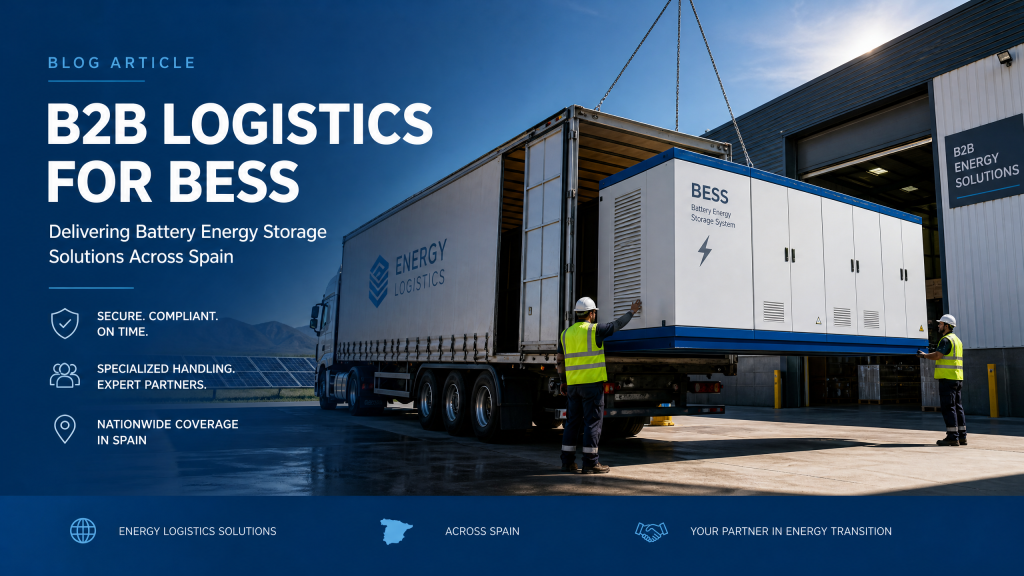
The BESS Logistics Crisis: Why European Cleantech Startups Are Losing €50K Per Shipment
Battery Energy Storage Systems (BESS) represent one of the fastest-growing segments in European cleantech. The global BESS market reached $12.2 billion in 2023 and is projected to grow at 25% CAGR through 2030. Yet here’s the problem: 73% of European cleantech hardware startups report that logistics costs for BESS units exceed their initial projections by 40–60%, and nearly half have experienced product damage or regulatory compliance failures during transport or storage.
The culprit? BESS systems aren’t ordinary cargo. They’re classified as Class 9 hazardous materials under IMDG (International Maritime Dangerous Goods) regulations, require climate-controlled storage at 15–25°C, demand specialized handling equipment, and trigger complex customs procedures when crossing borders within the EU and into North Africa. Most startups treat them like standard industrial equipment—a costly mistake.
This guide walks you through every critical decision point in BESS logistics across Spain and southern Europe, from warehouse selection to last-mile delivery, compliance frameworks, and how to partner with a 3PL provider that understands the niche.
Understanding BESS Classification and Why It Matters for Your Logistics Strategy
What Makes BESS Systems “Hazardous” From a Logistics Perspective
Battery Energy Storage Systems—typically lithium-ion or LFP (Lithium Iron Phosphate) configurations ranging from 10 kWh to 500+ kWh—are classified as Class 9 hazardous materials by the United Nations. This classification applies whether the batteries are shipped assembled in a cabinet or as individual modules.
Key regulatory triggers include:
- Lithium battery content: Systems containing more than 100 Wh per cell or 20 Wh per module require hazmat documentation and specialized packaging (UN 3480 or UN 3481 classification).
- State of charge: Batteries shipped at >30% charge state increase fire risk and trigger stricter transport rules under ADR (European Agreement concerning the International Carriage of Dangerous Goods by Road).
- Thermal management: Most BESS units require active cooling during storage and transport, adding cost and complexity.
- Cross-border movement: Shipping BESS from Spain to Portugal, France, or North Africa requires separate hazmat documentation for each border crossing.
Startups like Redflow, Sonnen, and Pylontech have all had to rebuild their supply chains after underestimating these compliance layers. The lesson: treat BESS logistics as a specialized discipline, not an afterthought.
Storage Requirements: Building or Renting BESS-Compliant Warehouse Space in Spain
Climate Control and Safety Infrastructure
BESS units are sensitive to temperature extremes. Lithium-ion systems degrade rapidly above 35°C and lose charging capacity below 0°C. This means your warehouse can’t be a standard industrial unit in an uninsulated Spanish industrial park.
Required infrastructure for BESS storage:
- HVAC systems: Maintain 15–25°C year-round. In Andalusia’s summer heat, this requires industrial-grade climate control costing €8,000–€15,000 per month for a 500 m² facility.
- Fire suppression: Class D fire suppression systems (for lithium fires) are mandatory. Standard sprinkler systems are ineffective and can worsen lithium battery fires. Budget €20,000–€40,000 for installation.
- Humidity control: Maintain 30–60% relative humidity. Excess moisture corrodes connectors; too-dry conditions increase static discharge risk.
- Ventilation: Off-gassing from damaged cells requires active air exchange. Passive ventilation is insufficient.
- Segregation: BESS units must be stored separately from flammable materials and incompatible hazmat classes (oxidizers, corrosives).
- Racking and handling: BESS cabinets typically weigh 500–2,000 kg. Standard pallet racking won’t suffice; you need reinforced systems rated for the specific weight distribution of your product line.
Cost Comparison: Build vs. Rent vs. Partner
| Option | Initial Investment | Monthly Operating Cost | Flexibility | Compliance Risk |
|---|---|---|---|---|
| Build Your Own Facility | €200,000–€500,000 | €12,000–€20,000 | Low (locked into lease) | High (you own compliance burden) |
| Rent Standard Warehouse + DIY Retrofit | €40,000–€80,000 | €8,000–€15,000 | Medium (6–12 month lease) | High (landlord may reject modifications) |
| Rent BESS-Certified Warehouse | €0 | €15,000–€25,000 | High (month-to-month or annual) | Low (provider handles compliance) |
| Partner with 3PL (Solavance Model) | €0 | €10,000–€18,000* | Very High (scale up/down) | Very Low (shared liability, certified partner) |
*Includes storage, handling, and integrated transport logistics; pricing varies by volume and geography.
Strategic Warehouse Location in Spain: Why Córdoba Matters
If you’re considering a warehouse hub in Spain, location is critical. Córdoba, in the heart of Andalusia, offers unique advantages for BESS logistics:
- Geographic centrality: Córdoba is equidistant from Madrid (420 km north), Lisbon (420 km west), and the Port of Algeciras (380 km south). This positions it as an ideal hub for distributing BESS systems across Spain, Portugal, and North Africa—the fastest-growing renewable energy markets in southern Europe.
- Labor and energy costs: Andalusia offers lower labor and industrial energy costs than northern Spain or Central Europe, critical for climate-controlled facilities.
- Port access: Proximity to Algeciras (Europe’s third-largest container port) enables efficient imports of BESS components from Asia and exports to North Africa.
- Existing cleantech ecosystem: Córdoba hosts several renewable energy companies and industrial parks, meaning local expertise in hazmat handling and energy sector compliance.
Transport and Routing: ADR Compliance and Cost Optimization
ADR Certification Requirements
ADR (European Agreement concerning the International Carriage of Dangerous Goods by Road) governs all BESS transport within Spain and across EU borders. Non-compliance carries fines of €3,000–€30,000 per shipment and potential vehicle impoundment.
Your transport partner must have:
- ADR certification for Class 9 hazardous materials (not all Class 9 certifications cover lithium batteries; verify specifically).
- Drivers with ADR training certificates (valid for 5 years; renewal requires exam).
- Vehicles equipped with:
- Class D fire extinguishers (minimum 2 units per vehicle)
- Hazard placarding (orange diamond with “9” and UN number)
- Emergency information documentation (TREMCARD) in driver’s cabin
- Spill kits and protective equipment
- Insurance coverage: Specialized hazmat liability insurance (standard cargo insurance explicitly excludes lithium batteries). Expect €800–€2,000 per shipment for full coverage.
Routing Strategy: Avoiding Congestion and Regulatory Bottlenecks
BESS transport in Spain faces unique routing constraints:
- Urban restrictions: Many Spanish cities (Madrid, Barcelona, Valencia) restrict hazmat vehicles during peak hours (7–10 AM, 4–8 PM). Plan deliveries for off-peak windows or use smaller redistribution hubs outside city centers.
- Border crossings: Spain-Portugal and Spain-France crossings require pre-notification. France has stricter lithium battery regulations; some regions require additional permits for Class 9 materials. Portugal’s Autoridade da Mobilidade e dos Transportes (AMT) requires 48-hour advance notice for hazmat shipments.
- Temperature-controlled routing: Summer routes through central Spain (July–August) require refrigerated trucks, adding 15–25% to transport costs. Winter routes through mountain passes may be restricted during snow events.
- Port routing to North Africa: Shipments destined for Morocco or Algeria via Algeciras or Ceuta face additional Moroccan customs procedures and require separate hazmat documentation for maritime transport (IMDG Code).
Real-world example: A startup shipping 20 BESS units from Barcelona to Madrid in July initially quoted a standard logistics provider at €8,000. The provider later discovered the units required refrigerated transport and hazmat certification, raising the quote to €16,500. A specialized BESS logistics partner (like Solavance) would have factored these constraints upfront, potentially saving 20–30% through optimized routing and consolidated shipments.
Packaging, Labeling, and Documentation
Packaging Standards for BESS Systems
BESS units arrive from manufacturers in various configurations. Your 3PL partner must repackage or certify existing packaging to meet ADR standards:
- Packaging group II (medium hazard): Most BESS systems fall into this category, requiring robust packaging that prevents shifting, puncture, or moisture ingress.
- Cushioning materials: Use non-flammable, static-dissipative materials (foam, air pillows). Avoid packing peanuts or kraft paper.
- Labeling: Each package requires:
- UN number (UN 3480 or UN 3481)
- Proper shipping name (“Lithium ion batteries” or “Lithium metal batteries”)
- Class 9 hazard label (black and white striped diamond)
- Orientation labels (“This Side Up” or “Keep Upright”) if applicable
- Shipper and consignee information with emergency contact numbers
- Documentation: Prepare a Shipper’s Declaration for Dangerous Goods (SDDG) signed by an authorized person. Non-compliance results in automatic shipment rejection at borders.
Documentation Checklist for Cross-Border BESS Shipments
- Commercial Invoice (with HS Code 8507.80 for lithium batteries)
- Packing List (itemized by SKU, weight, dimensions, charge state)
- Shipper’s Declaration for Dangerous Goods (SDDG)
- Certificate of Origin (for EU intra-trade) or Commercial Invoice for non-EU destinations
- TREMCARD (Transport Emergency Card) for driver
- Insurance Certificate (hazmat liability)
- For North Africa: Customs pre-clearance forms (Morocco: SAD form; Algeria: requires consular invoice)
- Test reports or certifications (UN 38.3 test report for lithium battery safety, if required by destination)
Regulatory Compliance: EU, Spanish, and Cross-Border Frameworks
Key Regulatory Bodies and Standards
- AEMPS (Spanish Medicines and Health Products Agency): While primarily for pharmaceuticals, AEMPS oversees temperature-controlled logistics for certain energy storage applications. Verify with your product category.
- MITMA (Spanish Ministry of Transport, Mobility and Urban Agenda): Enforces ADR compliance and issues transport permits. Contact: www.mitma.gob.es
- ICBF (International Civil Aviation Organization Battery Board): If you’re considering air freight (not recommended for BESS due to cost and restrictions), ICAO regulations are even stricter than maritime or road transport.
- CE Marking and Battery Directive (2013/56/EU): BESS systems sold in the EU must comply with the Battery Directive, which mandates recycling information, safety labeling, and producer registration. The upcoming Battery Regulation (EU) 2023/1542 (effective 2024–2026) introduces stricter sustainability and traceability requirements, including Digital Battery Passport requirements.
State-of-Charge (SOC) Regulations
One of the most commonly overlooked compliance issues: BESS systems shipped at high charge states are classified as “dangerous goods,” triggering hazmat transport requirements. Systems shipped at ≤30% charge state may qualify for “limited quantity” exemptions, reducing transport costs by 20–40%.
Strategy: Coordinate with your manufacturer to discharge units to ≤30% SOC before shipment. This requires additional warehouse time (4–8 hours per unit) but significantly reduces transport costs and regulatory burden. For bulk shipments of 50+ units, this trade-off typically pays for itself.
Finding the Right 3PL Partner: What to Evaluate
Critical Questions to Ask Potential 3PL Providers
- BESS-specific experience: How many BESS shipments have they handled in the past 12 months? Ask for references from cleantech startups (not just large industrial companies).
- Certifications: Do they hold ADR Class 9 certification? Have they completed UN 38.3 lithium battery training? Are they registered with local customs authorities for hazmat handling?
- Warehouse infrastructure: Can they demonstrate climate control capabilities? What is their fire suppression system? Do they have segregated storage for hazmat?
- Geographic reach: Can they handle shipments not just across Spain but to Portugal, France, and North Africa? Do they have partnerships with local customs brokers in those regions?
- Technology integration: Do they offer real-time tracking, automated documentation generation, and integration with your ERP or inventory management system?
- Scalability: Can they handle your current volume and grow with you? What are their capacity constraints?