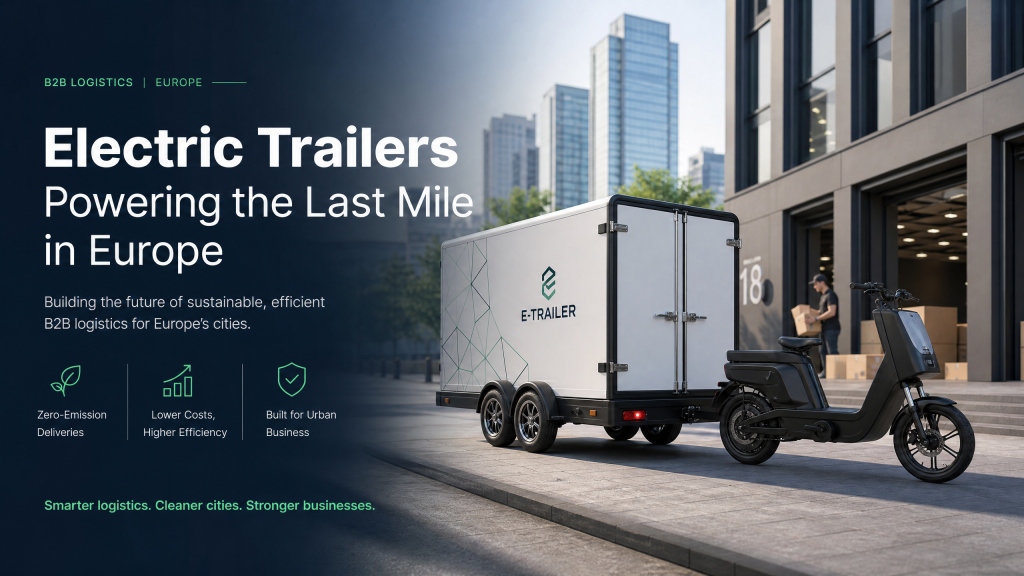
The Last-Mile Crisis: Why European Startups Building Electric Trailers Need Strategic B2B Distribution
The European last-mile delivery sector is hemorrhaging money. According to McKinsey research, last-mile logistics accounts for 53% of total shipping costs—and for bulky, heavy cargo like electric trailers and cargo vehicles, that figure climbs to 60–70%. Yet 78% of European logistics startups fail to achieve profitability within their first three years, primarily because they lack access to reliable, cost-effective B2B distribution networks that can move their hardware products across fragmented regional markets.
For startups manufacturing innovative electric trailers, modular cargo systems, and last-mile delivery vehicles, the challenge is acute: you’ve engineered a product that solves real problems for urban logistics operators, but getting that product into the hands of B2B buyers across Spain, Portugal, France, and Italy requires navigating warehouse logistics, cross-border compliance, and regional fleet deployment. Most startups outsource this to generic 3PL providers who treat electric hardware like consumer goods—and watch margins evaporate.
This is where specialized B2B logistics partners become essential. A hub-based distribution model, anchored in southern Spain and leveraging the region’s geographic advantage, can transform how European startups scale their electric trailer and cargo vehicle businesses across the continent.
The Market Opportunity: Electric Trailers and Last-Mile Hardware in Europe
The European electric trailer market is projected to grow at 18.4% CAGR through 2030, driven by EU emission regulations (Euro 7 standards), corporate net-zero commitments, and rising fuel costs. Companies like Cartamundi, Zenith Motors, and Arrival have raised hundreds of millions in venture capital to build modular electric cargo systems and last-mile delivery vehicles. But capital doesn’t solve the distribution problem.
Most of these startups operate on a “build-to-order” or “small batch” model, meaning they need:
- Flexible warehouse capacity that can accommodate oversized, heavy inventory without long-term commitments
- Cross-border logistics expertise (VAT, tariffs, documentation for Spain-to-Germany, Spain-to-Italy corridors)
- Regional demo and trial fleet management for B2B buyers who want to test electric trailers before committing to bulk orders
- Last-mile delivery coordination that doesn’t require owning trucks or maintaining a distributed warehouse network
The startup that solves this logistics puzzle first doesn’t just reduce costs—it captures market share by enabling faster go-to-market and lower customer acquisition costs.
Why Southern Spain Is the Optimal Hub for European Startup Distribution
Córdoba, in the heart of Andalusia, sits at the intersection of three major logistics corridors: the Madrid-Barcelona axis (Spain’s primary commercial spine), the Atlantic Gateway to Portugal (via Seville and Huelva), and the Mediterranean route to Italy and France. For startups distributing electric trailers and B2B logistics hardware across Europe, this location offers strategic advantages that inland or coastal hubs cannot match.
Geographic Access: From Córdoba, a truck can reach Madrid in 4 hours, Barcelona in 12 hours, Lisbon in 6 hours, and the Port of Algeciras (Europe’s gateway to North Africa and the Mediterranean) in 3 hours. For startups selling electric trailers to logistics operators in North Africa or serving multinational fleets across the Iberian Peninsula, this is irreplaceable.
Cost Structure: Spanish warehouse space costs 40–50% less than equivalent facilities in France, Germany, or the UK. Labor costs for warehouse operations, vehicle prep, and fleet management are similarly advantageous. For hardware startups operating on thin margins, this translates directly to profitability.
Regulatory Position: Spain is the EU’s logistics hub for southern Europe. Customs procedures, VAT compliance, and cross-border documentation are streamlined. A startup shipping electric trailers from a Córdoba hub to Italy faces fewer regulatory hurdles than one operating from northern Europe.
Solavance, headquartered in Córdoba with its own fleet of specialized trucks, is positioned to serve exactly this niche. The company understands the specific challenges of distributing bulky, high-value hardware—from electric trailers to industrial robotics—and has built its logistics model around the needs of European tech startups.
Core Challenges: Why Generic 3PLs Fail for Electric Trailer Startups
Before exploring solutions, it’s worth understanding why most startups struggle with traditional 3PL providers:
Challenge 1: Inventory Inflexibility
Standard 3PLs charge by pallet or cubic meter, with minimum storage commitments. An electric trailer startup might have 8 units in stock one month and 25 the next. Generic warehouses can’t accommodate this volatility without penalty fees. Specialized logistics partners, by contrast, understand batch production cycles and can scale warehouse allocation accordingly.
Challenge 2: Lack of Hardware Expertise
Electric trailers, modular cargo systems, and last-mile delivery vehicles require specialized handling. They’re not palletized consumer goods. They need climate control (to protect batteries), secure tie-down procedures, and often pre-delivery inspection and configuration. Most 3PLs lack this expertise and charge premium rates for custom handling.
Challenge 3: B2B Customer Expectations
B2B buyers of electric trailers expect detailed delivery coordination, on-site support, and often trial fleet deployment. A startup selling 5 units to a municipal logistics operator in Barcelona needs more than a truck arrival—they need a logistics partner who can manage the handover, provide training, and monitor early performance. Generic 3PLs offer “delivery” but not this consultative layer.
Challenge 4: Cross-Border Complexity
Selling electric trailers across Spain, Portugal, and France involves different VAT regimes, tariff classifications, and customs procedures. Most startups lack in-house expertise and end up paying consultants or accepting delays. A specialized partner with established cross-border relationships eliminates this friction.
The Specialized B2B Logistics Model for Electric Trailer Distribution
A purpose-built distribution strategy for electric trailer startups should include five core components:
1. Hub-Based Inventory Management with Flex Capacity
Instead of committing to fixed warehouse space, startups should partner with providers offering tiered capacity. During low-production months, store 10–15 units. During peak manufacturing, scale to 40–50 without renegotiating terms. Solavance operates this model specifically for hardware startups, with capacity that flexes based on production cycles.
2. Regional Demo Fleet and Trial Deployment
B2B buyers want to test before buying. A specialized logistics partner should maintain a small fleet of demonstration units that can be deployed to potential customers for 2–4 week trial periods. This dramatically shortens sales cycles and increases conversion rates. The logistics partner handles delivery, setup, monitoring, and retrieval.
3. Pre-Delivery Configuration and QA
Electric trailers often require final assembly, software configuration, or customization before delivery. A specialized partner should offer this as a standard service, not an add-on. This includes battery testing, telematics integration, and compliance verification.
4. Cross-Border Customs and Documentation
Partnering with a provider experienced in EU and Iberian trade should eliminate startup headaches around VAT, tariff classification, and export documentation. For a startup selling 20 units per month across four countries, this expertise is worth 2–3% of revenue.
5. Performance Monitoring and Fleet Analytics
Once electric trailers are deployed, startups need visibility into performance, utilization, and customer satisfaction. A logistics partner with telematics integration and customer feedback loops becomes a strategic asset, not just a warehouse operator.
Comparative Analysis: In-House vs. Hub-Based Distribution Models
| Metric | In-House Warehouse & Fleet | Generic 3PL Provider | Specialized B2B Hub (Southern Spain) |
|---|---|---|---|
| Initial Capital Investment | €150,000–€300,000 | €10,000–€20,000 (deposit) | €5,000–€15,000 (deposit + service fees) |
| Monthly Fixed Costs | €12,000–€18,000 | €3,000–€6,000 | €4,000–€8,000 |
| Per-Unit Delivery Cost (Spain) | €80–€150 | €120–€200 | €60–€100 |
| Cross-Border Delivery (Spain-Italy) | €300–€500 | €400–€700 | €200–€350 |
| Demo Fleet Capability | Yes (but capital-intensive) | No | Yes (included) |
| Customs/VAT Support | Startup responsibility | Limited | Full support (included) |
| Scalability (0–100+ units/month) | Limited (requires new hires, trucks) | High (but quality varies) | High (optimized for hardware startups) |
| Time to Market (first 50 units) | 8–12 weeks | 4–6 weeks | 2–3 weeks |
For a startup distributing 30–80 electric trailers per month across Spain and southern Europe, the specialized hub model delivers 35–45% cost savings compared to in-house logistics and 20–30% savings versus generic 3PLs, while dramatically accelerating time to market.
Real-World Application: How Electric Trailer Startups Should Structure B2B Logistics
Consider a hypothetical startup, ElectraHaul, manufacturing modular electric trailers for last-mile delivery operators. They’re based in Valencia, have secured €2M in Series A funding, and are ramping production from 15 units/month to 60 units/month over 12 months. Here’s how a specialized logistics partnership should work:
Month 1–2: Inventory Staging and Demo Fleet Setup
ElectraHaul ships 20 pre-production units to the Córdoba hub (Solavance). The logistics partner conducts QA, integrates telematics software, and configures 3 units as a regional demo fleet. These demo units are immediately available for trial deployments to logistics operators in Seville, Córdoba, and Badajoz.
Month 3–6: Regional Sales Acceleration
With demo units deployed, ElectraHaul closes 3 enterprise deals: 8 units to a Madrid logistics operator, 6 units to a Lisbon-based fleet company, and 5 units to a Barcelona urban delivery network. The Córdoba hub handles all logistics, including customs clearance for Portugal and cross-border documentation for France. ElectraHaul’s sales team focuses on selling; the logistics partner handles execution.
Month 7–12: Scale to 60 Units/Month
Production ramps. The Córdoba hub now maintains 40–50 units in staged inventory, with weekly shipments to customers across Spain, Portugal, France, and Italy. The logistics partner has expanded the demo fleet to 6 units and manages a rotating trial program. Performance data from deployed trailers flows back to ElectraHaul’s product team, accelerating iteration.
Outcome
By month 12, ElectraHaul has distributed 300+ units across four countries, captured 12% of the regional electric trailer market, and reduced per-unit logistics costs from €140 to €75. The company is profitable on logistics and can reinvest savings into R&D and sales.
Without the specialized hub, this trajectory would be impossible. In-house logistics would consume 40% of the Series A capital and delay market entry by 6 months. Generic 3PLs would lose units, miss cross-border deadlines, and damage customer relationships.
Technology Stack: Tools and Platforms for Startup-Focused Last-Mile B2B Logistics
A specialized logistics partner should integrate the following technologies to serve electric trailer startups effectively:
Inventory and Warehouse Management
Mecalux WMS or Generix Group are industry-standard warehouse management systems that can track oversized inventory, manage batch production cycles, and integrate with startup ERP systems. These platforms allow real-time visibility into inventory levels, automated reorder triggers, and custom reporting for finance teams.
Cross-Border Compliance and Customs
TraceLink or Descartes Systems automate customs documentation, VAT compliance, and tariff classification for EU shipments. For a startup distributing across four countries, this eliminates manual paperwork and reduces compliance errors by 95%.
Fleet Telematics and Performance Monitoring
Verizon Connect or Samsara provide real-time GPS tracking, battery health monitoring (critical for electric trailers), and performance analytics. A logistics partner using these tools can provide startups with dashboards showing how deployed trailers are performing in customer hands—invaluable for product iteration and customer support.
Last-Mile Delivery Routing
Route4Me or Optimoroute optimize delivery routes for multi-stop B2B shipments, reducing delivery time and fuel costs. For a startup scaling from 30 to 80 units/month, optimized routing can reduce per-unit delivery costs by 15–20%.
A specialized partner like Solavance should have these systems integrated and operational before onboarding a startup, not implementing them afterward.
Regulatory and Compliance Considerations for European Startup Distribution
Electric trailers and cargo vehicles are subject to evolving EU regulations that directly impact B2B logistics:
Euro 7 Emissions Standards
Effective 2026, Euro 7 standards will apply to all new commercial vehicles, including trailers. This creates urgency for startups—B2B buyers are accelerating purchases before the deadline. A logistics partner should help startups navigate this regulatory window and position their products as compliant solutions.
Battery Transport Regulations
Electric trailers contain lithium batteries classified as dangerous goods. Transport requires IATA/IMDG compliance and specialized documentation. A startup can’t ship across borders without this. A specialized logistics partner should manage all battery transport compliance as a standard service.
Cross-Border VAT and Tariffs
Shipping electric trailers from Spain to Italy triggers VAT reversal procedures