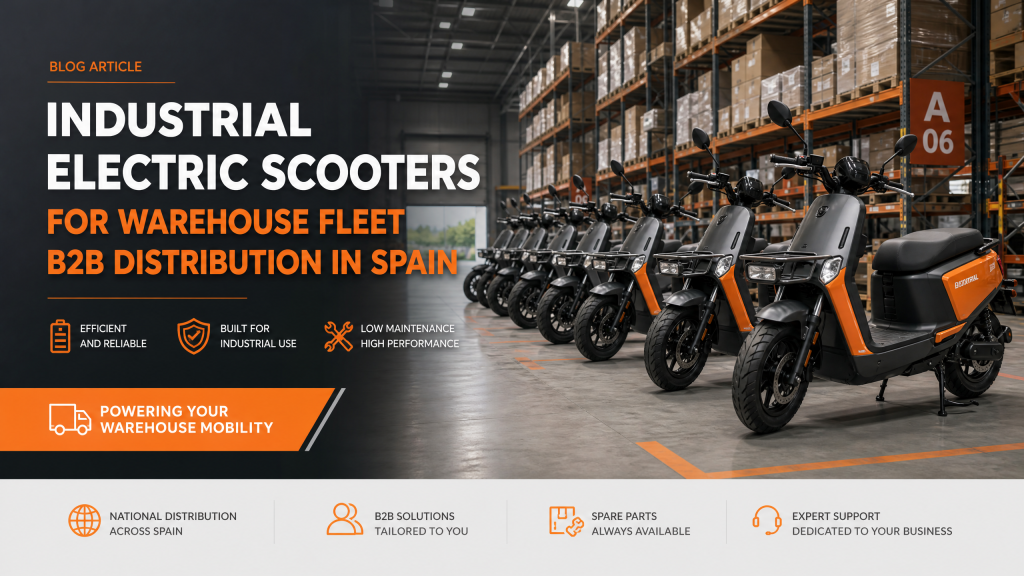
The Industrial Electric Scooter Market in Spain: Why B2B Warehouse Fleet Distribution Is a Logistics Frontier
European tech startups are shipping over 15 million electric scooters annually across the continent, yet fewer than 12% of these units are purpose-built for industrial warehouse and factory environments. The gap is critical: while consumer e-scooters dominate urban mobility conversations, industrial-grade electric scooters designed for material handling, intra-logistics, and heavy-duty warehouse operations represent a nascent but rapidly expanding B2B segment worth an estimated €180–220 million across Spain and southern Europe by 2025.
For manufacturers of these specialized vehicles—whether compact warehouse forklifts on wheels, heavy-payload industrial scooters, or autonomous mobility solutions—the distribution challenge is acute. Getting your hardware into the hands of logistics managers, warehouse directors, and factory procurement teams across Spain requires more than standard e-commerce fulfillment. It demands a logistics partner who understands both the physical demands of bulky industrial equipment and the complex B2B sales cycles of the logistics sector.
This article explores the complete landscape of distributing industrial electric scooter fleets to B2B buyers across Spain and southern Europe, with practical strategies for startups and actionable insights for procurement teams evaluating suppliers.
Understanding the Industrial Electric Scooter Market in Spain
Who Buys Industrial Electric Scooters and Why
Industrial electric scooters are not consumer toys. They are purpose-engineered vehicles designed for specific warehouse and factory applications:
- Material handling operators use them to move between picking stations, reducing fatigue and increasing throughput in large distribution centers.
- Factory floor supervisors
- Logistics hubs and 3PL providers
- Airport and port operations teams
Spanish logistics companies, particularly those in Andalusia and along the Madrid corridor, are increasingly adopting these solutions as part of broader Industry 4.0 and sustainability initiatives. The Spanish government’s Plan de Recuperación, Transformación y Resiliencia (Recovery, Transformation and Resilience Plan) includes €2.4 billion earmarked for digital transformation in logistics, creating tailwinds for industrial mobility innovation.
Market Drivers and Regulatory Environment
Three factors are accelerating demand for industrial electric scooter fleets in Spain:
1. Sustainability mandates: The EU’s Corporate Sustainability Reporting Directive (CSRD) and Spain’s own Ley de Cambio Climático (Climate Change Law) are pushing large logistics operators to decarbonize internal operations. Electric scooters replace diesel-powered vehicles for short-range intra-facility transport, directly reducing Scope 1 emissions.
2. Labor efficiency: Spain’s logistics sector faces persistent workforce shortages. Industrial electric scooters reduce operator fatigue, increase shift productivity by 15–25%, and make warehouse roles more attractive to younger workers familiar with micromobility.
3. Real estate optimization: As warehouse rents in Madrid, Barcelona, and Seville climb, operators seek technologies that maximize throughput per square meter. Electric scooters enable faster intra-facility movement without the infrastructure overhead of traditional conveyor systems or autonomous guided vehicles (AGVs).
B2B Distribution Channels for Industrial Electric Scooters in Spain
Direct-to-Logistics-Hub Sales vs. Dealer Networks
Startups manufacturing industrial electric scooters face a strategic fork: build a direct sales team, or work through established logistics equipment dealers and integrators.
| Distribution Channel | Typical Margin (Manufacturer) | Sales Cycle Length | Geographic Coverage | Best For |
|---|---|---|---|---|
| Direct Sales (In-House Team) | 60–75% | 6–12 months | 1–3 regions (initial) | High-value pilot programs; direct relationships with tier-1 logistics operators |
| Logistics Equipment Dealers | 35–50% | 3–6 months | National or multi-regional | Rapid market penetration; access to established procurement channels |
| 3PL and Logistics Integrators | 40–55% | 2–4 months | Highly localized | Fleet orders; bundled logistics solutions |
| Specialized B2B Logistics Partners | 50–65% | 4–8 months | Multi-country (southern Europe) | Startups lacking distribution infrastructure; rapid scaling across Spain and Portugal |
Most successful industrial mobility startups in Europe use a hybrid approach: direct sales for anchor customers and high-value regional accounts, combined with dealer or logistics partner networks for broader geographic reach. This balances margin retention with speed to market.
The Role of Specialized B2B Logistics Partners
For European tech startups manufacturing bulky, high-value industrial hardware, traditional freight forwarders are often inadequate. They lack the technical knowledge to position industrial electric scooters within warehouse ecosystems, cannot provide the consultative sales support that logistics buyers expect, and frequently mishandle delivery timelines for mission-critical equipment.
Specialized B2B logistics partners—companies with their own truck fleets, strategic warehouse hubs, and deep expertise in the logistics sector—fill this gap. Solavance, based in Córdoba, Spain, exemplifies this model. Operating a dedicated fleet and a strategic warehouse hub in Córdoba (which provides direct access to Andalusia, Portugal, the North African corridor, and the Madrid logistics corridor), Solavance combines logistics execution with B2B market knowledge specific to industrial mobility and bulky hardware distribution.
For a startup manufacturing industrial electric scooters, partnering with a logistics provider like Solavance means:
- Reliable, on-time delivery to warehouse and factory sites across southern Spain and Portugal.
- Technical support during unboxing, setup, and initial deployment at customer facilities.
- Feedback loops from the field that inform product development and market positioning.
- Access to existing relationships with tier-2 and tier-3 logistics operators who are early adopters of industrial mobility solutions.
Logistics Challenges Specific to Industrial Electric Scooter Distribution
Weight, Dimensions, and Packaging
Industrial electric scooters are heavier and bulkier than their consumer counterparts. A typical industrial-grade model weighs 40–80 kg and occupies 0.8–1.5 cubic meters when packaged for transport. This creates immediate logistics friction:
- Pallet optimization: Standard EUR pallets can accommodate only 3–5 units per pallet, reducing volumetric efficiency compared to lighter consumer products. Specialized packaging or custom palletization is often necessary.
- Last-mile delivery: Standard parcel carriers refuse shipments over 30 kg. Bulky industrial scooters require LTL (less-than-truckload) carriers or full-truck-load (FTL) consolidation, increasing per-unit logistics costs by 25–40%.
- Damage risk: Industrial scooters contain precision components (motor controllers, battery management systems, suspension). Poor handling during transport can trigger warranty claims and customer dissatisfaction.
Solavance’s model—with its own fleet and warehouse hub—mitigates these challenges. Rather than relying on external carriers, Solavance controls the entire handling chain, ensuring that industrial electric scooter shipments are packaged, loaded, and delivered with the care they demand.
Battery Shipping Regulations
Industrial electric scooters are powered by lithium-ion batteries, which fall under strict international shipping regulations (IATA, IMDG, ADR). Manufacturers and distributors must comply with:
- ADR (European Agreement concerning the International Carriage of Dangerous Goods by Road): Requires certified packaging, labeling, and driver training for lithium-ion battery transport within Europe.
- IATA Regulations: If shipping internationally or via air freight, additional restrictions apply (e.g., State of Charge limits, cell capacity thresholds).
- REACH and RoHS compliance: Batteries and electronic components must meet EU chemical and electronic waste directives.
Logistics partners handling industrial electric scooters must maintain ADR certification and employ trained, licensed dangerous goods handlers. This is a significant operational requirement that excludes many generalist freight forwarders from the market.
Installation and Setup Support
Unlike consumer e-scooters that arrive ready-to-ride, industrial models often require site-specific configuration: integration with warehouse management systems (WMS), fleet charging infrastructure setup, and operator training. Logistics partners that can coordinate these post-delivery services gain competitive advantage.
Warehouse Management Systems and Industrial Scooter Fleet Tracking
Integration with WMS and Telematics
Modern industrial electric scooter fleets are not standalone vehicles; they integrate with warehouse ecosystems through telematics, GPS tracking, and WMS APIs. Key platforms include:
- Manhattan Associates (MANH): A leading WMS provider used by large Spanish logistics operators. Industrial scooter fleets can integrate via API to track operator location, battery status, and utilization metrics in real time.
- Blue Yonder (formerly JDA): Another major WMS platform with growing support for IoT device integration, including industrial mobility solutions.
- Körber Warehouse Management: A German-headquartered WMS provider gaining traction in southern European logistics hubs, with native support for intra-facility mobility devices.
B2B buyers evaluating industrial electric scooters will ask: Does your fleet integrate with our WMS? Can we track utilization and battery health in real time? These technical requirements shape the distribution conversation and require manufacturers to work with logistics partners who understand the software ecosystem.
For more on optimizing warehouse operations with modern systems, see our guide on warehouse management systems and why your logistics business needs one.
Charging Infrastructure and Logistics
Industrial electric scooter fleets demand charging infrastructure. A 50-unit fleet operating across two warehouse shifts requires 10–15 charging stations (to maintain 80–90% uptime). This creates a secondary logistics service: charging station installation, electrical integration, and maintenance support.
Startups must address this in their go-to-market strategy. Do you supply charging stations? Do you partner with electrical contractors? Does your logistics partner handle site surveys and installation coordination? These questions directly impact customer adoption and satisfaction.
Practical B2B Sales Strategy for Industrial Electric Scooter Startups
Identifying and Reaching Decision-Makers
Industrial electric scooter purchasing decisions involve multiple stakeholders:
- Warehouse Operations Manager: Focused on throughput, safety, and ROI. Wants to see utilization data and cost-per-unit-moved metrics.
- Procurement Director: Driven by total cost of ownership (TCO), warranty terms, and vendor stability. Risk-averse; prefers established suppliers but open to innovation if risk is mitigated.
- Sustainability Officer: Increasingly common in large logistics companies. Wants carbon footprint data, lifecycle assessments, and alignment with ESG targets.
- IT/Systems Manager: Concerned with integration, data security, and API compatibility with existing WMS and telematics platforms.
Effective B2B sales requires messaging tailored to each stakeholder. A logistics partner like Solavance can facilitate these conversations by providing technical credibility and industry relationships.
Pilot Programs and Proof-of-Concept Deployments
B2B buyers of industrial hardware rarely commit to large fleet purchases without field validation. Successful startups offer 3–6 month pilot programs: 5–10 units deployed at a customer’s site, with performance monitoring, operator feedback collection, and ROI analysis.
Logistics partners play a crucial role here. They can:
- Manage pilot unit logistics (delivery, setup, retrieval).
- Coordinate on-site training and support.
- Collect performance data and generate pilot reports.
- Facilitate the transition from pilot to full fleet deployment.
Geographic Strategy: Why Córdoba and Southern Spain Matter
For industrial electric scooter startups targeting Spain and southern Europe, geographic distribution strategy is critical. Córdoba’s position in Andalusia provides unmatched strategic advantages:
- Andalusian logistics hub: Seville, Málaga, and Córdoba form a logistics triangle serving southern Spain’s largest concentration of distribution centers and manufacturing facilities.
- Portuguese corridor: Córdoba is 400 km from Lisbon; direct access to Portuguese logistics operators (increasingly adopting industrial mobility solutions as part of EU sustainability mandates).
- Madrid corridor: Via the A-4 and A-43 highways, Córdoba connects directly to Madrid’s massive logistics cluster (Spain’s largest), where tier-1 operators like Maersk, DHL, and Geodis operate major facilities.
- North African gateway: Córdoba-based logistics providers can facilitate cross-Mediterranean shipments to Morocco and North Africa, where industrial mobility adoption is accelerating.
A startup manufacturing industrial electric scooters can leverage Córdoba as its southern European distribution hub, reaching 85% of Spain’s logistics capacity and 60% of Portugal’s within 24–48 hours of shipment.
Scaling B2B Distribution: From Pilot to National Fleet Rollout
Building Inventory and Demand Forecasting
As pilot programs convert to full fleet orders, manufacturers face inventory and cash flow challenges. A single large logistics operator might order 100–300 units for deployment across multiple facilities. This requires:
- Demand forecasting: Working with logistics partners to predict order timing and volumes.
- Inventory management: Maintaining sufficient stock to meet delivery timelines without overcommitting capital.
- Warehouse partnerships: Storing finished goods at strategic hubs (like Solavance’s Córdoba facility) to reduce time-to-delivery and improve customer satisfaction.
For scaling advice specific to European logistics, see our article on advanced logistics and fulfillment strategies to scale ecommerce in Europe, which covers inventory optimization and 3PL partnerships.