Sole Trader vs Limited Company in Spain for Amazon Sellers: Which Structure Saves You More Tax?
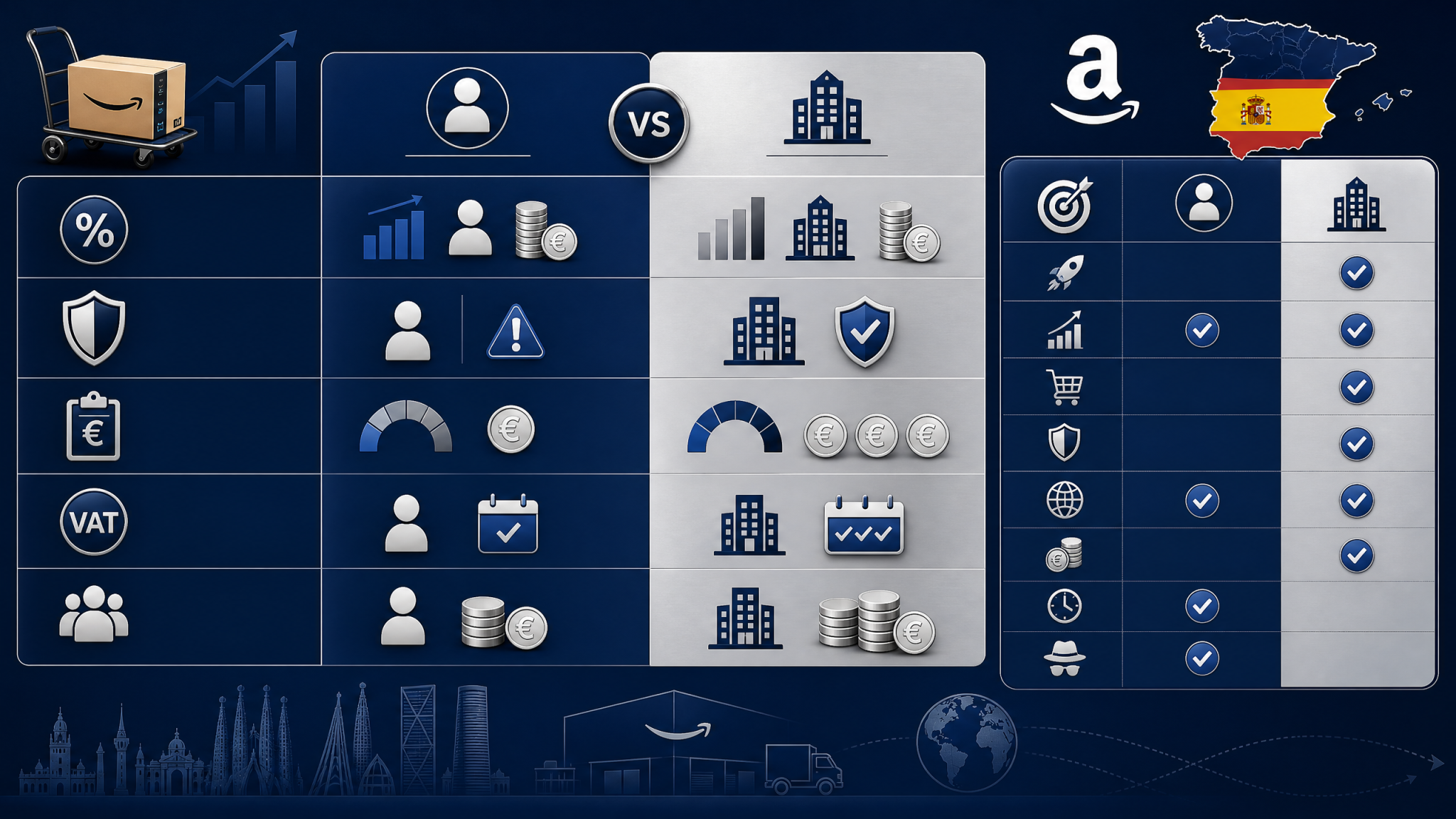
For ambitious Amazon sellers looking to establish or expand their operations in Spain, one of the most critical decisions revolves around choosing the right legal and tax structure. The choice between operating as a sole trader (autónomo) or forming a limited company (Sociedad Limitada, or SL) can significantly impact your tax burden, administrative complexity, and personal liability. This comprehensive guide, tailored for professional ecommerce entrepreneurs in 2026, delves into the intricacies of each structure, helping you determine which option offers the most tax efficiency and strategic advantages for your Amazon business in Spain.
Navigating the Spanish tax landscape can be daunting, especially when considering the unique demands of an online business. Understanding the nuances of autónomo vs SL Amazon Spain is paramount to optimizing your profitability and ensuring long-term compliance. We will explore the key differences in setup, ongoing costs, social security, income tax, and legal protections, providing actionable insights to inform your decision.
Understanding the Basics: Autónomo vs. Sociedad Limitada (SL)
What is an Autónomo (Sole Trader)?
An autónomo is the Spanish equivalent of a sole trader or self-employed individual. This is generally the simplest and quickest way to start a business in Spain. As an autónomo, there is no legal distinction between you and your business. You are personally responsible for all business debts and liabilities. This structure is often favored by those just starting out or with lower income projections due to its straightforward setup and reduced administrative burden.
What is a Sociedad Limitada (SL) (Limited Company)?
A Sociedad Limitada (SL) is a private limited company, akin to a UK Ltd or a US LLC. It is a separate legal entity from its owners, meaning the personal assets of the shareholders are protected from business debts and liabilities. While an SL involves a more complex setup and higher ongoing administrative costs, it offers significant advantages in terms of liability protection and potential tax optimization at higher profit levels. This structure is often considered the best business structure Amazon Spain for established sellers or those with substantial revenue forecasts.
Key Differences: A Comparative Analysis for Amazon Sellers

The decision between an autónomo and an SL hinges on several critical factors, each with distinct implications for your Amazon FBA business.
1. Setup and Administration
Autónomo: Simplicity and Speed
- Setup: Registering as an autónomo is relatively quick and easy, involving registration with the Social Security (Seguridad Social) and the Tax Agency (Hacienda).
- Administration: Less administrative paperwork and fewer formal requirements compared to an SL. Quarterly tax filings are standard.
Sociedad Limitada (SL): Complexity and Formalities
- Setup: More complex, requiring a minimum share capital of €3,000, notary deeds, and registration in the Mercantile Registry. This process can take several weeks.
- Administration: Significantly more administrative and accounting obligations, including annual accounts, corporate resolutions, and more detailed bookkeeping.
2. Social Security Contributions
Autónomo: Progressive Contributions (2026 Rates)
As of 2026, autónomos in Spain operate under a progressive social security contribution system based on their declared net income. New autónomos can benefit from the ‘tarifa plana’ (flat rate) for the first 12-24 months.
Autónomo Monthly Social Security Contributions (2026)
| Year of Registration | Monthly Amount |
|---|---|
| Year 1 | €80/month (tarifa plana discount) |
| Year 2 | €80/month (extended discount, if income below minimum wage) |
| Year 3+ | Based on income (progressive system) |
After the initial discount period, contributions scale with your declared income. For example, monthly contributions can range from €230 for net incomes under €670 to €390-530+ for incomes over €2,030 [1]. These contributions cover public healthcare, pension accrual, and sick/maternity/paternity leave.
Sociedad Limitada (SL): Fixed Administrator Contributions
If you are an administrator of your own SL and hold more than 25% of the company shares, you will typically pay a fixed social security contribution, often around €350-€400 per month, regardless of your income from the company [1]. This can be a significant fixed cost, especially in the early stages of your Spain company formation ecommerce seller journey.
3. Income Tax (IRPF) vs. Corporate Tax (IS)
Autónomo: Personal Income Tax (IRPF)
As an autónomo, your business profits are taxed as part of your personal income (IRPF) at progressive rates. These rates can be quite high for higher earners, ranging from 19% for incomes up to €12,450 to 47% for incomes over €300,000, plus potential regional surcharges [1]. For more details, see our guide on VAT accounting Pan-European Amazon sellers multiple countries.
Autónomo Income Tax (IRPF) Rates (2026)
| Income Bracket | Tax Rate |
|---|---|
| Up to €12,450 | 19% |
| €12,450-20,200 | 24% |
| €20,200-35,200 | 30% |
| €35,200-60,000 | 37% |
| €60,000-300,000 | 45% |
| Over €300,000 | 47% |
Sociedad Limitada (SL): Corporate Tax (IS)
An SL pays Corporate Tax (Impuesto de Sociedades, IS) on its profits. The general corporate tax rate in Spain is 25%. For small businesses, the first €50,000 of profit may be taxed at a reduced rate of 23% [1]. Additionally, new companies meeting certain conditions can benefit from a reduced rate of 15% for their first two years of profit. For more details, see our guide on Amazon Pan-European program VAT multiple warehouses worth it. For more details, see our guide on importing to Europe and surviving tariff increases.
However, it’s crucial to remember that you still need to extract money from the company for personal use. This can be done through a salary or dividends:
- Salary: Subject to personal income tax (IRPF) and social security, similar to an employee.
- Dividends: Taxed at 19-26% depending on the amount, after the company has already paid corporate tax on those profits.
The combined effective tax rate (corporate tax + personal tax on salary/dividends) can sometimes be higher than for an autónomo at moderate income levels, making the sole trader vs limited company Spain Amazon seller tax comparison complex.
4. VAT (IVA) Obligations
VAT (Impuesto sobre el Valor Añadido, IVA) obligations are generally similar for both autónomos and SLs. If you sell goods or services that are subject to VAT, you will need to register for VAT and charge it to your customers. The general VAT rate in Spain is 21%, with reduced rates for certain goods and services [2]. For Amazon sellers, understanding VAT rules, especially for cross-border sales within the EU, is crucial. Both structures will need to file quarterly VAT returns (Modelo 303) and an annual VAT summary (Modelo 390).
5. Legal Liability
Autónomo: Unlimited Personal Liability
This is a significant drawback for autónomos. Your personal assets (house, car, savings) are not protected and can be used to cover business debts or legal claims. For an Amazon seller, this means that if your business faces a major lawsuit or financial difficulty, your personal wealth is at risk.
Sociedad Limitada (SL): Limited Liability Protection
One of the primary advantages of an SL is limited liability. The company is a separate legal entity, and the liability of its shareholders is limited to the amount of capital they have invested in the company. This protects your personal assets from business risks, making it a safer option for businesses with higher potential liabilities, such as those involved in product sales.
6. Deductible Expenses
Both autónomos and SLs can deduct legitimate business expenses from their taxable income, reducing their overall tax burden. Common deductible expenses for Amazon sellers include:
- Amazon seller fees and commissions
- Cost of goods sold
- Shipping and logistics costs
- Marketing and advertising expenses
- Office supplies and equipment
- Professional services (e.g., gestor, legal advice)
- Travel expenses related to business
While the types of deductible expenses are broadly similar, the administrative requirements for documenting and justifying these expenses can be more stringent for an SL.
The Inflection Point: When Does an SL Make Sense for Amazon Sellers?
The decision to transition from an autónomo to an SL often comes down to your business’s profitability and growth trajectory. While there’s no one-size-fits-all answer, several profit thresholds serve as general guidelines:
- Below €40,000/year Net Profit: For most Amazon sellers starting out or with modest profits, remaining an autónomo is almost always the more sensible choice. The lower overhead, simpler administration, and the ‘tarifa plana’ social security discount make it the clear winner at lower income levels [1].
- €40,000 – €60,000/year Net Profit: This is a marginal zone. An SL might start to offer tax advantages, particularly if you can strategically manage your salary and dividend distributions. However, the increased setup costs (€3,000+) and ongoing accounting fees (€200-€300/month) can quickly eat into any potential savings. It’s crucial to run the numbers with a gestor at this stage [1].
- Above €60,000/year Net Profit: At this level, seriously considering an SL becomes highly advisable. The corporate tax rate of 23-25% on company profits significantly beats the higher personal IRPF marginal rates (37-47%) that an autónomo would face. An SL allows you to cap your personal salary (and thus your high IRPF bracket), retain profits within the company at a lower tax rate, and withdraw them as dividends over time [1].
- Above €100,000/year Net Profit: An SL is almost always the superior structural choice. The substantial personal tax rates for autónomos at this income level make the overhead and complexity of an SL well worth it for tax optimization and liability protection.
Case Studies: Real-World Scenarios
To illustrate the financial implications, consider these simplified examples (figures are approximate and for illustrative purposes only):
Case 1: Amazon Seller with €35,000 Net Profit/Year
- Autónomo: Total tax + costs (social security, IRPF, gestor) ≈ €9,700. Take-home ≈ €25,300.
- SL: Minimum overhead (gestor, social security) ≈ €7,200. Corporate tax + personal tax on salary ≈ €6,000. Total tax + costs ≈ €13,200. Take-home ≈ €21,800.
In this scenario, the autónomo structure clearly wins by approximately €3,500 per year [1]. For more details, see our guide on Amazon selling models: Vendor vs Seller Central.
Case 2: Amazon Seller with €70,000 Net Profit/Year
- Autónomo: Total tax + costs (social security, IRPF, gestor) ≈ €26,000. Take-home ≈ €44,000.
- SL: Overhead ≈ €8,400. Pay yourself a €30,000 salary (lower IRPF bracket). Corporate tax on €40,000 retained profits ≈ €9,200. Personal tax on salary ≈ €5,000. Total tax + costs ≈ €22,600. Take-home ≈ €47,400 (with €31,000+ retained in the company).
Here, the SL structure can be more advantageous, especially if you are comfortable retaining some profits within the company for reinvestment or future distribution [1].
Common Pitfalls and Mistakes for Amazon Sellers in Spain
Many ecommerce entrepreneurs, particularly those new to the Spanish market, fall into common traps when choosing their business structure. Avoiding these can save you significant headaches and financial penalties.
1. Overcomplicating Early
A frequent mistake is rushing to form an SL before your business has reached a consistent and substantial profit level. The higher setup and ongoing costs of an SL can quickly erode your margins if your revenue is not yet stable or high enough to justify the expense. As a general rule, avoid an SL until you are consistently earning €60,000+ in net profit [1].
2. Underestimating Autónomo Costs
While the ‘tarifa plana’ of €80/month for new autónomos is attractive, many underestimate the costs once this discount period ends. With the progressive social security system, monthly contributions can quickly rise to €300-€400 or more, even before you factor in income tax and gestor fees. It’s crucial to budget realistically for these ongoing expenses [1]. For more details, see our guide on OSS one stop shop Amazon sellers VAT EU.
3. Ignoring the Gestor Relationship
A gestor (tax advisor/accountant) is indispensable for both autónomos and SLs in Spain. They handle your tax declarations, social security filings, and provide crucial advice. A good gestor can save you money by ensuring compliance and identifying legitimate deductions, while a poor one can lead to costly mistakes. Invest time in finding a reputable and experienced gestor who understands ecommerce businesses.
4. Assuming Foreign Company Structures Work in Spain
A common misconception among expats is that they can continue to operate through a UK Ltd or US LLC while living and working in Spain. If you are tax resident in Spain (generally, spending more than 183 days a year in the country or having your center of vital interests here), your worldwide income is taxable in Spain. Attempting to avoid Spanish taxes by maintaining a foreign company structure for work performed in Spain is a significant risk and can lead to severe penalties from Hacienda (the Spanish Tax Agency) [1]. HMRC and Hacienda actively exchange information under the Common Reporting Standard (CRS).
Recommendations for Amazon Sellers in Spain
Based on the comparative analysis, here are tailored recommendations for Amazon sellers:
Starting Out (Net Profit < €40,000)
Begin as an autónomo. The ease of setup, lower initial costs, and the ‘tarifa plana’ social security discount provide a flexible runway to build your Amazon business. Focus on generating sales and validating your product market fit without the burden of complex administrative overhead. This is often the best business structure Amazon Spain for new entrants.
Growing Business (€40,000 – €60,000 Net Profit)
As your Amazon business grows and approaches this profit bracket, it’s time to consult with a specialized gestor. They can help you perform a detailed financial analysis to determine if the tax savings and liability protection of an SL outweigh its increased costs and administrative complexity. Consider your personal risk tolerance and long-term business goals. For more details, see our guide on selling across Europe from a single warehouse.
Established Business (Net Profit > €60,000)
For established Amazon sellers with consistent high profits, forming an SL generally becomes the more tax-efficient and legally sound option. The ability to manage your personal income tax exposure, retain profits at a lower corporate tax rate, and benefit from limited liability protection are significant advantages. This structure also provides more flexibility for future growth, potential investors, or selling the business.
Conclusion: Making an Informed Decision for Your Amazon Business
Choosing between a sole trader vs limited company Spain Amazon seller tax structure is a pivotal decision that requires careful consideration of your current business stage, financial projections, and risk appetite. While the autónomo path offers simplicity and lower initial costs, the SL provides robust liability protection and significant tax optimization opportunities for higher-earning Amazon sellers. For more details, see our guide on VAT cross-border ecommerce Europe guide.
There is no universal solution; the optimal choice depends on your specific circumstances. Always consult with a qualified Spanish gestor or tax advisor who specializes in ecommerce to get personalized advice tailored to your unique situation. By making an informed decision, you can ensure your Amazon business in Spain is structured for maximum tax efficiency, legal protection, and sustainable growth in 2026 and beyond.
References
- [1] Waypoint Sur. “Autónomo vs SL in Spain: Which Business Structure Actually Makes Sense? (2026)”. https://guides.waypointsur.com/autonomo-vs-sl-which-spanish-business-structure/
- [2] Stripe. “VAT for ecommerce businesses in Spain”. https://stripe.com/resources/more/vat-ecommerce-businesses-spain