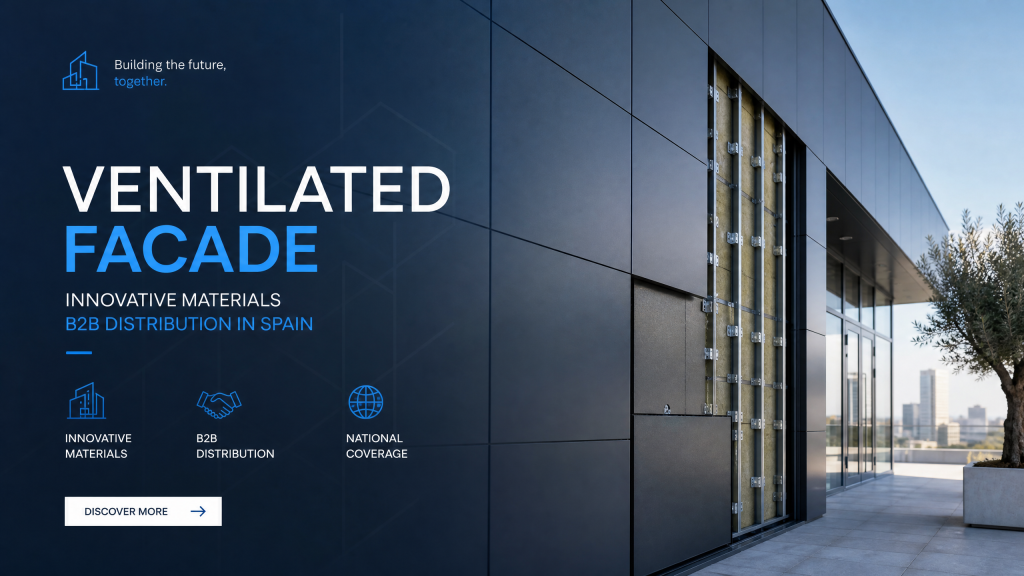
Spain’s Ventilated Facade Market Is Growing Faster Than Supply Chains Can Handle
Spain’s construction sector spent €47.2 billion in 2023, with renovation and energy efficiency upgrades accounting for 62% of that investment. Within that segment, ventilated facade systems—also known as rain screen or double-skin facades—represent one of the fastest-growing material categories, yet fewer than 30% of Spanish architects and builders report having reliable B2B access to innovative European manufacturers.
This supply-demand gap exists not because ventilated facades lack demand, but because most European startups manufacturing next-generation facade materials lack the logistics infrastructure to reach fragmented B2B buyers across Spain and southern Europe efficiently. A startup with breakthrough composite materials or innovative ceramic tile systems can design world-class products, but without a partner capable of managing bulky, high-value inventory and coordinating complex delivery schedules to construction sites across Andalusia, Castilla-La Mancha, and Portugal, market entry remains stalled.
This article explains how European tech startups manufacturing ventilated facade systems can build effective B2B distribution networks in Spain, and why logistics partnership strategy is as critical as product innovation itself.
Understanding the Ventilated Facade Market in Spain
What Are Ventilated Facade Systems and Why Does Spain Need Them?
Ventilated facades are multi-layer exterior wall systems featuring an outer cladding material (ceramic, composite, stone, or metal), an air gap, insulation, and an inner structural layer. The air gap allows moisture to escape and creates a thermal buffer, reducing energy consumption in buildings by 15–25% compared to traditional solid facades. In Spain’s Mediterranean and continental climate zones, this translates directly to lower heating and cooling costs—a compelling value proposition for both new construction and retrofit projects.
Spain’s 2020 Building Energy Code (CTE, Código Técnico de la Edificación) mandates improved thermal performance in new buildings and major renovations. This regulatory push has created sustained demand for ventilated facade systems among architects designing compliant projects and builders executing energy efficiency upgrades on existing residential and commercial properties.
Market Size and Growth Trajectory
The Spanish ventilated facade market was valued at approximately €340 million in 2022 and is projected to grow at a compound annual growth rate (CAGR) of 8.2% through 2028, according to construction materials analysts. This growth is driven by three factors:
- Energy renovation mandates: The EU’s Energy Performance of Buildings Directive (EPBD) requires member states to mandate deep energy renovations on 3% of public building stock annually, with Spain targeting 1.2 million residential units by 2030.
- Aesthetic and performance innovation: Architects increasingly specify ventilated facades for their aesthetic flexibility, durability, and performance characteristics, moving beyond traditional render systems.
- Sustainability credentials: Developers marketing LEED, BREEAM, or WELL-certified projects often include ventilated facades as a key sustainability feature.
However, this growth has created a bottleneck: demand for innovative ventilated facade materials—particularly from European startups offering novel composite systems, recycled ceramic solutions, or biomimetic materials—far exceeds available distribution capacity.
The B2B Buyer Landscape: Who Purchases Ventilated Facade Systems in Spain?
Primary Decision-Makers and Procurement Patterns
Ventilated facade systems are not purchased by end consumers. Instead, B2B buyers include:
- Architects and design firms: Specify facade systems during design phase; influence 70% of material selections but rarely purchase directly. Instead, they recommend suppliers to contractors and developers.
- General contractors and construction companies: Procure materials on behalf of project owners; require reliable supply, technical support, and logistics coordination. Typically work with 3–5 facade suppliers to manage project variability.
- Renovation and retrofit specialists: Focus on energy efficiency upgrades; often undertake 50–100 facade projects annually and need streamlined procurement and delivery logistics.
- Facade installation subcontractors: Specialized firms that install ventilated systems; often source materials directly and require technical training, product guarantees, and just-in-time delivery.
- Real estate developers: Large-scale residential and commercial developers; purchase in bulk and demand volume pricing, extended payment terms, and supply chain transparency.
Each buyer segment has distinct procurement timelines, volume requirements, and logistics constraints. Architects plan 6–12 months ahead; contractors operate on 4–8 week cycles; developers require quarterly forecasting and dedicated account management.
Geographic Concentration and Regional Demand Patterns
Ventilated facade adoption in Spain is geographically clustered:
- Madrid and surrounding regions: Largest concentration of commercial development and renovation projects; highest specification rates for premium facade systems.
- Catalonia (Barcelona, Tarragona): Strong architectural innovation culture and established facade subcontractor networks; high demand for innovative materials.
- Andalusia (Seville, Málaga, Córdoba): Growing renovation market driven by EU energy efficiency funding; emerging demand for innovative materials.
- Basque Country (Bilbao, San Sebastián): Established construction sector and high building standards; premium pricing for innovative systems.
However, smaller cities and secondary markets remain underserved. A startup with effective B2B distribution can capture significant market share by establishing presence in regions where established suppliers have limited reach.
Key Barriers to Market Entry for Startups Manufacturing Ventilated Facade Systems
The Logistics Problem: Bulky, High-Value, Fragmented Orders
Ventilated facade materials present acute logistics challenges. A typical facade project requires 500–2,000 square meters of cladding material, weighing 8–15 tons, with delivery to a specific construction site on a precise schedule. Unlike consumer products, facade materials cannot be stored indefinitely on-site; they must arrive days before installation to allow for inspection and acclimation.
A startup manufacturer based in Germany, Italy, or Portugal cannot efficiently manage direct delivery to dozens of scattered construction sites across Spain. The cost per delivery becomes prohibitive; the coordination burden overwhelms internal operations; and missed deliveries damage customer relationships and project timelines.
This is why established facade suppliers maintain regional warehouses and partner with logistics providers. A startup without this infrastructure cannot compete effectively.
Regulatory and Technical Certification Requirements
Ventilated facade systems must comply with Spanish Building Code (CTE) and European standards including EN 13823 (reaction to fire), EN ISO 9239-1 (thermal performance), and EN 12600 (impact resistance). Additionally, facade systems must be tested for wind load resistance, water tightness, and durability in specific climate zones.
Architects and contractors will not specify a system without verified compliance documentation and CE marking. Obtaining these certifications requires testing, third-party validation, and technical file preparation—processes that cost €15,000–€50,000 and take 8–16 weeks.
Startups must budget for compliance and certification before approaching B2B buyers. Without it, market access is blocked regardless of product quality.
Established Supplier Networks and Switching Costs
Major construction firms and facade contractors maintain relationships with 3–5 established facade suppliers, often formalized through framework agreements with negotiated pricing, payment terms, and performance guarantees. Switching to a new supplier requires approval from procurement, technical evaluation, and often pilot projects—processes that take 3–6 months.
Breaking into these networks requires a compelling value proposition: either significantly lower pricing, demonstrably superior performance, or innovative features that address specific customer pain points (e.g., faster installation, better sustainability credentials, novel aesthetics).
Building a B2B Distribution Strategy for Ventilated Facade Systems in Spain
Step 1: Secure Compliance Certification and Technical Documentation
Before approaching any B2B buyer, ensure your ventilated facade system is fully compliant and certified. This includes:
- CE marking under the Construction Products Regulation (CPR 305/2011)
- Technical file prepared by a notified body
- Test reports for fire performance (EN 13823), thermal performance (EN ISO 9239-1), and mechanical performance (EN 12600)
- Installation guidelines and maintenance documentation in Spanish
- Environmental Product Declarations (EPD) if sustainability is a key differentiator
Partner with a testing laboratory experienced in facade systems—organizations like APPLUS+ or DEKRA in Spain can guide compliance pathways and manage third-party validation. Budget €25,000–€40,000 and 12–14 weeks for this process.
Step 2: Identify and Map Your Target Customer Segments
Rather than attempting to reach all Spanish buyers simultaneously, focus on a specific, high-value segment:
- Renovation specialists in Andalusia: Concentrated in Seville, Málaga, and Córdoba; actively pursuing EU energy efficiency funding; open to innovative materials; lower switching costs than large developers.
- Commercial developers in Madrid: High project volumes; premium specifications; strong purchasing power; longer sales cycles but larger order values.
- Architects specializing in sustainability: Actively seek innovative materials; influence material selection; can become advocates for your product across multiple projects.
- Facade installation subcontractors: High-volume buyers; require reliable supply and technical support; can become channel partners if relationship is strong.
Create a target account list of 20–30 high-priority buyers in your chosen segment. Research their recent projects, procurement patterns, and decision-makers. This focused approach is far more effective than broad marketing.
Step 3: Establish a Logistics Partnership with Regional Warehouse Presence
This is the critical step most startups overlook. You cannot succeed without reliable, cost-effective logistics infrastructure. Your options include:
| Logistics Option | Advantages | Disadvantages | Typical Cost (€/month) |
|---|---|---|---|
| Regional 3PL provider with warehouse | Professional management, established networks, flexible scaling, technical support | Less control, shared warehouse space, potential service variability | €2,500–€5,000 (includes storage, handling, delivery coordination) |
| Dedicated warehouse lease + own logistics coordination | Full control, customized operations, direct customer relationships | High fixed costs, operational complexity, capital requirement, limited geographic reach | €1,200–€2,500 (warehouse only; additional costs for labor, vehicles, software) |
| Just-in-time manufacturing + direct customer shipping | Minimal inventory carrying costs, reduced warehouse footprint | Inflexible, high per-unit shipping costs, difficult to meet urgent requests, requires perfect demand forecasting | €800–€1,500 (shipping only; no warehouse) |
| Hybrid: Regional 3PL for Spain + direct EU shipping from manufacturing | Balanced cost and flexibility, professional logistics for Spain market, direct control for other regions | Coordination complexity, split inventory management | €2,000–€4,000 (3PL Spain) + manufacturing-based direct shipping |
For most startups, partnering with a specialized 3PL provider offering warehouse, handling, and delivery coordination is the most practical option. Look for providers with:
- Experience managing bulky, high-value construction materials
- Regional warehouse presence in key Spanish markets (Madrid, Andalusia, Catalonia)
- Established relationships with construction logistics networks
- Flexible inventory management and just-in-time delivery capabilities
- Technical support and customer communication capabilities
In southern Spain and the Andalusia region, Solavance offers specialized logistics infrastructure specifically designed for bulky, high-value construction materials and innovative European tech products. Based in Córdoba—a strategic hub providing access to Andalusia, Portugal, the Madrid corridor, and North Africa—Solavance operates its own fleet of specialized trucks and maintains dedicated warehouse capacity for construction materials. For ventilated facade startups targeting the Spanish market, Solavance’s regional presence and experience with innovative construction materials distribution make it an ideal logistics partner.
Step 4: Develop Technical Sales Support and Customer Training Programs
B2B buyers of ventilated facade systems require more than product availability; they need technical expertise, installation support, and problem resolution. Establish:
- Technical sales team: 1–2 engineers who can discuss performance specifications, compliance, and system integration with architects and contractors.
- Installation training program: Regular workshops (quarterly, in-person or virtual) for facade subcontractors, covering installation techniques, troubleshooting, and warranty procedures.
- Technical documentation library: Comprehensive installation guides, CAD details, specification templates, and case studies in Spanish, accessible online and in print.
- Responsive technical support line: Dedicated phone/email support during business hours for urgent on-site questions.
This support infrastructure differentiates innovative startups from commodity suppliers and justifies premium pricing.
Step 5: Establish Channel Partnerships with Facade Contractors and Distributors
Rather than selling directly to every end-customer, identify and partner with facade installation specialists and material distributors who already have established relationships with architects and contractors. Offer:
- Competitive wholesale pricing (typically 25–35% margin for channel partners)
- Technical training and certification for their installation teams
- Co-marketing support and project case studies
- Flexible payment terms and volume discounts
- Exclusive territorial arrangements if appropriate
Channel partners can accelerate market penetration significantly. A single facade contractor handling 30–50 projects annually can generate €150,000–€300,000 in annual revenue for your system.
Practical Tools and Technologies for B2B Facade Distribution
CRM and Project Management Platforms
Implement a CRM system to track customer relationships, project pipelines, and order history. Recommended platforms for construction B2B include:
- Salesforce with construction-specific modules: Enterprise-grade CRM with customizable workflows for project-based sales cycles. Integrates with accounting, inventory, and logistics systems. Cost: €165–€330/user/month.
- HubSpot CRM: Mid-market focused; strong pipeline management and sales automation. Free tier available for startups. Cost: €50–€1,200/month depending on features.