Introduction: Navigating the Evolving Amazon Ecosystem in 2026
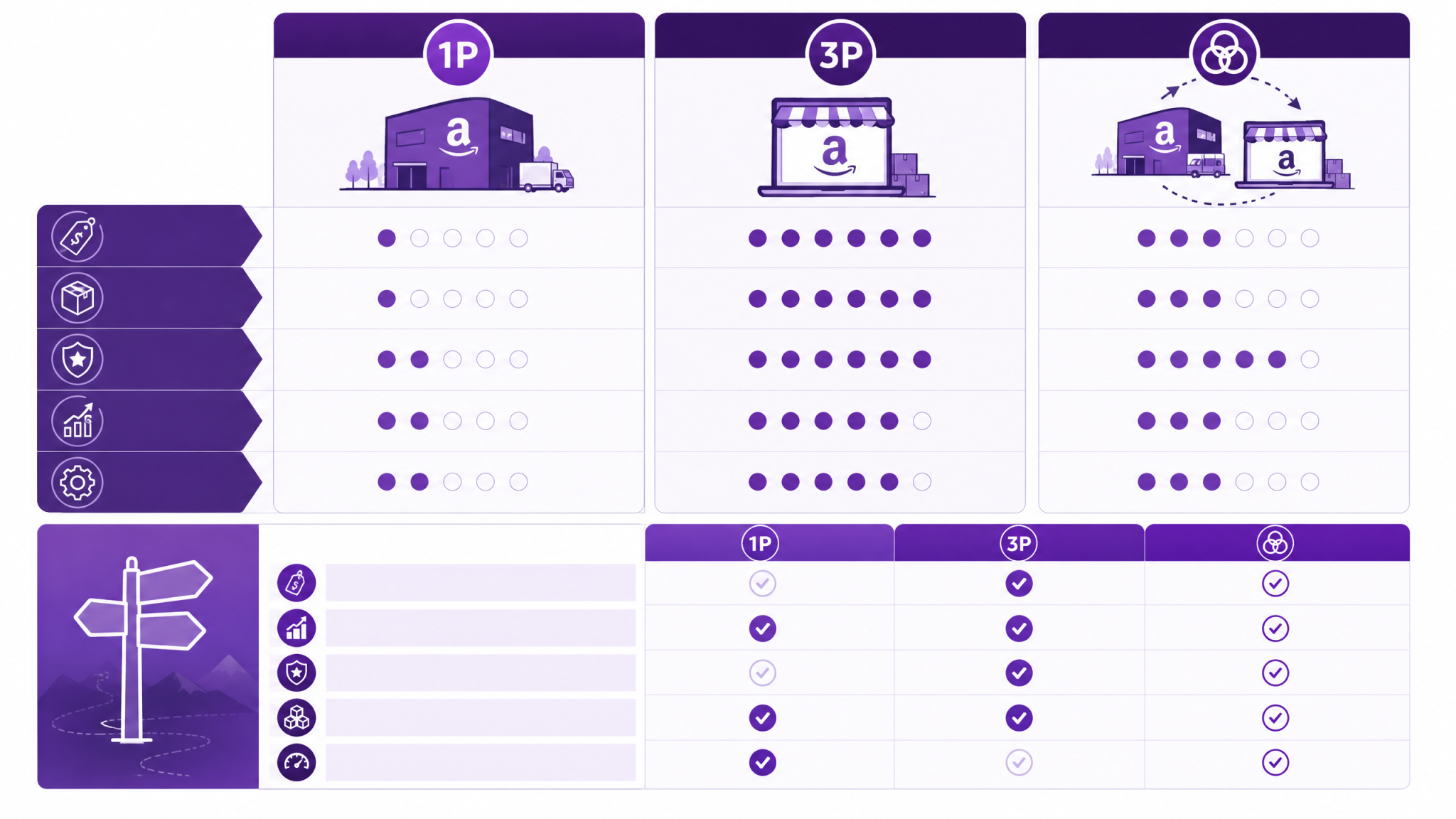
As the e-commerce landscape matures into 2026, brands selling on Amazon face increasingly complex strategic decisions. Gone are the days when simply listing a product guaranteed success. Today, enterprise brands, manufacturers, and ambitious private label sellers must carefully architect their backend operations to maximize profitability, maintain brand equity, and ensure supply chain resilience.
At the core of this strategic architecture is the decision of how you interface with Amazon. Do you act as a traditional wholesale supplier, or do you sell directly to consumers? Or, perhaps, do you leverage the best of both worlds? If you are struggling to determine the right path, you are in the right place. This comprehensive Amazon Vendor Central vs Seller Central hybrid model guide is designed to dissect every nuance of these platforms. For more details, see our guide on definitive guide to international expansion for Amazon sellers.
We will explore the intricacies of Amazon 1P vs 3P selling, conduct a deep-dive Vendor Central Seller Central comparison, and ultimately help you answer the critical question: Amazon selling model which is better for your specific brand?
Understanding the Basics: Amazon 1P vs 3P Selling
Before diving into complex hybrid strategies, we must establish a firm understanding of the two foundational selling models on Amazon: First-Party (1P) and Third-Party (3P). According to Gartner supply chain insights, these strategies are increasingly important.
First-Party (1P): Amazon Vendor Central
In the 1P model, you act as a wholesale supplier to Amazon. You negotiate terms, and Amazon issues weekly or monthly Purchase Orders (POs) for your products. Once you ship the inventory to Amazon’s fulfillment centers, ownership of the goods transfers to Amazon. Amazon then prices the product, sells it to the end consumer, and handles all customer service. The listing will display the highly coveted badge: “Ships from and sold by Amazon.” This relationship is managed through a portal called Vendor Central. For more details, see our guide on advanced growth strategies for established Amazon sellers.
Third-Party (3P): Amazon Seller Central
In the 3P model, you are the retailer of record. You use Amazon’s marketplace to sell your products directly to consumers. You retain ownership of your inventory until a customer purchases it. You have complete control over retail pricing, listing optimization, and inventory levels. You can choose to fulfill orders yourself (Fulfillment by Merchant – FBM) or pay Amazon to handle fulfillment (Fulfillment by Amazon – FBA). This relationship is managed through Seller Central.
Deep Dive: Amazon Vendor Central (1P)

Vendor Central is traditionally an invite-only platform, aimed at manufacturers, distributors, and established brands with significant market presence. While the prestige of being a direct supplier to Amazon is appealing, the reality of operating in Vendor Central requires robust operational capabilities.
The Pros of Vendor Central
- Consumer Trust and Conversion Rates: The “Sold by Amazon” badge carries immense weight. Consumers inherently trust Amazon, which often leads to higher conversion rates compared to 3P listings.
- Simplified Business Model: For traditional manufacturers, 1P mimics a standard B2B wholesale relationship. You receive a PO, ship the goods in bulk, and wait for your invoice to be paid. You do not have to worry about sales tax collection or direct-to-consumer customer service.
- Access to Premium Marketing Tools: While Seller Central has closed the gap in recent years, Vendor Central still offers unique promotional opportunities, specialized Vine programs, and deeper integration with Amazon’s retail teams (if you have a Vendor Manager).
The Cons of Vendor Central
- Loss of Pricing Control: This is the most significant drawback. Amazon’s algorithm dynamically prices 1P products to match or beat other retailers (like Walmart or Target). This can trigger a “race to the bottom,” eroding your brand’s Minimum Advertised Price (MAP) across all sales channels.
- Rigid Financial Terms and Squeezed Margins: Amazon negotiates aggressively. You will be subject to Market Development Funds (MDF), co-op fees, freight allowances, and damage allowances. Furthermore, Amazon expects wholesale costs to decrease over time.
- The Threat of Chargebacks: Amazon’s operational requirements for routing and receiving are notoriously strict in 2026. Minor infractions in labeling, packaging, or PO fulfillment rates (fill rate) result in immediate and costly chargebacks, which can severely impact your net margins.
- CRaP Status: If Amazon cannot realize a profit (CRaP) on your item due to price matching and fulfillment costs, they will simply stop issuing POs, leaving your product out of stock.
Deep Dive: Amazon Seller Central (3P)
Seller Central is open to almost anyone and has become the engine driving the majority of Amazon’s global retail sales. In 2026, professional brands are increasingly migrating to 3P to regain control over their businesses. For more details, see our guide on how to get Amazon Vendor Central invitation.
The Pros of Seller Central
- Total Pricing Control: As the retailer of record, you dictate the final selling price. This allows you to protect your brand equity, enforce MAP policies, and run strategic discounts without triggering automated price wars across the internet.
- Higher Profit Margins: By cutting out Amazon as the wholesale middleman and selling directly to the consumer, brands often realize significantly higher gross margins, even after accounting for FBA fees and referral commissions.
- Inventory Control and Agility: You do not have to wait for Amazon’s algorithm to issue a PO. You forecast your own demand and send inventory to FBA as needed. This prevents stockouts on fast-moving items and allows you to launch new products instantly.
- Actionable Analytics: Seller Central provides robust data through Brand Analytics, giving you deeper insights into consumer search behavior, demographic data, and market basket analysis.
The Cons of Seller Central
- Operational Heavy Lifting: You are responsible for the entire consumer lifecycle. This means managing FBA inventory limits, handling customer inquiries (if FBM), managing returns, and navigating complex sales tax liabilities.
- Intense Competition: The barrier to entry is low, meaning you are competing against millions of other sellers, including aggressive international manufacturers.
- Account Suspension Risks: 3P sellers are subject to strict performance metrics. A sudden spike in Order Defect Rates (ODR) or intellectual property complaints can result in an immediate automated account suspension, freezing your funds and revenue stream.
Vendor Central Seller Central Comparison: A Strategic Breakdown
To truly understand the operational differences, we must conduct a side-by-side Vendor Central Seller Central comparison across three critical pillars: Financials, Logistics, and Advertising. For more details, see our guide on channel conflict Amazon distributors selling directly.
1. Financial Implications and Cash Flow
In Vendor Central, you are paid on wholesale terms, typically Net 30, Net 60, or Net 90. However, Amazon often deducts a percentage (e.g., 2%) if they pay within 30 days. You must also factor in the hidden costs of chargebacks and co-op fees, which can reduce your actual payout by 10% to 15% of the PO value.
In Seller Central, cash flow is generally faster. Amazon disburses funds every 14 days (or sooner, depending on account health). Your costs are transparent: a monthly subscription fee, a referral fee (typically 8-15% depending on the category), and FBA fulfillment fees based on weight and dimensions. For optimized brands, the 3P model almost always yields a superior net margin. For more details, see our guide on pricing strategies for professional Amazon sellers.
2. Logistics and Inventory Management
For 1P Vendors, Amazon’s EDI (Electronic Data Interchange) system dictates what is ordered. If Amazon’s predictive algorithm miscalculates demand, they may under-order, leading to lost sales, or over-order, leading to requests for massive return allowances. You have little say in the matter.
For 3P Sellers, you rely on your own supply chain forecasting. You must navigate Amazon’s FBA Capacity Manager, ensuring you have enough stock to meet demand without incurring exorbitant long-term storage fees. The risk is entirely on your shoulders, but so is the reward of uninterrupted availability.
3. Advertising and Brand Control
Historically, Vendor Central had superior advertising tools. By 2026, this gap has completely closed. Both 1P and 3P sellers enrolled in Amazon Brand Registry have full access to Sponsored Products, Sponsored Brands, Sponsored Display, and the Amazon Demand-Side Platform (DSP).
However, 3P sellers have a distinct advantage in Brand Control. Because they control the price, they can ensure their advertising ROI is not destroyed by a sudden drop in the Buy Box price. Furthermore, 3P sellers can instantly update A+ Content, titles, and images, whereas 1P vendors often struggle with Amazon’s catalog team locking their listings.
The Best of Both Worlds: The Amazon Hybrid Model Explained
Given the distinct advantages and disadvantages of both platforms, enterprise brands are no longer asking, “Which one should we choose?” Instead, they are asking, “How can we leverage both?” This brings us to the core of our Amazon Vendor Central vs Seller Central hybrid model guide.
What is the Hybrid Model?
The Hybrid Model is an advanced e-commerce strategy where a brand operates both a Vendor Central (1P) account and a Seller Central (3P) account simultaneously. By strategically dividing their product catalog between the two platforms, brands can mitigate risk, maximize profitability, and maintain total control over their market presence.
Strategic Implementation of the Hybrid Catalog
Operating a Hybrid Model requires a surgical approach to catalog management. Here is how leading brands structure their product lines in 2026: For more details, see our guide on Vendor Central profitability Amazon forced discounts margins.
- High-Volume, Core Products on 1P: Items with massive demand, stable margins, and low risk of CRaP status are kept on Vendor Central. Amazon’s wholesale purchasing power and the “Sold by Amazon” badge help drive maximum volume for these flagship items.
- New Releases and Variations on 3P: When launching a new product, Amazon’s 1P algorithm lacks the historical data to issue large POs. By launching new items on Seller Central, brands can generate initial sales velocity, gather reviews, and prove demand before eventually migrating the product to 1P (if desired).
- MAP-Sensitive and Premium Products on 3P: High-end items where price erosion would damage relationships with brick-and-mortar retail partners are strictly sold through Seller Central. This guarantees absolute control over the retail price.
- Oversized or Low-Margin Items on 3P (FBM): Products that are too large or heavy for profitable FBA or 1P wholesale margins are sold via Seller Central using Fulfillment by Merchant (FBM). This allows the brand to ship directly from their own warehouse, saving on Amazon’s hefty logistics fees.
The Ultimate Safety Net: Inventory Redundancy
Perhaps the greatest advantage of the Hybrid Model is supply chain redundancy. If Amazon’s 1P algorithm suddenly stops issuing POs for a top-selling item, a 1P-only brand loses its revenue stream instantly. In a Hybrid Model, the brand can immediately activate their 3P FBA or FBM listing for that same ASIN, capturing the Buy Box and ensuring consumers can still purchase the product. This dual-node fulfillment strategy is essential for surviving Q4 peak seasons and global supply chain disruptions.
Amazon Selling Model Which is Better? (A Decision Framework)
So, regarding the Amazon selling model which is better? The answer depends entirely on your operational maturity, financial goals, and brand equity requirements.
Choose Vendor Central (1P) ONLY if:
- You are a massive manufacturer optimized for pallet-level B2B wholesale.
- You lack the internal infrastructure to manage consumer-facing logistics, sales tax, and daily account health monitoring.
- Brand awareness and sheer volume are more important to you than maximizing per-unit profit margins.
Choose Seller Central (3P) if: For more details, see our guide on Amazon Vendor Central vs Seller Central 2026 hybrid.
- You are a digitally native brand, private label seller, or agile manufacturer.
- Protecting your Minimum Advertised Price (MAP) is critical to your omnichannel retail strategy.
- You want to maximize your gross margins and have the operational bandwidth to manage FBA inventory.
- You demand fast, predictable cash flow (14-day disbursements).
Choose the Hybrid Model if: According to Amazon Seller Central guidelines, these strategies are increasingly important.
- You are an established enterprise brand currently struggling with 1P profitability and chargebacks.
- You want to launch new products quickly without waiting for Amazon’s PO algorithm to catch up.
- You need an inventory fail-safe to protect against 1P stockouts and CRaP designations.
- You have a dedicated in-house Amazon team or an expert agency capable of managing the complexities of both platforms simultaneously without violating Amazon’s terms of service.
Conclusion: Taking Control of Your Amazon Destiny
The Amazon marketplace in 2026 is unforgiving to those who rely on outdated strategies. Relying solely on Vendor Central leaves your brand vulnerable to margin compression and algorithmic whims. Conversely, relying purely on Seller Central may leave massive wholesale volume on the table for legacy manufacturing brands.
By understanding the nuances of Amazon 1P vs 3P selling, you can architect a bespoke strategy that serves your business goals. For the vast majority of growing and established brands today, transitioning to a Hybrid Model is the ultimate competitive advantage. It provides the volume and prestige of wholesale, combined with the profitability, price control, and agility of direct-to-consumer retail.
Evaluate your catalog, analyze your true net margins after chargebacks and fees, and start planning your transition. The brands that master the Hybrid Model will be the ones that dominate their categories for the next decade.