Selling on Amazon Germany and France: Language Barriers, LUCID/EPR Compliance, and Tax Requirements
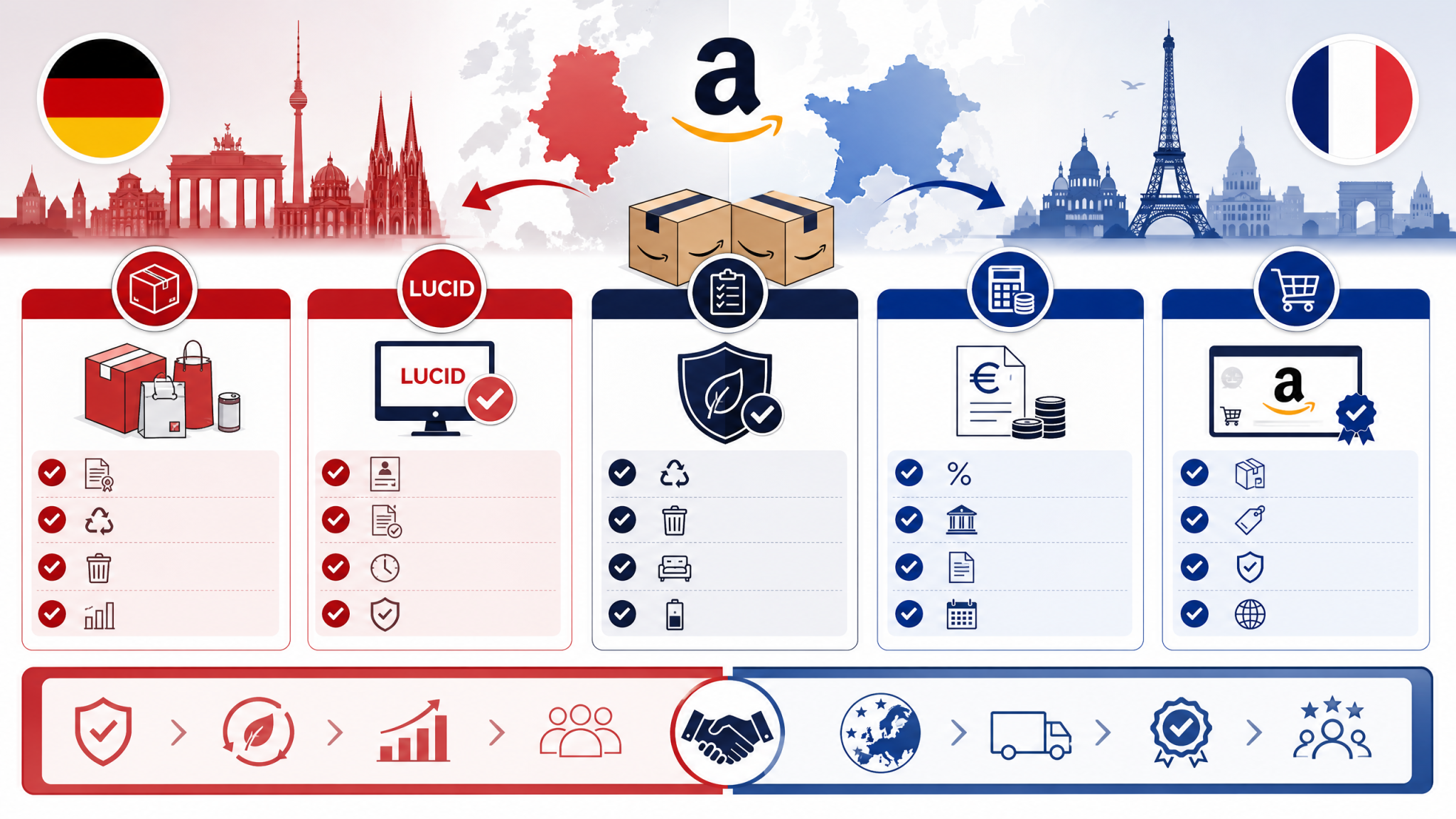
Expanding your Amazon FBA business into Europe presents a monumental opportunity, with Germany and France standing out as the continent’s largest and most lucrative markets. However, these markets are not without their complexities. Success hinges not just on product-market fit, but critically, on navigating a labyrinth of regulatory hurdles, including language barriers, stringent environmental compliance (LUCID and EPR), and intricate tax requirements. This comprehensive guide is designed for the ambitious e-commerce entrepreneur of 2026, providing an authoritative and actionable roadmap to conquer these challenges and thrive when selling Amazon Germany France LUCID EPR compliance is paramount.
Ignoring these compliance aspects is not an option; it can lead to significant fines, operational disruptions, and even expulsion from Amazon’s marketplaces. By proactively addressing these requirements, you not only mitigate risks but also build a foundation for sustainable growth and a reputable brand presence in two of Europe’s most dynamic economies.
The Allure of Amazon Germany & France: Unlocking European Potential
Germany and France collectively represent a colossal share of the European e-commerce landscape. Germany, with its robust economy and tech-savvy population, boasts the largest e-commerce market in Europe. France, a close second, offers a similarly attractive consumer base with a strong appetite for online shopping. For Amazon FBA sellers, these markets offer:
- Vast Customer Bases: Access to millions of potential customers actively shopping on Amazon.
- High Purchasing Power: Consumers in both countries have significant disposable income, leading to higher average order values.
- Strategic Gateway: Success in these markets can serve as a springboard for further expansion into other European countries.
- Established Logistics: Amazon’s FBA infrastructure is highly developed, offering efficient storage, fulfillment, and customer service.
However, this immense potential comes with a caveat: the need for meticulous preparation and adherence to local regulations. Understanding and implementing strategies for language, environmental responsibility, and taxation are not merely administrative tasks; they are strategic imperatives for market entry and long-term success.
Navigating the Language Barrier: More Than Just Translation
The most immediate and often underestimated challenge when expanding into Germany and France is the language barrier. While many Europeans speak English, conducting business in the local language is non-negotiable for building trust, ensuring clarity, and optimizing sales. This extends beyond product listings to every touchpoint of your customer journey.
- Product Listings & A+ Content: Direct, literal translations are insufficient. Listings must be localized, meaning adapting the language to cultural nuances, local idioms, and search terms. Professional, native-speaking translators are crucial to ensure your product descriptions resonate with local buyers and rank effectively in search results.
- Customer Service: Providing customer support in German and French is essential. Customers expect to communicate in their native language, especially when dealing with inquiries, returns, or complaints. This can be managed through in-house native speakers, outsourcing to specialized agencies, or leveraging translation tools for less complex queries.
- Advertising & Marketing: Your Amazon PPC campaigns, social media ads, and any external marketing efforts must be in the local language. Keywords need to be researched and optimized for German and French search engines and Amazon’s internal search algorithms.
- Legal & Compliance Documents: All legal disclaimers, terms of service, and privacy policies must be available in the respective local languages to comply with consumer protection laws.
Investing in high-quality localization demonstrates respect for your customers and significantly enhances your brand’s credibility and conversion rates. It’s a foundational step that underpins all other compliance efforts.
LUCID Registration in Germany: The Packaging Act (VerpackG)
Germany’s Packaging Act (VerpackG), effective since 2019, mandates that any company placing packaged goods on the German market must register with the Central Agency Packaging Register (Zentrale Stelle Verpackungsregister – ZSVR) and participate in a dual system for packaging recycling. This is a critical component of Amazon Germany LUCID registration.
What is LUCID?
LUCID is the public register where producers (which includes Amazon sellers, even if based outside Germany) declare their packaging volumes. The goal is to ensure that packaging is collected, sorted, and recycled, contributing to a circular economy.
Who Needs to Register?
If you sell products to end-consumers in Germany that are packaged (this includes primary, secondary, and shipping packaging), you are considered a ‘producer’ under VerpackG and must register with LUCID. This applies regardless of your company’s location.
Step-by-Step LUCID Registration Process:
- Register with LUCID: Go to the ZSVR website (lucid.verpackungsregister.org) and complete the registration process. You will receive a LUCID registration number.
- Contract with a Dual System: Choose and contract with one of the approved dual systems (e.g., Reclay, Interseroh, Landbell). You will declare your estimated annual packaging volumes (by material type) to this system and pay a fee based on these volumes.
- Data Reporting to LUCID: Report the same packaging volumes and the name of your dual system partner to the LUCID register. Ensure consistency between your dual system declaration and your LUCID declaration.
- Regular Reporting: Annually, and sometimes quarterly, you will need to report actual packaging volumes to both your dual system and LUCID.
Amazon actively enforces VerpackG. Sellers without a valid LUCID registration number risk having their listings suppressed or even their selling privileges revoked. Ensure your LUCID ID is provided to Amazon. For more details, see our guide on launch Amazon USA Canada from Spain legal requirements. For more details, see our guide on fulfillment strategies for scaling in European markets.
EPR Compliance Across Europe: Extended Producer Responsibility
Extended Producer Responsibility (EPR) is a policy approach under which producers are given a significant responsibility – financial and/or physical – for the treatment or disposal of post-consumer products. It’s a cornerstone of environmental policy in the EU, and EPR compliance Amazon Europe is becoming increasingly strict.
What is EPR?
EPR schemes aim to shift the burden of waste management from taxpayers and municipalities to the producers of goods. This incentivizes producers to design more environmentally friendly products and packaging.
Categories Covered by EPR:
EPR applies to various product categories, which differ slightly by country but commonly include:
- Packaging (e.g., Germany’s VerpackG, France’s Citeo/Adelphe)
- Electrical and Electronic Equipment (WEEE)
- Batteries
- Textiles
- Furniture
- Tyres
- Chemicals
Specific Requirements for Germany:
Beyond VerpackG (packaging), Germany has specific EPR requirements for: For more details, see our guide on Amazon international expansion guide sellers.
- WEEE (Waste Electrical and Electronic Equipment): If you sell electronics, you must register with stiftung ear and join a take-back system.
- Batteries (BattG): If your products contain batteries, you must register with the German Federal Environment Agency (UBA) and join a take-back system.
Specific Requirements for France:
France has one of the most comprehensive EPR frameworks in Europe, covering a wide array of categories. If you sell products in France, you likely need to comply with multiple EPR schemes:
- Packaging: Register with a PRO like Citeo or Adelphe.
- WEEE: Register with a PRO like Ecosystem or Ecologic.
- Batteries: Register with a PRO like Corepile or Screlec.
- Textiles: Register with Refashion.
- Furniture: Register with Ecomaison or Valdelia.
- Tyres: Register with Aliapur or France Recyclage Pneus.
For each applicable category, you must register with an approved Producer Responsibility Organization (PRO) in France, declare your sales volumes, and pay eco-contributions. Amazon requires proof of your EPR registration numbers (Unique Identification
Numbers – UINs) for each category in France.
Amazon’s Role in Enforcing EPR:
Amazon has taken an active role in enforcing EPR compliance. For both Germany and France, Amazon requires sellers to provide valid EPR registration numbers for all applicable product categories. Failure to do so can result in Amazon either blocking your listings or, in some cases, automatically deducting eco-contributions from your sales and remitting them on your behalf, often at a higher cost than if you had registered directly.
VAT Requirements in Germany & France: Understanding Your Tax Obligations
Value Added Tax (VAT) is a consumption tax levied on goods and services in the European Union. For Amazon FBA sellers, understanding and complying with VAT regulations in Germany and France is crucial to avoid significant financial penalties and ensure smooth operations. This is particularly important for Amazon France VAT requirements and its German counterpart. For more details, see our guide on VAT compliance for cross-border Amazon sellers. For more details, see our guide on Vendor Central vs Seller Central in 2026.
Understanding VAT Thresholds:
Since July 1, 2021, the EU introduced new VAT e-commerce rules, including a single EU-wide distance selling threshold of €10,000. This means that once your total cross-border sales to EU consumers exceed €10,000 in a calendar year, you are generally required to charge VAT at the rate of the customer’s country and remit it to that country’s tax authority. For most Amazon FBA sellers, this threshold is quickly surpassed, necessitating VAT registration in Germany and France. According to Amazon Seller Central guidelines, these strategies are increasingly important.
When to Register for VAT in Each Country:
- Storage in a Country: If you store inventory in an Amazon FBA warehouse in Germany or France, you trigger a VAT registration obligation in that country from day one, regardless of sales volume. This is the most common scenario for FBA sellers.
- Distance Selling Threshold: If you sell from one EU country to consumers in Germany or France, and your total EU-wide distance sales exceed €10,000, you must register for VAT in Germany and/or France (or use the One Stop Shop – OSS scheme).
VAT Rates:
Both Germany and France have standard and reduced VAT rates. It’s essential to apply the correct rate to your products. The standard VAT rate in Germany is 19%, and in France, it is 20%. Reduced rates apply to specific goods and services (e.g., certain foodstuffs, books, medical supplies).
Fiscal Representation:
For non-EU businesses, registering for VAT in Germany and France often requires appointing a fiscal representative. A fiscal representative is a local entity that acts as your liaison with the tax authorities, handles your VAT registrations, filings, and payments, and is jointly liable for your VAT obligations. This adds an additional layer of cost and complexity but is a mandatory requirement in many cases.
FBA Implications for VAT:
Amazon’s FBA program simplifies logistics but complicates VAT. When Amazon moves your inventory between fulfillment centers in different EU countries (e.g., from Germany to France), these are considered intra-community movements of your own goods, which must be reported on your VAT returns. This necessitates accurate tracking and reporting of inventory movements and sales. For more details, see our guide on Amazon global selling Europe single warehouse Spain.
Many sellers opt for the One Stop Shop (OSS) scheme to simplify VAT reporting for cross-border sales to consumers within the EU. However, OSS does not negate the need for local VAT registration if you store goods in a particular country.
Strategic Compliance: Best Practices for 2026
In the evolving landscape of European e-commerce, a proactive and strategic approach to compliance is not just good practice—it’s a competitive advantage. Here’s how to ensure your business is robustly compliant in 2026:
- Early Engagement with Experts: Do not attempt to navigate these complex regulations alone. Engage with specialized tax advisors, legal counsel, and EPR service providers who have expertise in German and French e-commerce compliance. Their guidance can save you from costly mistakes.
- Leverage Technology: Utilize accounting software and compliance platforms that integrate with Amazon and can help track sales, inventory movements, and generate reports necessary for VAT and EPR declarations.
- Stay Informed: Regulations are subject to change. Regularly monitor updates from the ZSVR, French PROs, and EU tax authorities. Subscribe to industry newsletters and consult with your compliance partners to stay ahead of any new requirements.
- Document Everything: Maintain meticulous records of all registrations, declarations, payments, and communications with authorities and service providers. This documentation is invaluable in case of audits or inquiries.
- Budget for Compliance: Factor in the costs of translation services, dual system fees, PRO contributions, fiscal representation, and professional advice into your business model. Viewing these as necessary investments rather than mere expenses will help you allocate resources appropriately.
The cost of non-compliance—fines, legal battles, business interruption, and reputational damage—far outweighs the investment in proper compliance. By embracing these best practices, you position your Amazon FBA business for sustained success in the lucrative German and French markets. For more details, see our guide on US tariffs impact European Amazon sellers 2026.
Conclusion: Mastering the European Market
Germany and France offer unparalleled opportunities for Amazon FBA sellers, but they demand a high level of operational diligence. Overcoming language barriers, meticulously adhering to LUCID and EPR compliance, and expertly managing VAT requirements are not merely obstacles; they are gateways to unlocking immense growth. By adopting an authoritative, actionable, and proactive approach to these challenges, e-commerce entrepreneurs can confidently expand their reach, build strong brands, and secure a dominant position in the heart of Europe’s digital economy. The future of selling Amazon Germany France LUCID EPR compliance is about strategic preparation and unwavering commitment to regulatory excellence.