
Introduction: The Backbone of E-commerce Efficiency
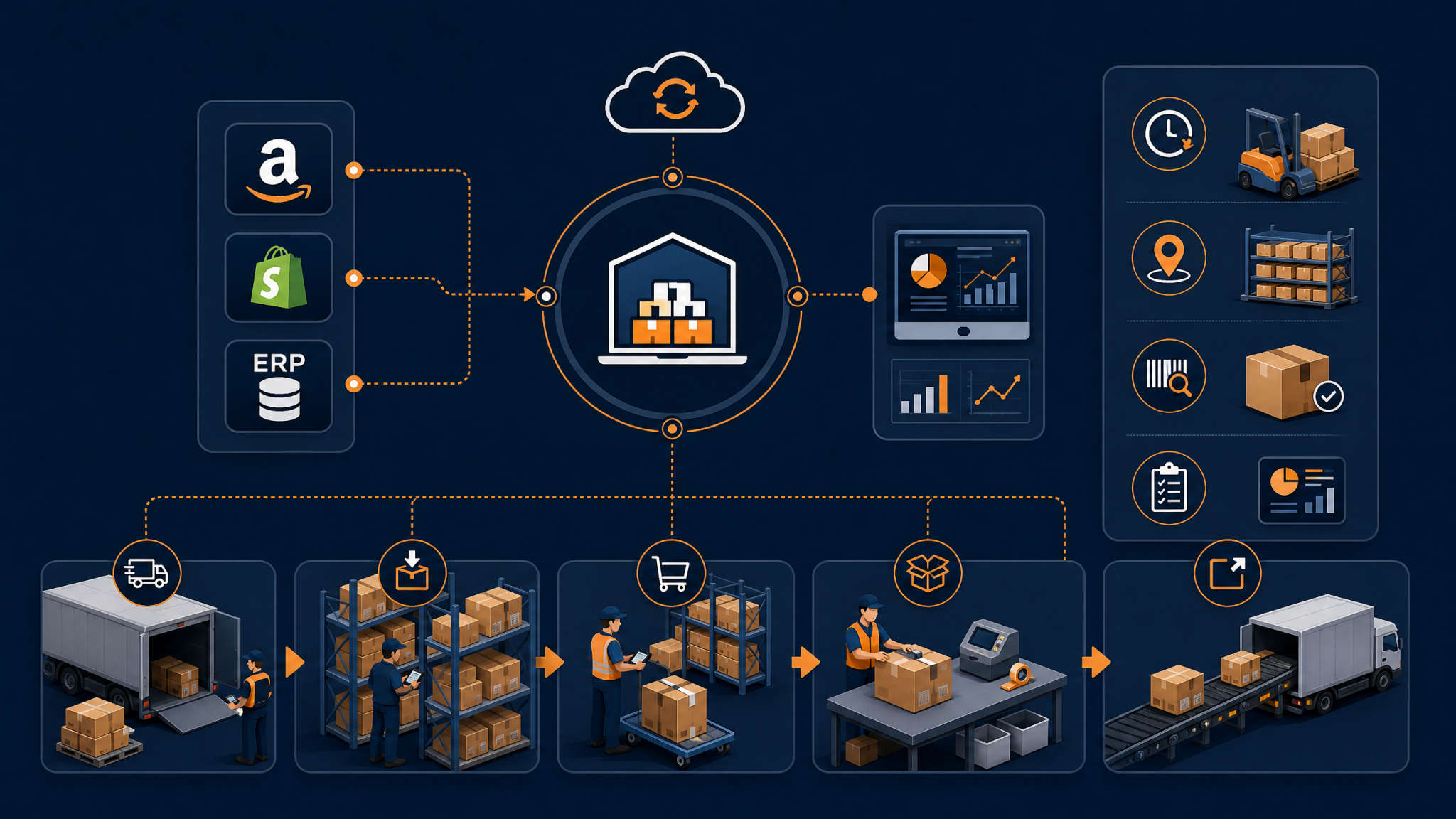
In the fast-paced world of e-commerce, operational efficiency is the key to success. As online businesses grow, inventory management and order fulfillment become increasingly complex. This is where a Warehouse Management System (WMS) comes into play. A WMS is not just a tool; it’s the backbone that allows e-commerce businesses to optimize their warehouse operations, from receiving products to final customer shipment.
What is a WMS?
A WMS (Warehouse Management System) is a software application that helps businesses control and manage daily warehouse operations, from the moment goods or materials enter a distribution center or warehouse until they leave. Its primary goal is to optimize inventory movement and storage, improve operational efficiency, and reduce costs. For an e-commerce business, this directly translates into increased customer satisfaction and higher profitability.
Why Your E-commerce Business Needs a WMS
E-commerce presents unique challenges for warehouse management. Order volumes can fluctuate dramatically, customers expect fast and accurate deliveries, and returns management is an integral part of the business. Without a robust WMS warehouse management system ecommerce guide, e-commerce businesses can face:
- Inventory errors and stockouts.
- Delays in order processing and shipping.
- High operating costs due to manual inefficiencies.
- Low customer satisfaction due to order errors.
- Difficulty scaling operations as the business grows.
A WMS addresses these challenges by providing real-time inventory visibility, automating key processes, and optimizing warehouse space and resource utilization. It is a strategic investment that enables e-commerce businesses to compete effectively in an increasingly demanding market.
Key Features of a WMS for E-commerce
An effective WMS for e-commerce must offer a range of functionalities designed to handle the complexity of online operations. Here are the essential features to consider: For more details, see our guide on advanced fulfillment strategies ecommerce Europe. For more details, see our guide on kitting assembly Amazon FBA profit margins.
Real-time Inventory Management
The ability to accurately track inventory in real-time is fundamental. This includes:
- SKU Tracking: Detailed management of each stock keeping unit, providing granular control over product variations.
- Inventory Location: Optimal assignment of storage locations (e.g., primary, secondary, overflow) and tracking of movements within the warehouse. This ensures efficient retrieval and minimizes search times.
- Cycle Counting and Audits: Tools to maintain inventory accuracy through continuous counting and reconciliation, reducing the need for disruptive annual physical inventories.
- Batch and Lot Tracking: Essential for products with expiration dates or those requiring recall capabilities, ensuring compliance and quality control.
- Demand Forecasting Integration: Some advanced WMS solutions integrate with forecasting tools to predict future demand, helping businesses optimize stock levels and prevent overstocking or stockouts.
Picking and Packing Optimization
Picking and packing processes are critical for the speed and accuracy of order fulfillment. A good WMS should support: For more details, see our guide on when to switch from Amazon FBA to 3PL. For more details, see our guide on cold chain fulfillment frozen products Spain.
- Picking Strategies: Such as batch picking (multiple orders at once), zone picking (pickers assigned to specific areas), or wave picking (picking based on priority or shipping deadlines) to maximize efficiency and throughput.
- Route Optimization: Algorithms that calculate the most efficient path for pickers, minimizing travel time and increasing productivity. This can be enhanced with mobile devices and voice-guided picking.
- Order Verification: Barcode scanning at each stage to ensure correct items are packed, significantly reducing picking errors and improving order accuracy.
- Packing Station Guidance: Providing instructions on optimal box size, dunnage, and special packing requirements to protect products and reduce shipping costs.
Shipping and Returns Management
The WMS must integrate with carriers and facilitate returns management:
- Carrier Integration: Automatic generation of shipping labels, manifests, and tracking numbers for various carriers, streamlining the shipping process and ensuring compliance with carrier requirements.
- Returns Management (RMA): Efficient processing of returned products, including automated return authorization, inspection workflows, quality control, and intelligent disposition (restock, repair, scrap). This is crucial for customer satisfaction and managing reverse logistics costs.
- Freight Cost Optimization: Some WMS solutions can analyze shipping rates from multiple carriers to select the most cost-effective option for each shipment.
Integration with Other Systems
For seamless workflow, the WMS must integrate with other key business systems:
- E-commerce Platforms: Such as Shopify, Magento, or WooCommerce, to automatically receive orders and update inventory levels.
- Enterprise Resource Planning (ERP) Systems: For a holistic view of finances, operations, and supply chain, ensuring data consistency across the organization.
- Customer Relationship Management (CRM) Systems: To provide customer service with real-time order status and inventory information, enhancing customer satisfaction.
- Transportation Management Systems (TMS): For advanced logistics planning, route optimization, and carrier selection beyond basic shipping label generation.
- Material Handling Equipment (MHE): Integration with automated systems like conveyors, sortation systems, and robotics to further enhance warehouse automation and efficiency.
How a WMS Works: A Detailed Look

Understanding the internal workings of a WMS is crucial to appreciating its value. A WMS orchestrates every step of the product lifecycle within the warehouse:
Receiving and Putaway
When products arrive at the warehouse, the WMS records them, verifies the quantity and quality against purchase orders, and assigns optimal storage locations based on factors such as demand, size, weight, and rotation. This process, known as putaway, minimizes the time products spend in receiving and maximizes the use of available storage space. Advanced WMS can even suggest dynamic slotting strategies.
Inventory Management
The WMS maintains a precise, real-time record of every item, its exact location, and its status (e.g., available, on hold, damaged). It leverages technologies like barcodes, QR codes, and RFID for accurate tracking, significantly reducing human errors and improving overall inventory accuracy. This real-time visibility is critical for making informed decisions about stock levels and order fulfillment.
Order Processing
When an online order is placed, the WMS receives it from the e-commerce platform, prioritizes it based on predefined rules (e.g., expedited shipping, customer value), and generates optimized picking lists for warehouse operators. It guides pickers to the exact product locations using mobile devices, voice-guided systems, or pick-to-light technology, ensuring efficiency and accuracy.
Packing and Shipping
Once picked, items move to the packing station, where the WMS can suggest the most suitable packaging size and type, generate custom packing slips, and print shipping labels. The system then consolidates orders, verifies contents, and prepares them for dispatch. Orders are loaded onto delivery vehicles, and the WMS automatically updates the shipping status, generates tracking numbers, and notifies the customer, providing end-to-end visibility. For more details, see our guide on most profitable niches on Amazon Europe in 2026.
Returns Management
The WMS simplifies the complex process of returns (reverse logistics). It manages everything from the initial return authorization (RMA) to the physical receipt of the product, inspection for damage or defects, and intelligent disposition – whether to restock, repair, or scrap the item. Efficient returns management is vital for maintaining customer satisfaction and minimizing financial losses in e-commerce. For more details, see our guide on Amazon Global Selling from a single warehouse in Spain.
WMS Integration with Shopify and Amazon
Integrating a WMS with popular e-commerce platforms like Shopify and Amazon is fundamental for a smooth and efficient workflow. Successful integration allows for real-time data synchronization, eliminating the need for manual entry and reducing errors. This is especially important for businesses looking for warehouse management software Amazon integration.
WMS and Shopify
WMS integration Shopify Amazon allows:
- Order Synchronization: Orders placed on Shopify are automatically sent to the WMS for processing, ensuring immediate action on new sales.
- Inventory Updates: The WMS automatically updates inventory levels on Shopify in real-time as products are sold or received, preventing overselling and improving inventory accuracy visible to customers.
- Shipping Information: Tracking numbers, carrier details, and delivery status updates are sent back to Shopify, keeping customers informed and reducing customer service inquiries.
- Product Data Synchronization: Ensuring product details, descriptions, and images are consistent across both platforms.
WMS and Amazon (FBA and FBM)
For Amazon sellers, a WMS can be invaluable, whether they use Fulfillment by Amazon (FBA) or Fulfillment by Merchant (FBM). For more details, see our guide on reduce Amazon FBA costs hidden fees.
- FBA: A WMS can help manage inventory before sending it to Amazon’s fulfillment centers. This includes optimizing shipment quantities, generating Amazon-compliant labels, and ensuring that inbound shipments are accurate and meet Amazon’s strict receiving requirements, thereby avoiding costly penalties and delays.
- FBM: For FBM, the WMS manages the entire fulfillment process directly from your warehouse. This includes receiving the Amazon order, picking, packing, and shipping directly to the customer, with seamless integration for generating Amazon shipping labels and updating order status on the Amazon Seller Central platform.
- Multi-channel Fulfillment: A WMS can centralize inventory for sales across Amazon, Shopify, and other channels, providing a single source of truth for stock levels and preventing overselling.
Choosing the Best WMS for Your E-commerce Business in 2026
Selecting the best WMS for ecommerce 2026 requires careful consideration of several factors. The market is full of options, and the right choice will depend on the specific needs, size, and growth trajectory of your business.
Factors to Consider
- Scalability: The WMS must be able to grow with your business, accommodating increased order volumes, new product lines, and additional warehouse locations without requiring a complete system overhaul.
- Cost: Consider the total cost of ownership (TCO), which includes not only licensing fees but also implementation costs, hardware requirements, training, ongoing maintenance, and potential customization expenses.
- Ease of Use: An intuitive, user-friendly interface reduces the learning curve for warehouse staff, minimizes training time, and improves overall productivity and adoption rates.
- Integration Capabilities: Ensure the WMS integrates seamlessly with your existing technology stack, including ERP systems, e-commerce platforms (Shopify, Magento), CRM, and shipping carriers. Robust APIs are a key indicator.
- Support and Training: Evaluate the vendor’s customer support, including availability, responsiveness, and the quality of training resources. A strong support system is crucial for smooth operations.
- Industry-Specific Features: If your business has unique requirements (e.g., handling perishable goods, hazardous materials, oversized items, or specific compliance regulations), ensure the WMS offers specialized functionalities to address these needs.
- Reporting and Analytics: A good WMS should provide comprehensive reporting and analytics capabilities to track key performance indicators (KPIs), identify bottlenecks, and drive continuous improvement in warehouse operations.
Cloud-Based vs. On-Premise WMS
The decision between a cloud-based (SaaS) and an on-premise WMS is important and depends on your business’s IT infrastructure, budget, and control preferences:
- Cloud-Based WMS: Offers flexibility, scalability, and lower upfront costs as it operates on a subscription model. It’s managed by the vendor, reducing the burden on internal IT staff. Cloud WMS solutions are ideal for most e-commerce businesses, especially those seeking rapid deployment and continuous updates.
- On-Premise WMS: Requires a larger initial investment in hardware and software licenses and demands in-house IT staff for management and maintenance. However, it offers maximum control over data, customization options, and can be preferred by very large enterprises with specific security or integration needs.
Implementing a WMS: Best Practices
Implementing a WMS is a significant project that requires careful planning and strategic execution to ensure success and maximize ROI.
Planning and Evaluation
Before implementation, conduct a thorough assessment of your current warehouse processes, identifying inefficiencies, pain points, and areas for improvement. Clearly define your business objectives, key performance indicators (KPIs), and expectations for the new system. This initial phase is critical for setting the project scope and ensuring alignment with business goals. For more details, see our guide on Amazon MCF vs 3PL Shopify 2026. For more details, see our guide on TikTok Shop fulfillment Spain requirements. For more details, see our guide on unit economics and real margins on Amazon FBA.
Vendor Selection
Choose a WMS vendor with extensive experience in your industry and a proven track record of successful implementations. Request detailed demonstrations, speak with reference customers, and evaluate the vendor’s long-term vision and ability to support your evolving business needs. A strong partnership with your vendor is key.
Data Migration and Configuration
Plan for meticulous data migration from existing systems to the new WMS. This includes inventory data, customer information, and historical order data. Configure the WMS to align with your specific warehouse layout, picking strategies, and business rules. This customization ensures the system optimizes your unique operations.
Training and Change Management
Adequate and comprehensive training for all warehouse staff is paramount for successful WMS adoption. Develop a robust training program that covers all aspects of the system. Implement a strong change management strategy to communicate the benefits of the new system, address concerns, and foster acceptance among employees, ensuring a smooth transition. According to Gartner supply chain insights, these strategies are increasingly important.
Testing and Optimization
Conduct thorough testing of the WMS in a simulated environment before go-live. This includes unit testing, integration testing, and user acceptance testing (UAT) to identify and resolve any issues. After implementation, continuously monitor system performance, gather feedback, and optimize processes to maximize the benefits of the WMS and achieve continuous improvement.
Conclusion: The Future of E-commerce Fulfillment
In an ever-evolving e-commerce market, a WMS warehouse management system ecommerce guide is no longer a luxury but a necessity. By providing real-time visibility, automating processes, and optimizing every aspect of warehouse operations, a WMS enables e-commerce businesses not just to survive, but to thrive.
Investing in the best WMS for ecommerce 2026, with robust WMS integration Shopify Amazon, is a strategic decision that will drive efficiency, reduce costs, and most importantly, enhance the customer experience. Prepare for the future of fulfillment and position your business for sustained growth.