Introduction: The Transatlantic Ecommerce Opportunity
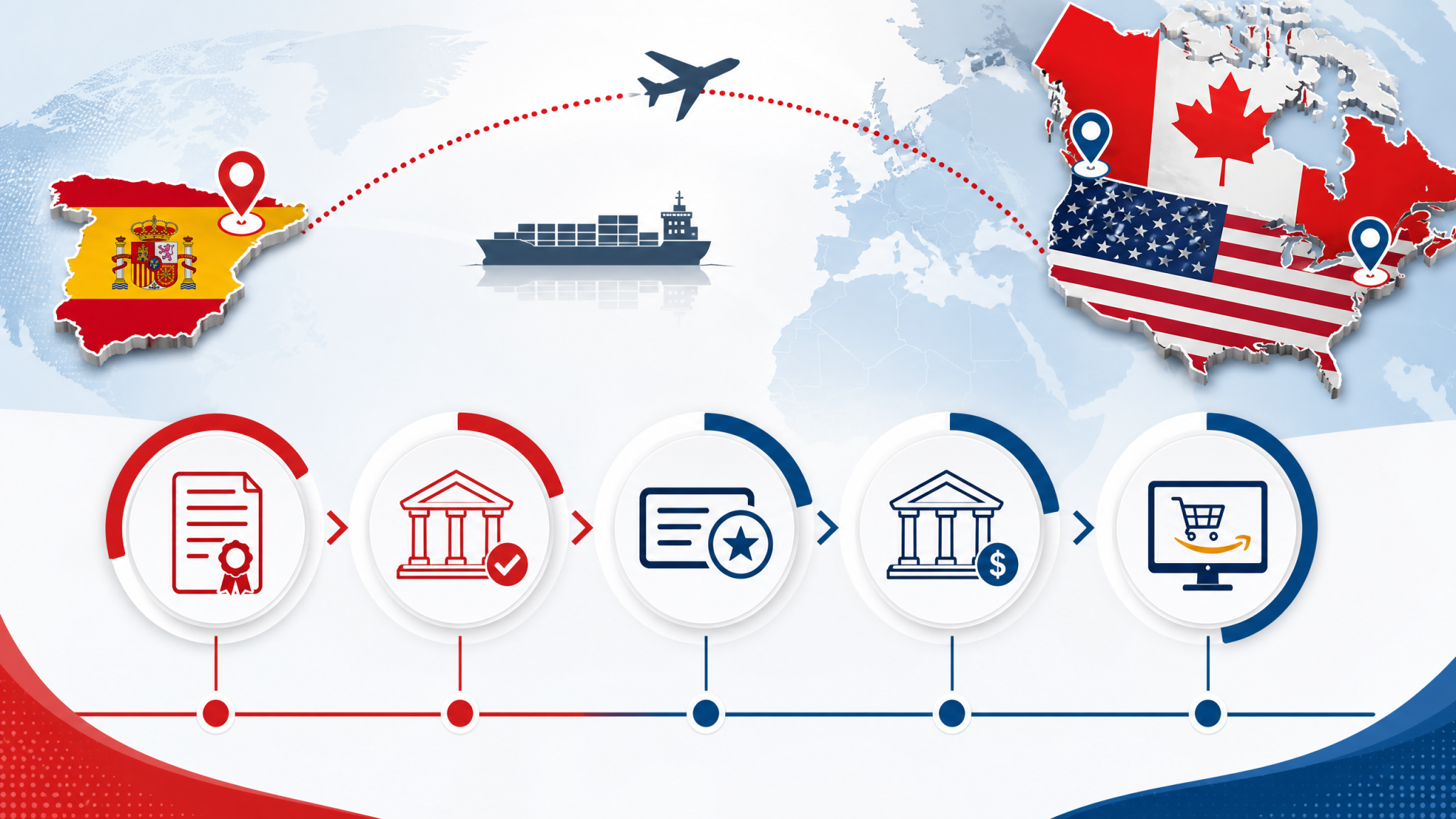
Expanding your ecommerce empire beyond European borders is a monumental step for any seller. If you have already established a successful presence on Amazon Europe—navigating the complexities of Pan-European FBA, VAT registrations, and multi-language listings—looking westward to the North American market is the logical next phase of exponential growth. However, to successfully launch Amazon USA Canada from Spain legal requirements, logistics, and tax implications must be meticulously planned and executed.
The North American market, encompassing both the United States and Canada, offers unparalleled consumer demand, immense daily traffic, and a highly developed fulfillment network that is the envy of the retail world. Yet, for European sellers, crossing the Atlantic introduces a completely new set of operational complexities. From understanding whether you need to form a US entity to navigating customs, tariffs, and transatlantic shipping, the learning curve can be steep and unforgiving if not approached with a solid strategy. For more details, see our guide on Vendor Central vs Seller Central in 2026.
This comprehensive Amazon US from Spain guide is designed specifically for professional ecommerce entrepreneurs in 2026. We will dive deep into the legal frameworks, LLC formation, tax obligations, product compliance, and the logistical strategies required to seamlessly expand your operations and sell on Amazon USA from Europe. By the end of this guide, you will have a clear, actionable roadmap to conquer the world’s most lucrative ecommerce marketplace.
Why Expand to Amazon USA and Canada?
Before diving into the technicalities and legal frameworks, it is crucial to understand the sheer scale of the opportunity that awaits in North America. The US marketplace (Amazon.com) is Amazon’s largest and most mature platform, boasting hundreds of millions of highly engaged Prime members and generating the lion’s share of the company’s global retail revenue. Canada (Amazon.ca), while smaller in population, is a highly lucrative, rapidly growing market that is easily accessible once you are established in the US through the North America Unified Account.
For Spanish sellers, the expansion means significantly diversifying revenue streams, mitigating regional economic risks within the Eurozone, and tapping into a consumer base with exceptionally high purchasing power and a strong propensity for online shopping. Furthermore, the Q4 holiday season in the US—driven by the massive retail events of Black Friday, Cyber Monday, and the extended Christmas shopping period—can generate sales volumes in a single month that dwarf those seen over an entire quarter in smaller European marketplaces.
Additionally, the US market is often the proving ground for brand valuation. If your long-term goal is to build a brand that can eventually be acquired by an aggregator or private equity firm, demonstrating strong, profitable sales velocity in the US market is often a prerequisite for a high-multiple exit.
Legal Requirements: Structuring Your Business for North America

One of the most common and daunting hurdles European sellers face is understanding the legal structure required to operate compliantly in the US and Canada. Do you need to incorporate a US company, or can you sell using your existing Spanish entity, such as a Sociedad Limitada (SL) or as an Autónomo?
Selling as a Foreign Entity vs. US LLC
Amazon’s policies absolutely allow you to sell on Amazon USA from Europe using your existing Spanish business entity. You do not strictly need a US company to open a North American seller account. However, many professional sellers opt for LLC formation Spain Amazon strategies for several compelling, long-term business reasons:
- Liability Protection: The United States is known for being a highly litigious environment. A US Limited Liability Company (LLC) creates a corporate shield that separates your US operations from your European assets, providing a critical layer of legal protection in the event of a product liability lawsuit.
- Supplier Relationships: If you plan to source products domestically within the US, many US-based wholesale suppliers, distributors, and brands will only open B2B accounts for registered US businesses with a valid EIN and state resale certificate.
- Payment Gateways and Credit: Accessing certain US financial services, business credit cards (which offer lucrative cashback and travel rewards), and alternative payment gateways is significantly easier—and often only possible—with a US entity.
- Tax Efficiency and Flexibility: Depending on your overarching corporate structure, a US LLC (often formed in business-friendly states like Wyoming or Delaware) can offer favorable tax treatments. A single-member LLC is treated as a “disregarded entity” by the IRS, meaning the tax liability passes through to the owner, which requires careful coordination with Spanish tax authorities (Hacienda) to avoid double taxation.
The LLC Formation Process for Non-Residents
If you choose the LLC route, the process in 2026 is highly streamlined and digitized. You can form a US LLC entirely remotely from Spain without ever stepping foot in the United States. The typical steps include:
- Choosing a State of Incorporation: Wyoming and Delaware remain the top choices for non-residents. Wyoming is favored for its low annual fees, strong privacy laws, and lack of state income tax. Delaware is preferred if you plan to seek venture capital funding in the future.
- Hiring a Registered Agent: This is a strict legal requirement in the US. A registered agent is a third-party service located in your state of incorporation that receives official legal and tax correspondence on behalf of your LLC.
- Filing the Articles of Organization: This is the official document submitted to the state government to legally create your company. It typically requires basic information about the LLC and the registered agent.
- Drafting an Operating Agreement: An internal, yet vital, document outlining the ownership structure, profit distribution, and operating procedures of your LLC. Even for single-member LLCs, this document is crucial for proving the separation between personal and business affairs.
Obtaining an EIN (Employer Identification Number)
Whether you form a US LLC or operate as a Spanish entity, you will absolutely need an EIN from the IRS (Internal Revenue Service) to import goods commercially and manage your tax obligations. For non-US residents without a Social Security Number (SSN) or Individual Taxpayer Identification Number (ITIN), obtaining an EIN involves submitting Form SS-4 to the IRS via fax or mail. This process can take anywhere from a few days to several weeks, so it should be initiated as early as possible in your expansion timeline to avoid delays in shipping and account setup.
Tax Implications: W-8BEN and Sales Tax
Navigating the tax landscape is a critical component when you launch Amazon USA Canada from Spain legal requirements. The US tax system is fundamentally different from the European VAT system.
Federal Income Tax: If you operate as a Spanish entity and do not have a “nexus” (which generally means a physical presence, employees, or warehouses that you own and operate) in the US, you are generally not subject to US federal income tax on your ecommerce sales. You will need to file a W-8BEN-E form (for entities) or W-8BEN (for individuals) with Amazon to certify your foreign status and claim tax treaty benefits between the US and Spain. This ensures Amazon does not automatically withhold 30% of your gross revenue for the IRS. For more details, see our guide on VAT compliance for cross-border Amazon sellers.
State Sales Tax: The US does not have a national VAT system; instead, it has state-level, county-level, and even city-level sales taxes. Fortunately, the landscape has simplified dramatically for Amazon sellers. Amazon now operates as a “Marketplace Facilitator.” This means Amazon automatically calculates, collects, and remits sales tax on your behalf for orders shipped to customers in states with Marketplace Facilitator laws (which currently encompasses all states that levy a sales tax). This significantly reduces the compliance burden for international sellers, meaning you generally do not need to register for sales tax permits in individual states unless you are selling on other platforms like Shopify. For more details, see our guide on Amazon global selling Europe single warehouse Spain.
Product Compliance and FDA Regulations
Before shipping a single unit across the Atlantic, you must ensure your products comply with US and Canadian regulations. What is legal and compliant in the EU (CE marking, for example) does not automatically translate to compliance in North America.
If you sell electronics, you must ensure compliance with the Federal Communications Commission (FCC). If you sell children’s toys, you must adhere to the strict guidelines of the Consumer Product Safety Commission (CPSC) and obtain a Children’s Product Certificate (CPC) based on testing from a CPSC-accepted laboratory.
For sellers in the health, beauty, food, or dietary supplement categories, the Food and Drug Administration (FDA) is the governing body. You may need to register your manufacturing facility with the FDA, ensure your labeling meets FDA standards (which are vastly different from EU labeling requirements), and potentially appoint a US FDA Agent. Failure to comply with these regulations will result in your inventory being seized by US Customs at the border, leading to catastrophic financial losses.
Setting Up Your North America Unified Account
Amazon makes it relatively easy to expand your digital footprint by offering the North America Unified Account, which allows you to sell in the US, Canada, and Mexico from a single, centralized Seller Central dashboard.
If you already have a European account in good standing, you can use the “Sell Globally” feature in Seller Central to link your accounts. During the setup process, you will undergo a stringent identity verification process (SIV). It is absolutely paramount that the business details, utility bills, and bank statements you provide exactly match the information on your Spanish corporate documents or your new US LLC documents. Any discrepancy—even a slightly different spelling of an address—can lead to immediate account suspension before you even begin selling. Ensure all documents are translated into English by a certified translator if required.
Transatlantic Logistics and Supply Chain Management
Moving physical inventory across the Atlantic is where many sellers face their biggest operational and financial challenges. Your logistics strategy will depend heavily on where your products are manufactured and your cash flow capabilities.
Shipping from Europe vs. Direct from Manufacturer
If your products are manufactured in Spain or elsewhere in Europe, you will need to arrange transatlantic freight (air or ocean) to US FBA fulfillment centers. Air freight is significantly faster (typically 5-10 days door-to-door) but exponentially more expensive, making it suitable primarily for lightweight, high-margin items, or for initial test launches where speed to market is prioritized over margin. Ocean freight is much more cost-effective for bulk shipments but requires a lead time of 30-45 days, demanding rigorous inventory forecasting.
If your products are manufactured in Asia (e.g., China, Vietnam, India), it is far more efficient and cost-effective to ship directly from the factory to the US, bypassing Europe entirely. This requires partnering with a highly reliable freight forwarder who can handle the complex logistics from the factory floor directly to the designated Amazon warehouse in the US. According to McKinsey operations research, these strategies are increasingly important.
Importer of Record (IOR) and Customs Bonds
When shipping commercial goods into the US, someone must act as the Importer of Record (IOR). The IOR is legally responsible for ensuring the imported goods comply with all US laws, paying the required import duties and tariffs, and filing the necessary documentation. It is critical to note that Amazon will not act as your IOR under any circumstances.
If you are a Spanish entity, you can act as a Foreign Importer of Record. To do this, you will need a Customs Assigned Number (which your customs broker can help obtain) and a Customs Bond. A continuous customs bond is highly recommended if you plan to import multiple shipments per year, as it covers all your imports for a 12-month period. Partnering with an experienced, licensed US customs broker is non-negotiable to ensure smooth clearance through US Customs and Border Protection (CBP) and to avoid costly delays at the port.
Managing Inventory Across the Atlantic
Once your goods successfully arrive in North America, you must decide how to store and fulfill orders efficiently.
FBA vs. 3PL in the US
Fulfillment by Amazon (FBA) is the gold standard for most sellers, offering Prime eligibility, high conversion rates, and hands-off customer service and fulfillment. However, Amazon’s strict inventory capacity limits (restock limits) and high long-term storage fees mean you cannot simply dump six months of inventory into their warehouses at once. For more details, see our guide on Amazon international expansion guide sellers.
A highly effective strategy for international sellers is to utilize a Third-Party Logistics (3PL) provider located in the US. You ship bulk inventory to the 3PL via cost-effective ocean freight, and then drip-feed smaller, frequent shipments into Amazon FBA as needed. This hybrid approach optimizes storage costs, provides a buffer against supply chain disruptions, and ensures you never run out of stock due to Amazon’s capacity constraints.
Remote Fulfillment with FBA (NARF)
To tackle the Canadian and Mexican markets, you do not necessarily need to send dedicated inventory directly to those countries immediately. Amazon’s Remote Fulfillment with FBA (NARF) program allows you to store your inventory in US fulfillment centers and fulfill orders for customers in Canada and Mexico directly from that US stock. Prime customers in Canada get free shipping (though it takes slightly longer than domestic FBA), and the customer pays the import duties at checkout. This is an excellent, low-risk, capital-efficient way to test the Canadian market before committing to sending dedicated inventory across the northern border. For more details, see our guide on selling Amazon Germany France LUCID EPR compliance.
Financial Management and Currency Conversion
Selling in USD and CAD while operating a business whose primary expenses are in EUR introduces significant currency exchange risks and hidden fees. Amazon’s default currency converter (ACCS) is convenient but charges high margins (often up to 3-4%) on your disbursements, eating directly into your net profit. For more details, see our guide on US tariffs impact European Amazon sellers 2026. For more details, see our guide on fulfillment strategies for scaling in European markets.
To maximize your profit margins, you should utilize a specialized Payment Service Provider (PSP) such as Payoneer, Wise Business, or PingPong. These financial services provide you with virtual US and Canadian bank accounts. You input these virtual account details into your Amazon Seller Central. Amazon then deposits your USD and CAD earnings into these accounts without conversion. You can then choose when to convert the funds to EUR at mid-market exchange rates with significantly lower, transparent fees (typically ranging from 0.5% to 1%), saving you thousands of euros annually.
Conclusion: Executing Your North American Expansion
Expanding your ecommerce business across the Atlantic is a complex, multi-faceted, but ultimately highly rewarding endeavor. By thoroughly understanding the launch Amazon USA Canada from Spain legal requirements, you can build a robust, compliant foundation for international growth.
Whether you choose to operate under your existing Spanish entity or pursue an LLC formation Spain Amazon strategy for added protection and flexibility, the key to success lies in meticulous preparation and partnering with the right experts. Engage with experienced international tax professionals, reliable freight forwarders, and leverage the right financial tools to protect your hard-earned margins. The North American market is vast, dynamic, and incredibly profitable. With the right strategy, your European brand can not only compete but thrive on a truly global scale.